In a world where traditional values collide head-on with modern realities, a fierce debate is brewing within South Asian communities across the United States. It’s not about politics or social norms—it’s about love, trust, and money.
The once unshakable sanctity of marriage is now being scrutinized through a new lens: the prenuptial agreement. With changing dynamics in gender roles, skyrocketing divorce rates, and a growing desire for financial independence, South Asians in America are grappling with a question that challenges age-old cultural values: Should a marriage be bound only by love, or should it also include a legally binding financial safety net?
This debate has set the community ablaze, with families, couples, and cultural leaders torn between preserving tradition and embracing modernity.
Prenuptial agreements (prenups) have become a significant point of discussion among South Asian communities in the United States. As societal attitudes evolve, especially among younger generations, these legal instruments are increasingly being considered for their practicality and protection.
Is the rising trend of prenuptial agreements a sign of growing mistrust in modern South Asian marriages, or simply a smart financial move?
Image Credit: Photo by Ketut Subiyanto
Are prenuptial agreements disrupting centuries-old family expectations, or are they necessary tools for securing financial stability in the face of rising divorce rates?
Why Prenups Are Gaining Traction:
Financial Security and Clarity
Proponents of prenuptial agreements argue that they offer crucial financial security and clarity, particularly in the event of a divorce. Legal experts stress that a well-drafted prenup can clearly define how assets and debts will be divided, minimizing the potential for prolonged legal disputes and emotional distress.
With many South Asians in the U.S. achieving professional success and accumulating substantial wealth, a prenup can provide protection for business assets, investments, and personal earnings.
For example, entrepreneurs or individuals who own family businesses might find it essential to secure their business assets from being divided in a divorce. By establishing clear guidelines on asset ownership and financial responsibilities, prenups can help preserve the continuity of family businesses, which are often passed down through generations.
Addressing Changing Gender Dynamics
Another factor driving the acceptance of prenups in these communities is the shifting gender dynamics. Traditionally, South Asian marriages have adhered to a gendered division of labor and financial roles.
However, with more women in these communities achieving financial independence and entering high-income professions, the need for clear financial agreements is increasingly recognized. Younger South Asians view prenups as instruments of transparency and fairness, reflecting evolving attitudes toward gender equality and personal autonomy.
Reddit threads and other online forums reveal a growing acceptance of prenups among younger generations. Many express that discussing financial matters and expectations beforehand can help foster openness and prevent misunderstandings later. As one Reddit user mentioned, “It’s not about mistrust; it’s about being responsible and making sure both parties are on the same page.”
Are South Asian families right to see prenups as a betrayal of trust, or should they be redefined as a new form of transparency in relationships?
Concerns and Opposition to Prenups:
Despite the practical benefits, prenups face significant resistance due to their perceived impact on traditional South Asian values:
Cultural and Emotional Tensions
In many South Asian cultures, marriage is seen as a sacred institution based on mutual respect, trust, and familial bonds. Introducing a prenuptial agreement may be viewed as a lack of faith in the marriage’s longevity, causing emotional strain. Cultural leaders often argue that prenups undermine the sanctity of marriage by introducing legal and financial considerations that are more transactional in nature.
In traditional families, discussing a prenup before marriage might be seen as an act that disrupts the harmony between families, which often play a pivotal role in the marriage process. Parents and elders may perceive prenups as a negative Western influence that contradicts South Asian customs of unconditional commitment and sacrifice.
Are South Asian couples choosing to protect their assets over their love, or is the concept of a fair partnership evolving with the times?
The Risk of Imbalance and Coercion
There are concerns that prenups could lead to power imbalances if one party imposes unfair terms on the other, especially in cases where one partner comes from a wealthier background or has a stronger legal understanding. If not carefully negotiated, a prenup might favor one partner over the other, leading to resentment and conflict.
Legal experts emphasize the importance of ensuring that prenups are drafted with mutual consent and fairness. Prenups should ideally be negotiated with legal representation for both parties to avoid issues of coercion or misunderstanding. However, cultural taboos around discussing finances before marriage can make it difficult for couples to approach this conversation with complete openness.
Legal Status and Evolving Attitudes:
The legal status of prenuptial agreements varies widely depending on the country of origin and local U.S. state laws. In India, for instance, prenups are not explicitly recognized under the law, leading to ambiguity and varying court interpretations. In contrast, U.S. courts typically uphold prenuptial agreements as long as they meet specific criteria of fairness and disclosure.
The evolving attitudes towards marriage and financial independence in the South Asian diaspora in the U.S. have influenced a more favorable view of prenups. Community members active on platforms like Quora and Reddit often discuss how these agreements align with contemporary values of self-sufficiency and mutual respect.
A Balanced Perspective: Navigating the Future:
As South Asian communities in the U.S. continue to grapple with the pros and cons of prenuptial agreements, a balanced approach that considers both cultural values and modern realities is essential. The debate highlights a broader trend of reconciling traditional customs with contemporary needs, including financial independence and gender equality.
Moving forward, there is a need for increased dialogue within families and communities to reduce the stigma around prenuptial agreements.
Educational initiatives that focus on the legal, financial, and personal aspects of prenups can help couples make informed decisions without feeling pressured or judged. Ultimately, the goal should be to create a framework that respects both partners’ financial and emotional well-being, supporting the longevity and health of the marriage.
Do prenuptial agreements represent a betrayal of cultural values, or are they merely adapting these values to fit the modern realities of love and marriage?
The debate over prenuptial agreements within South Asian communities in the U.S. is emblematic of the broader challenges these communities face in adapting to new cultural contexts.
While prenups offer clear financial benefits, they also challenge the emotional and cultural foundations of marriage. By fostering open discussions and promoting a nuanced understanding of prenuptial agreements, South Asian communities can navigate this complex issue with greater confidence and clarity.
Nimishka Mehta is a filmmaker and visual storyteller passionate about combining cinematic excellence with meaningful narratives. Her work spans film, documentaries, digital media, and emerging storytelling technologies.
The Name Debate: Why Many South Asian Women Are Keeping Their Last Names After Marriage
In a Reddit thread last year, a user posed the question of whether she should change her last name after marriage, igniting a lively discussion.
One user reminisced about how, in ancient times, kings ensured their wives took their names as a mark of pride and power.
This conversation mirrors a growing trend among South Asian women today who are choosing to keep their maiden names.
Breaking Tradition: Embracing Maiden Names
More South Asian women are defying centuries-old customs by keeping their maiden names post-marriage. Traditionally, adopting the husband’s surname symbolized marital unity and family cohesion, marking a woman’s transition from her father’s household to her husband’s.
“My Name, My Identity”
Priya Patel, a marketing executive in New York, decided to keep her maiden name.
“My last name is a significant part of who I am. It’s linked to my cultural heritage, my career, and my family’s legacy. Changing it felt like erasing a part of myself.”
For many women, keeping their maiden name is a statement of personal and professional identity, representing continuity in their achievements, networks, and personal histories.
Professional Identity: “It’s More Than Just a Name”
In fields like academia, medicine, law, and business, a maiden name carries professional weight. It is the name under which women have published papers, built reputations, and established careers. Changing it can lead to confusion and disrupt professional recognition.
Dr. Anjali Sharma, a physician in San Francisco, chose to keep her maiden name for this reason.
“All my degrees, certifications, and professional licenses are under my maiden name. Changing it would have been a logistical nightmare and could have affected my professional standing.”
Legal Labyrinths: The Hassle Factor
Beyond personal and professional reasons, the process of legally changing one’s name is cumbersome. It involves updating numerous documents, from passports and driver’s licenses to bank accounts and social security records. The effort and expense are often not worth it.
Cultural Backlash: The Family Feud
Despite the growing trend, keeping a maiden name can invite cultural backlash from older generations and conservative segments of the community.
Nisha Singh, a software engineer in Toronto, faced pushback from her family.
“My parents were initially upset and thought it reflected poorly on them. They felt it was a rejection of our traditions. It took a lot of conversations to help them understand my perspective.”
Divorce and Separation: Minimizing Complications
Keeping a maiden name can simplify matters in cases of divorce or separation. When a woman retains her original name, it avoids the need for another legal name change post-divorce, reducing stress and bureaucratic hurdles during an already challenging time.
Immigration and Legal Issues: Consistency is Key
For South Asian women living abroad, maintaining a consistent name across all legal documents can streamline immigration processes and avoid complications with visas, work permits, and other legal matters.
A consistent name helps prevent issues that might arise from having different names on various legal documents.
The Future of Naming Conventions: A Shift in Mindset
As more South Asian women assert their right to choose their surname, societal attitudes are likely to continue shifting. Younger generations are increasingly supportive of individual choice and gender equality, recognizing that a name does not diminish marital commitment or familial bonds.
While there is no specific research on South Asian naming trends, we still want to highlight authoritative research conducted by Harvard before concluding this story.
The document “Making a Name: Women’s Surnames at Marriage and Beyond” by Claudia Goldin and Maria Shim examines historical and contemporary trends of women retaining their surnames after marriage.
It highlights the significant shifts in social norms and legal frameworks influencing women’s decisions to keep or change their surnames over time.
Key Points/Highlights OF Harvard Study:
Historical Context: Traditionally, few women deviated from taking their husband’s surname. Lucy Stone was one of the earliest known U.S. women to retain her surname after marriage in 1855.
Data Sources: The study uses New York Times wedding announcements, Harvard alumni records, and Massachusetts birth records to analyze patterns of surname retention.
Trends: The fraction of college graduate women retaining their surnames rose from about 2-4% around 1975 to just below 20% in 2001, with a slight decline in the 1990s.
Factors Influencing Retention: Legal, social, and economic changes in the 1970s, such as the introduction of the appellation “Ms.”, the increase in age at first marriage, and the rise in advanced academic degrees for women, contributed to the increase in surname retention.
Impact of Children: Among the Harvard class of 1980, 52% of women kept their surnames upon marriage, and only 10% changed their surname subsequently, often influenced by the arrival of children.
Racial Differences: African-American women, both college graduates and non-graduates, were more likely to retain their surnames compared to white women.
Marriage Age and Education: Higher education levels and marrying at an older age were associated with higher rates of surname retention.
Additional Details:
Legal Changes: Significant legal milestones, such as the 1975 Supreme Court of Tennessee decision in Dunn v. Palermo, helped remove state laws that pressured women to take their husband’s names.
Social Changes: The appellation “Ms.” became widely accepted in the 1970s, addressing the social issue of what to call a married woman who retained her surname.
Economic Factors: The diffusion of the oral contraceptive pill allowed women to delay marriage and pursue advanced degrees, thereby increasing the likelihood of retaining their surnames.
Professional Identity: Women in professions where they had “made a name” for themselves, such as academia and the arts, were more likely to keep their surnames.
Based on the Harvard research, here is a visual of the trend of surname retention among college graduate women over the years.
Chart Explanation
The chart above illustrates the trend of surname retention among college graduate women from 1975 to 2001. The data shows a significant increase in the fraction of women retaining their surnames from 2% in 1975 to around 33% in 2001, with notable peaks in the mid-1980s and early 2000s.
Chart Explanation
The second chart illustrates the fraction of women retaining their surnames in Massachusetts from 1990 to 2000, segmented by age groups. The data shows a decline in surname retention across all age groups over this period, with older women (ages 35-39) consistently having a higher retention rate compared to younger women (ages 25-29).
Conclusion:
Many South Asian women’s decision to retain their maiden names after marriage is a powerful assertion of identity and autonomy.
It reflects broader changes in societal attitudes towards gender roles and equality. While challenges remain, the trend is a step towards more inclusive and diverse expressions of cultural identity.
As these women navigate the delicate balance between tradition and modernity, they are paving the way for future generations to define their identities on their own terms, one name at a time.
I keep a low profile, but people say I’m kind of a big deal! You’ll often hear me bragging about being Substack’s first investor or telling stories about my prime years in my 20s. 🙂 Haters will say my profile picture is fake—and they’re right, at least once in a lifetime. 🙂
Vijay, originally from Hyderabad and living in the USA for the past eight years, has been resisting his mother’s constant urging to buy a house in India. She always reminded him how important it was to have a permanent home back in India.
After years of saying no, Vijay finally gave in and bought a modern apartment in Hyderabad. His decision was not only influenced by his mother’s wishes but also by the uncertainty surrounding his future in the US due to the long wait for a Green Card.
Rohan, on the other hand, bought a home for his parents in Mumbai. Even though he has no plans to return to India, he wanted to make sure his parents live comfortably, surrounded by all the luxuries in a modern apartment.
His parents often visit the US to spend time with him and their grandson, but they love being in Mumbai, where they’ve spent most of their lives. Though Rohan sometimes feels guilty about not having them live with him, he finds comfort knowing they have everything they need, including excellent medical facilities.
So what’s the common thread in Vijay’s and Rohan’s stories? It’s the same reason why so many articles, like The Economic Times NRI Desk or ICICI Bank’s Property Guide for NRIs, all focus on one big goal for NRIs: buying a home back in India.
Even top developers like Rustomjee, known for building high-end properties in Mumbai and other metro cities, have released special guides for NRIs. TheirUltimate Guide for NRIs Buying Property in India in 2024 is packed with tips on what types of properties NRIs can buy, an overview of FEMA rules, tax implications, and a step-by-step process to make property buying easier.
All these efforts have a clear purpose: to attract NRIs to invest in India’s real estate market.
Before we dive into why NRIs are buying properties in India in record numbers, let’s take a closer look at the current trends driving NRI real estate investments.
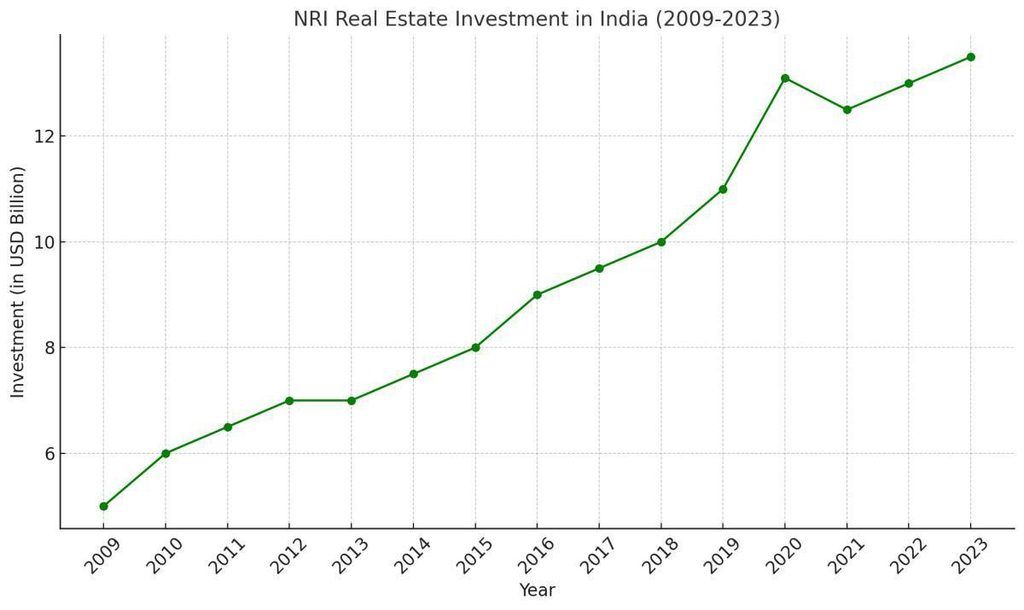
The real estate market for NRIs has experienced remarkable growth, with investments in 2023 alone surpassing $13 billion.
By 2025, NRI investments are expected to make up 20% of all real estate transactions in India. This surge is being driven by several factors, including favorable currency exchange rates, increased transparency through regulations like the Real Estate Regulatory Authority (RERA), and the adoption of digital platforms that make remote property purchases more convenient.
Cities: While traditional investment hubs like Mumbai and Bengaluru continue to capture the most attention, there is a noticeable shift towards Tier 2 and Tier 3 cities.
According to HomesKart and Zoltan Properties, emerging cities such as Pune, Ahmedabad, and Kochi are becoming popular among NRIs for their affordability and strong growth potential.
Investment Patterns: NRIs tend to focus on high-value properties, with a significant portion of their investments targeting residential properties worth over ₹1 crore, particularly in premium and luxury segments.
Real Estate Sector Size: India’s real estate market is projected to reach $1.04 trillion by 2029, up from $227 billion in 2024, driven by a combination of domestic and NRI investments.
Market Growth: The residential real estate sector alone is expected to grow at a compound annual growth rate (CAGR) of 24.77% from 2024 to 2029.
For NRIs, India’s real estate market offers both a deep emotional connection and a solid financial opportunity, bolstered by supportive policies and advances in technology.
The chart above illustrates the NRI real estate investments in India from 2009 to 2023. The data shows steady growth over the years, with key spikes around 2019-2021 driven by several factors, including currency fluctuations, regulatory reforms, and the COVID-19 pandemic.
Data for NRI Real Estate Investments (2009-2023)
If we were to look at the data for the past 10-15 years, the trend would likely show fluctuations driven by key factors like currency movements, global economic conditions, and policy reforms in India.
Here’s an estimated trend over the last 10-15 years:
2009-2013: Investments were moderate (~$5-7 billion), influenced by global financial recovery post the 2008 crisis and cautious NRI sentiment due to policy uncertainties in India.
2014-2015: A gradual rise (~$8 billion) as India’s economic reforms started taking shape, including relaxed norms for foreign direct investment (FDI) in real estate.
2016-2017: A slight dip (~$7-9 billion) as the market adjusted to the new RERA regulations and demonetization in India, which temporarily affected liquidity in the real estate market.
2018-2019: A steady increase (~$10 billion), driven by regulatory clarity, favorable currency conditions, and the growing preference for luxury real estate among NRIs.
2020-2021: The pandemic-related spike (~$13 billion), as explained earlier, caused by a mix of currency advantages, emotional investments, and the digitalization of the buying process.
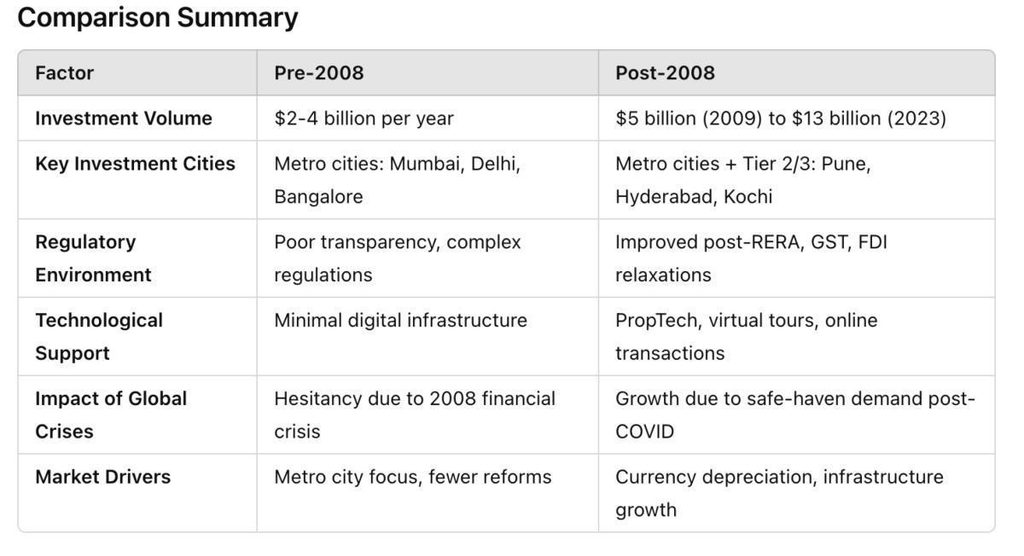
NRI Real Estate Investment Pre-2008 vs. Post-2008:
The pre-2008 period was characterized by a cautious approach from NRIs, with smaller volumes of investment, limited to metro cities and faced with regulatory complexities.
Post-2008, the market matured significantly with regulatory reforms, increased transparency, and wider geographic options.
This allowed NRIs to expand their investments across a broader spectrum, leading to the substantial growth seen over the last decade.
Various insights are derived from general trends observed in NRI investments, currency advantages, and the impact of government reforms like FDI norms. These sources provide a mix of market data.
In recent years, Non-Resident Indians (NRIs) have increased their real estate investments in India significantly. This trend is driven by a mix of economic, technological, and emotional factors.
Let’s explore some of the key reasons behind this surge in NRI property purchases and the broader implications for the Indian real estate market.
1. Green Card Limbo and Immigration Uncertainty Many NRIs, especially those in the U.S. on H1B or L1 visas, face an uncertain future due to the Green Card backlog, which can take decades to resolve.
With layoffs and visa expiration risks, the stress of potentially having to leave the U.S. is real. According to data from USCIS, Indian nationals face some of the longest Green Card waiting times, stretching over 100 years in some cases due to per-country caps.
As Rahul Mehta, an NRI living in New Jersey, explains: “I’ve been on an H1B visa for over seven years, and there’s no clarity on when or if I’ll get my Green Card. Having a house in India gives me a safety net. If I ever need to return, I know I’ll have a home there.”
Given the immigration challenges, many NRIs are purchasing homes in India to have a permanent residence, just in case their U.S. plans don’t pan out. Buying property in India becomes not just a financial decision but also a plan for emotional and practical security.
2. Lucrative Investment Returns
Indian real estate continues to offer high returns compared to global markets, with cities like Mumbai, Delhi, and Bangalore showing consistent property value growth over the last decade. Even Tier 2 and Tier 3 cities like Pune and Hyderabad have seen annual growth rates of over 10% in the past five years.
For example, Vikas Sharma, living in London, invested in an apartment in Pune in 2015: “I sent small amounts each month to pay off the loan, and today the property is worth almost double. Plus, I get rental income from it.”
NRIs are drawn to real estate as a tangible asset, offering security and potential rental income compared to volatile investments like stocks or cryptocurrencies.
One key driver is the depreciation of the Indian Rupee against major currencies like the U.S. dollar and British pound, giving NRIs greater purchasing power and making real estate acquisitions in cities like Mumbai, Bengaluru, and Delhi more appealing.
Indian real estate also offers higher rental yields than many global markets, especially in major urban centers where demand for residential and rental properties is strong.
For example, Bengaluru’s thriving IT sector and startup culture have increased demand for rentals, ensuring steady returns and long-term capital appreciation.
Government reforms, such as the Real Estate Regulatory Authority (RERA), have further boosted NRI confidence by increasing transparency and protecting buyers from fraud and delays, making real estate in India a safer and more attractive investment option.
3. Buying Homes for Parents Many NRIs, especially those who are the only child or whose siblings also live abroad, feel the responsibility of ensuring their parents live comfortably in India.
Modern apartments with 24/7 security, medical facilities, and access to care services have become a go-to solution. Apartments in gated communities provide peace of mind for both parents and NRIs living thousands of miles away.
Rahul Vaidya, a Bay Area resident, explains: “When my father passed away, my mother refused to move to the U.S. with me. So, I bought her a modern apartment in Mumbai with all the amenities. There’s a caretaker for her, and I monitor things remotely. She’s healthier now, and I feel more relaxed knowing she’s in good hands.”
Many NRIs purchase properties for their parents in cities like Mumbai, Pune, and Hyderabad, where senior-living options are growing.
This not only takes care of their aging parents but also provides a future home should they return.
4. Fear of Missing Out (FOMO) In the NRI community, especially in tightly-knit circles, real estate investments can sometimes feel like a bandwagon effect.
When one family member or friend invests in a property back in India, others follow suit, not wanting to miss out on what is perceived as a golden opportunity.
According to Suresh Patel, an NRI living in New York: “It felt like everyone I knew was buying property in India. I didn’t want to be the only one left out if prices skyrocketed. In hindsight, it was a great decision as property prices in Bangalore, where I bought, have appreciated by 30%.”
This herd mentality (referred to as “bhedchal” in Hindi) is driven by the fear that if they don’t invest now, they’ll miss out on the appreciation and growth that Indian real estate promises.
5. Regulatory Reforms (RERA and GST) The introduction of RERA (Real Estate Regulatory Authority) in 2016 has been a game-changer for NRIs, ensuring transparency in property deals and project completion, thereby making investments safer.
Developers are now held accountable, and stricter timelines have increased investor confidence.
Similarly, the Goods and Services Tax (GST) has simplified the tax structure, reducing confusion surrounding property taxes. As a result, NRIs feel more assured when investing in Indian properties.
Anjali Gupta, a Chicago-based NRI, shares: “Before RERA, I was hesitant to invest in India due to project delays and lack of transparency. Now, I know I’m protected under RERA, and my investment is safer.”
In addition, favorable government policies are boosting NRI confidence. The Indian government has introduced several reforms that have made real estate more accessible and appealing to NRIs.
RERA has fostered a more transparent environment, ensuring developers meet their commitments and protecting buyers from delays and legal issues.
Furthermore, the government’s infrastructure initiatives, such as smart cities and metro expansions, have made real estate investment even more attractive.
6. Long-Term Rental Income Potential With India’s growing economy and urbanization, NRIs are increasingly investing in properties that offer rental income.
Major cities like Bangalore, Mumbai, and Hyderabad have strong demand for rental housing due to the influx of IT professionals and students.
A well-located property in these cities can yield rental returns of 3-5%, with capital appreciation on top.
Priya Nair, an NRI in Dubai, bought a flat in Hyderabad near the IT corridor: “I’m earning a steady rental income every month, and the property has appreciated by 40% since I bought it three years ago.”
This combination of steady rental yields and potential for long-term growth makes Indian real estate a lucrative option for NRIs.
7. Technology and Increased Transparency The rise of PropTech (Property Technology) has made it easier for NRIs to invest in Indian real estate. Platforms offering virtual property tours, 3D walkthroughs, and secure online transactions have removed the need for NRIs to travel to India for property purchases.
From exploration to documentation, everything can now be done remotely.
Sandeep Malhotra, an NRI in Australia, shares: “I never thought I’d buy a property without visiting, but the technology today makes it feel like I’m there in person.”
This ease of access has significantly boosted NRI interest in real estate, making remote investments more common.
Additionally, many developers and property management companies now offer end-to-end services tailored specifically for NRIs, including property inspections, legal assistance, tenant management, and rent collection.
These services have addressed one of the biggest challenges NRIs previously faced—managing properties from abroad.
8. Tax Benefits NRIs enjoy the same tax benefits as resident Indians on home loans. Under Section 24(b) of the Income Tax Act, they can claim deductions on interest paid on home loans up to ₹2 lakh per year.
Additionally, under Section 80C, they can claim up to ₹1.5 lakh on principal repayment. Furthermore, rental income is taxed, but NRIs can reduce their liability by deducting maintenance costs and property taxes.
Nandini Rao, an NRI based in London, notes: “I was pleasantly surprised to find that the tax benefits for NRIs are on par with residents. It made the decision to invest even easier.”
9. India’s Growing Economy and Infrastructure Development India’s rapid economic growth and infrastructure development have significantly boosted the attractiveness of its real estate market.
Projects like the expansion of metro systems, highways, and smart city initiatives in cities like Ahmedabad, Pune, and Kochi have driven up property values, even in Tier 2 and Tier 3 cities.
Many NRIs see this as the ideal time to invest before prices rise further. Ajay Iyer, an NRI from Singapore, shares: “The infrastructure boom is the biggest factor for me. I bought a property in Pune, and with all the development happening, its value has shot up.”
10. Emotional Connection and Desire to Return Despite living abroad for years, many NRIs maintain a strong emotional connection to India. For some, owning a home in their homeland helps them stay connected to their roots, while for others, it forms part of a long-term plan to return to India, particularly after retirement.
Arun Singh, an NRI in Canada, shares: “I want my kids to know where they come from. Buying a home in India is my way of maintaining that link.”
As India’s urban infrastructure improves and the standard of living rises, NRIs are increasingly drawn to luxury properties.
High-net-worth NRIs are particularly interested in gated communities, villas, and premium apartments that offer world-class amenities, such as smart home technologies, eco-friendly features, and top-notch security.
Cities like Bengaluru and Mumbai have seen a surge in demand for luxury homes, driven by the desire for safety, privacy, and a high quality of life.
Gated communities and premium residential projects are especially popular among NRIs seeking properties that offer a cosmopolitan lifestyle, with access to top educational institutions, healthcare, and entertainment options.
The rise in NRI investments in Indian real estate reflects a deeper pursuit of security, growth, and emotional connection. Whether it’s to safeguard against visa uncertainties, plan for future returns, or stay linked to their roots, NRIs find real estate a powerful tool.
With favorable exchange rates, government reforms like RERA, and new technology making investments easier, India’s real estate market has become more accessible and appealing.
As India’s infrastructure expands and demand for urban housing grows, NRIs have a unique opportunity to invest in a rapidly developing market.
This is more than just a financial move—it’s about building a lasting bond with home and creating a secure future. For NRIs, now is the perfect moment to invest in not just property, but in their vision of tomorrow.
“For thousands of skilled immigrants like Vijay Sharma, the H1B visa, once seen as a golden ticket to the American Dream, has turned into a living nightmare. Trapped by the very system that promised opportunity, these professionals find themselves in a cycle of exploitation and uncertainty, unable to break free.”
Vijay Sharma’s Story: A Dream Deferred
Vijay Sharma (name changed for privacy) arrived in the U.S. in January 2011 on an H1B visa, full of hope and ambition. His employer, a software giant based in India and the USA, offered him a salary of $56,000 per year to work in Dallas, Texas. A figure that matched the bare minimum required by the Labor Condition Application (LCA).
This LCA document is supposed to ensure employers pay foreign workers fair wages appropriate to their job role and region.
For Vijay, this salary was a start. Little did he know that his pay would stagnate for two years, leaving him trapped. Like many H1B visa holders, Vijay found it nearly impossible to switch jobs due to visa sponsorship requirements. The promise of a green card, the ultimate goal for many, felt like a distant dream.
On a different path but facing similar hurdles, Vamshi Reddy came to the U.S. for his master’s degree, hoping to secure an H1B visa and eventually a green card.
As his Optional Practical Training (OPT) period neared its end, Vamshi struggled to find a job with H1B sponsorship. Desperate, he turned to a desi IT consultancy, a common route for many international students.
The consultancy took 30% of his earnings as a fee. Though it seemed reasonable initially, Vamshi soon realized he was trapped in a low-paying job for years, unable to leave due to visa constraints.
Vijay and Vamshi’s experiences highlight the systemic issues plaguing many H1B visa holders in the U.S. From wage stagnation and job immobility to long green card backlogs, thousands of skilled professionals find themselves trapped in a complex and exploitative system.
Their stories are just part of a larger narrative, one that reveals how the H1B visa system has, for many, become a form of modern-day slavery.
The H1B Visa: Origins and Intentions
The H1B visa program was established under the Immigration Act of 1990 to address critical labor shortages by allowing companies to hire foreign professionals in specialized fields like technology, healthcare, and engineering.
The aim was to help the U.S. maintain its competitive edge by filling skill gaps with global talent, benefiting both the U.S. economy and the foreign workers who could gain valuable experience.
But the program’s initial promise has largely fallen short for many, as it has now become a mechanism for labor exploitation, particularly in the tech industry.
Silicon Valley’s Dependence on H1B Workers
The tech industry, particularly Silicon Valley, has long been one of the biggest beneficiaries of the H1B visa program. Giants like Google, Microsoft, and Apple rely heavily on foreign talent to fill critical skill shortages and sustain rapid innovation.
Indian professionals, who dominate the H1B applicant pool, have been instrumental in driving the U.S. tech sector’s success.
However, critics argue that this reliance has led to wage suppression and worker displacement. The system, designed to bring in specialized talent, has instead fostered a cycle where many foreign workers, particularly from India, are overworked and underpaid.
An infographic showing how the U.S. tech industry relies on H1B visa holders, juxtaposed with a wage disparity chart comparing H1B workers and U.S. workers.
Employer Dependency: The Golden Cage
H1B visa holders are legally tied to their employers, meaning their visa status—and their ability to remain in the U.S.—is directly linked to their employment.
Changing jobs is a complex and uncertain process that involves finding a new employer willing to sponsor their visa, navigating bureaucratic procedures, and dealing with potential delays. This system creates a significant power imbalance, trapping workers in their roles.
Infosys, one of the largest users of H1B visas, has faced allegations of discouraging workers from leaving by creating additional hurdles for those seeking to transfer their visas.
H1B workers report long hours and tight deadlines, fearing that non-compliance or performance issues could result in termination—and the loss of their visa.
Key Data: The Economic Policy Institute (EPI) reports that H1B visa holders earn 17% less on average compared to their American counterparts. This wage suppression is enabled by the dependency visa holders have on their employers, knowing that any attempt to negotiate better pay could jeopardize their immigration status .
The Exploitation by Desi Consultancies
Desi consultancies, or Indian-owned staffing firms, play a significant role in placing Indian professionals in U.S. jobs—but often at a high cost. Commonly referred to as ‘tech body shops,’ these consultancies take a substantial portion (up to 30-40%) of the worker’s salary as fees.
Despite these deductions, workers are often placed in roles with minimal benefits and job security, frequently enduring 12-14-hour workdays to meet client demands.
In one notable case, Cognizant was fined $34 million for wage violations and visa misuse , highlighting the exploitation faced by visa holders who feel powerless to seek better opportunities.
Wage Disparities and LCA Misuse
The Labor Condition Application (LCA), meant to protect foreign workers by ensuring fair wages, is often circumvented.
Many H1B visa holders earn significantly less than their American counterparts, especially in roles within Indian outsourcing firms. According to a study by the Economic Policy Institute, over 60% of H1B workers are employed in roles paying below the prevailing wage level for their job titles .
Visual: A bar chart comparing wages of H1B visa holders in IT and engineering roles with their American counterparts, emphasizing the wage gap.
Psychological Toll: Fear of Visa Revocation and Job Insecurity
H1B workers live under the constant threat of losing their visa status. If an employee is laid off, they have just 60 days to find another sponsor—an almost impossible task in such a short period.
This uncertainty creates immense stress, particularly for those with families. For many, losing their visa means uprooting their children from school and returning to India, an emotional and financial burden.
Key Data: The Migration Policy Institute reports that nearly 40% of H1B visa holders experience intense psychological stress due to job insecurity and fear of visa revocation .
The Green Card Backlog: Living in Limbo
For Indian nationals, the wait for a green card can last up to 50 years due to per-country caps. This backlog leaves thousands of skilled professionals in immigration limbo, forcing them to continuously renew their H1B visas while living in constant fear of policy changes that could disrupt their lives.
Key Data: According to the Cato Institute, there are currently over 200,000 Indian nationals stuck in the green card backlog , unable to secure a stable future despite working in high-demand professions.
Impact on Families: The H4 Visa and Children’s Struggles
Spouses of H1B visa holders, typically on H4 visas, face severe employment restrictions. Though a 2015 rule allowed some H4 visa holders to work, this option is limited, leaving many highly educated spouses unable to pursue careers.
Children of H1B holders also face challenges. When they turn 21, they must switch to F1 student visas, which often disrupts their education and limits their access to financial aid.
Key Data: The National Foundation for American Policy reports that over 20,000 children of H1B visa holders struggle with this transition, leading to significant financial and emotional strain on families .
The Hidden Psychological Cost: Modern-Day Slavery
The power imbalance, constant stress, and lack of job security for H1B visa holders have created conditions that resemble modern-day slavery.
Workers are exploited for their skills but denied the freedom to seek better opportunities. Many experience depression, anxiety, and burnout due to the uncertainty of their visa status.
Key Data: A survey by the International Labor Organization found that 35% of H1B workers report deteriorating mental health due to job insecurity and fear of visa revocation .
Conclusion: A Call for Urgent Reform
For too many H1B visa holders, the American Dream has become a nightmare. Highly skilled workers, many of whom contribute significantly to the U.S. economy, are trapped in a system that limits their growth, exploits their labor, and strains their mental well-being.
It’s time for meaningful reform. The U.S. must implement policies that reduce the power imbalance between employers and visa holders, increase job mobility, and address the green card backlog.
Without reform, the H1B visa will remain a system that promises opportunity but delivers exploitation.
Reference Sources:
Economic Policy Institute Report – Wage Disparities
Migration Policy Institute – Psychological Stress 【8†source】
Cato Institute – Green Card Backlog
National Foundation for American Policy – Children of H1B Visa Holders
International Labor Organization – Survey on Mental Health
Mandavi holds a master’s degree in English literature and is passionate about exploring the intersections of politics, culture, art, and literature. With a curious and analytical mind, she is drawn to storytelling and crafting narratives that capture the complexity of the human experience.
One morning, while driving to work and listening to my favorite radio show in DFW, I heard a South Asian host enthusiastically mention “Nanban Foundation, Nanban Ventures, Nanban ESG” company names that blurred together, leaving just “Nanban” stuck in my memory.
Little did I know, nearly a year later, this name would be synonymous with one of the largest Ponzi schemes targeting South Asians in North Texas, primarily Indian-Americans based in Frisco.
The Promise:
Nanban Ventures, spearheaded by Gopala Krishnan (GK), presented itself as a groundbreaking investment opportunity, promising a jaw-dropping 20% monthly return without any risk.
From 2021 onward, GK’s “GK Strategies” were marketed as a sophisticated financial system that could offer consistent returns without exposure to the risks of Wall Street.
The promise of such high returns combined with assurances of safety led to a staggering $130 million investment in just two years.
The Hook: Exclusive Invitations and Targeted Marketing
Nanban Ventures’ rise was fueled by more than just enticing numbers. GK employed a carefully orchestrated affinity-based marketing strategy that played on cultural ties and personal trust within the Indian-American community.
He didn’t rely on typical advertising methods. Instead, GK hosted invite-only events at upscale venues, framing them as private educational seminars.
These were not your run-of-the-mill investment meetings but exclusive gatherings designed to make attendees feel special and privileged.
Imagine walking into a lavish ballroom filled with familiar faces, family friends, neighbors, and community leaders.
The air is thick with anticipation, not just because of the luxurious surroundings, but because attendees were told they were “chosen” to access these strategies.
The presentations felt more like financial masterclasses than sales pitches, with attendees led to believe they were on the verge of discovering a secret to financial success that only a select few could access.
Attendees were treated to polished presentations and personal success stories that reinforced GK’s credibility. He frequently referred to his own financial wins, showing how he had “perfected” his strategies through years of trading.
By framing his offerings as educational sessions, GK shifted the focus away from a traditional investment pitch and towards a sense of mentorship and learning.
Targeting Through Personal Referrals and Reinforcement
Nanban’s strategy was rooted in personal connections and trust. Initial investors were encouraged to bring along friends and family members, fueling a cycle of personal referrals.
Each new investor received the same warm, exclusive welcome, reinforcing a sense of community and shared success.
Those who were unsure or on the fence were reassured by seeing people they trusted already on board. As investments flowed in, so did invitations to more exclusive sessions, where investors received deeper insights into the “science” behind GK’s methods.
As attendees became more engaged, they began to act as evangelists for Nanban, bringing more people into the fold. This wasn’t just a recruitment strategy; it was a way to keep investors emotionally and financially invested.
The more sessions they attended, the more they believed in the strategy, and the more committed they were to keeping it going.
I keep a low profile, but people say I’m kind of a big deal! You’ll often hear me bragging about being Substack’s first investor or telling stories about my prime years in my 20s. 🙂 Haters will say my profile picture is fake—and they’re right, at least once in a lifetime. 🙂
A teddy bear sits beside an empty plate with crumbs, accompanied by a fork and knife on a dark wooden table.
TRIGGER WARNING: This article contains disturbing descriptions of child neglect, including police reports of extreme malnourishment. Reader discretion is advised.
In the quiet town of Morrisville, North Carolina, where neighbors greet each other warmly and the streets are often filled with the laughter of children, an unthinkable tragedy has shaken the community to its core.
Just days before Christmas, on December 20, 2023, a mother called 911 with a chilling report—her son was unresponsive.
When authorities arrived, they found not a sick child in need of help, but the lifeless body of a young boy in a state of advanced decomposition. Officers reported finding a home with virtually no edible food and a child whose emaciated condition showed clear signs of prolonged starvation.
The child, just 9 years old, appeared so severely malnourished that one investigator described it as “one of the worst cases of neglect I’ve seen in my career.” His body was in such an advanced state of decomposition that the medical examiner initially struggled to determine the exact cause of death.
His name was Aarav (name changed to protect his identity), a bright, sweet soul born on September 8, 2014. He loved simple joys—crisp parathas, special treats from KFC, and cuddling with the family dog, Gucci.
Neighbors remember his smile and presence with great fondness. He was, as one person described, “a ray of sunshine.” And now, he is gone.
His mother, Priyanka Tiwari, 33, has been charged with first-degree murder and felony child abuse. She remains in custody without bail.
Her husband, Shashikant Tiwari, 40, was charged in February 2024 with felony child abuse for allegedly failing to remove Aarav from the home despite knowing of Priyanka’s deteriorating mental state.
He was later released on $30,000 bail while Priyanka faces life in prison or the death penalty if convicted.
Mandavi holds a master’s degree in English literature and is passionate about exploring the intersections of politics, culture, art, and literature. With a curious and analytical mind, she is drawn to storytelling and crafting narratives that capture the complexity of the human experience.
The mysterious death of Suchir Balaji, a former OpenAI engineer, has shocked the tech industry. Balaji, 26, was found dead in his San Francisco apartment on November 26, 2024.
Authorities ruled it a suicide, citing a self-inflicted gunshot wound and no evidence of foul play. However, his family’s doubts and his whistleblowing activities have raised significant concerns.
Legal Concerns Raised by Suchir Balaji
Balaji made serious allegations against OpenAI, including:
Copyright Infringement: He accused OpenAI of using copyrighted materials without authorization to train its AI systems, infringing on creators’ rights and gaining an unfair market advantage.
Breach of Confidentiality: By going public, Balaji risked legal action from OpenAI, which denied wrongdoing. His evidence reportedly included detailed documentation suggesting company-wide practices that could impact intellectual property laws in the AI era.
Corporate Retaliation: After leaving OpenAI in August 2024, Balaji feared retaliation for his whistleblowing. His family reported unusual activity on his devices after his death, suggesting attempts to suppress evidence related to his claims.
Evidence and Claims Presented by Balaji
Balaji’s main assertion was that OpenAI misused copyrighted content to train its AI systems, violating creators’ rights and distorting market competition. His evidence included:
Documentation of Copyright Violations: Records allegedly showing OpenAI’s unauthorized use of copyrighted materials during AI model training.
Relevant Documents: Court filings indicated Balaji had critical documents supporting lawsuits against OpenAI by media outlets and copyright holders.
Public Statements and Writings: In a blog post and media interviews, Balaji questioned OpenAI’s reliance on “fair use” as a defense for its data practices, suggesting potential legal challenges.
He had scheduled interviews with major media outlets and prepared a legal strategy. His untimely death left questions unanswered, including the whereabouts of a pen drive reportedly containing crucial evidence, which remains missing.
Parallels with The New York Times vs. OpenAI
Balaji’s claims align with ongoing legal battles, notably The New York Times lawsuit against OpenAI. The Times accused OpenAI of reproducing its articles without authorization, undermining journalism’s financial model.
Both cases highlight concerns about transparency in AI data usage and underscore the need for regulatory clarity and corporate accountability in the AI era.
Impact of the Incident
Balaji’s case highlights the challenges faced by whistleblowers and the need for robust protections. His death and allegations have intensified calls for greater transparency and reform in the tech industry.
The legal and policy outcomes may influence how AI companies handle data and protect whistleblowers in the future. As the industry evolves, this case could play a pivotal role in shaping the treatment of whistleblowers and the impact of their disclosures.
Conclusion
Suchir Balaji’s story is a poignant reminder of the personal costs of seeking justice against powerful entities.
His death demands a thorough investigation to honor his memory and address the concerns he raised. As society grapples with the ethical and legal ramifications of AI, Balaji’s courage and tragedy underscore the need for a framework that protects truth-tellers and ensures accountability.
The fight for justice in his name continues, challenging us to build a system where transparency and ethics prevail over silence and fear.
Indian mother with her two daughters sharing a joyful moment at home, reflecting family love and cultural warmth.
In an age of globalization, mobility, and shifting cultural values, many Indian Americans find themselves at a crossroads—torn between two homes, two generations, and two deeply important responsibilities.
A recent post on social media ignited a heartfelt discussion around a difficult and deeply personal question: Should Indian Americans move back to India to care for their aging parents, or should they stay in the U.S. to secure a brighter future for their children?
This question may seem straightforward at first glance, but peel back the layers, and it reveals a complex web of emotional, practical, financial, and philosophical considerations.
The online debate drew hundreds of comments—each reflecting lived experiences, sacrifices, regrets, and resilience. Here’s a deeper dive into this multilayered issue, capturing voices from both sides and shedding light on a choice that resonates with countless families.
The Case for Returning: Reclaiming Presence and Purpose
For many who have made the move back to India, the choice was not just logical—it was emotional, spiritual, and profoundly satisfying. They speak of reconnecting with aging parents in a way that transcends weekly calls and annual visits.
Physical presence, they argue, allows them to be part of their parents’ daily rhythms, provide real-time medical and emotional support, and rediscover the family fabric they grew up with.
Gayathri, who relocated from Seattle to Bangalore after more than a decade in the U.S., describes the move as “the best decision ever made.” She no longer worries about emergency phone calls in the middle of the night or coordinating long-distance caregiving through intermediaries.
“I felt like I had been absent during their silent years of decline,” she shares. “Now, I’m there—not just to help, but to live alongside them.”
Another poignant account came from a user who wrote, “I gave my father-in-law 20 years of a respectful life and my mother 15 years. No regrets.” These narratives underscore a sense of closure, honor, and duty fulfilled—values deeply embedded in Indian culture.
From Afar with Love: The Power of Virtual Presence and Financial Support
Yet, returning to India isn’t the only form of caregiving. A growing number of Indian Americans believe it’s possible—and sometimes preferable—to support parents from a distance.
With technology bridging many gaps, children and grandchildren can stay connected through daily video calls, online medical consultations, and even remote home monitoring systems.
Mihir, who resides in Boston, explains, “Most parents actually prefer staying in India, in their own homes, surrounded by familiar people, language, and food. As long as they are financially secure and connected emotionally, they don’t necessarily want us to uproot our lives.”
Moreover, India has seen a significant rise in private eldercare services, retirement communities, and domestic support networks.
For families who can afford it, these alternatives can provide comfort and care without requiring relocation. However, this route also demands meticulous planning and trust in local support systems.
The Balancing Act: Parents and Children
Caught between aging parents on one side and growing children on the other, many Indian Americans identify themselves as the “sandwiched generation.” One user vividly described this position: “You are the stuffing that holds this sandwich together, so your strength matters most.”
Parents with younger children may find the decision to move back easier—especially if children are still in elementary or middle school, when adaptation is smoother.
But for teenagers, the shift can be more turbulent. Educational alignment, social adjustment, and college entrance timelines in India and the U.S. differ significantly. “High school is going to be tricky, but doable,” one commenter said, encapsulating the uncertainty many feel.
This generation also grapples with time anxiety—feeling as though they’re racing against the clock with their parents’ health on one side and their children’s critical developmental years on the other.
Prioritizing the Next Generation: The Argument for Staying Put
While filial responsibility remains a powerful cultural anchor, many Indian Americans are rethinking what that responsibility should look like in a modern context.
Some argue that their children’s futures—particularly in terms of education, career opportunities, and mental health—should take precedence.
Antony, a father of two, expressed this evolving mindset clearly: “Just because you’re a parent doesn’t mean your kid should serve you throughout their life. Let them live and experience life.” His view reflects a generational shift from reciprocal duty to individual freedom—a hallmark of contemporary parenting.
For many, the idea of returning to India seems like stepping away from years of hard-won stability. Concerns about career trajectories, medical care standards, and loss of personal freedom in traditional family dynamics often outweigh the emotional pull.
The Social Fabric: Belonging and Identity
Beyond caregiving logistics, this dilemma also forces Indian Americans to confront a deeper question: Where do I belong? For some, returning to India revives a sense of social ease and cultural rootedness that they never fully found abroad.
Gayathri shared, “Life in Bangalore was vibrant. I didn’t need to make appointments for socializing. A social circle happened effortlessly.” In contrast, many feel isolated in the U.S., despite material comforts and professional success.
However, not all returns are smooth. Family politics, especially with in-laws or extended relatives, can sour the experience. “If your spouse’s family is supportive, India is heaven. If not, you’ve just chosen one hell over another,” one person candidly observed.
Cultural Philosophy: What Do We Owe Our Parents?
Some commenters invoked Hindu philosophy to guide this decision. A recurring idea was the concept of “PitR RuNa”—the debt to one’s parents. According to Hindu tradition, every individual bears three sacred debts:
Deva RuNa – debt to the God,
Rishi RuNa – debt to the learned, and
PitR RuNa – debt to one’s parents and ancestors.
One user suggested, “Our obligation to parents is not just caregiving—it’s raising the next generation well, with values and strength. That is how we repay them.”
This perspective reframes the decision: perhaps the true tribute to our parents is not geographical, but intentional—anchored in how we live, love, and lead our lives.
No One-Size-Fits-All Answer: Embracing Personal Truth
In the end, there is no universal solution—only personal resolutions that reflect each family’s unique landscape of health, relationships, finances, and dreams.
Some find peace in returning to India, reclaiming roots and reconnecting with parents. Others choose to remain abroad, nurturing the next generation while honoring their elders in meaningful, albeit distant, ways.
The most empowering realization? You are allowed to change your mind. Life is fluid, and so are your options. Perhaps caregiving evolves over time—first from afar, then up close. Perhaps what matters most is not location, but connection.
Whatever the choice, it’s a profound one—and deserves to be made not out of guilt or fear, but from a place of clarity, compassion, and care.
Mandavi holds a master’s degree in English literature and is passionate about exploring the intersections of politics, culture, art, and literature. With a curious and analytical mind, she is drawn to storytelling and crafting narratives that capture the complexity of the human experience.
Analysis of Frisco’s housing market showing decline, related to recent post on market trends and buyer sentiment.
📍 Frisco, TX — It all began with a simple Reddit post:
Whoa… Way too many houses for sale right now. Reminds one of the 2001 bubble burst.
Then — just like that — the post vanished. Deleted without warning. But not before it caught fire with over 165+ comments and 100+ upvotes from locals across Frisco, Plano, Prosper, and beyond.
So… what’s really going on with the Frisco housing market?
We did the scrolling (and scrolling… and scrolling) to bring you the full story. From equity cash-outs to tax shocks, from H1B fallout to Desi demand — here’s what people are saying and what it all means.
🏠 So Why Are So Many Homes REALLY for Sale?
We broke it down into the top 8 theories people are discussing, plus real user comments that show how residents are thinking and reacting.
1. The Great Equity Cash-Out 💰
THE THEORY: Many homeowners bought 10–20 years ago at rock-bottom prices. Today, their homes have tripled in value — and they’re ready to sell and cash in.
Reddit Says:
“My neighbors bought for $195K, now listed at just under $1M.” – u/Paulie__Wallnuts “Sold our 4-bed for a big gain — bought it at $170K.” – u/SpiritualCelery
Bottom Line: It’s not fear — it’s opportunity. They’re not forced to sell, they want to.
2. End of the 3% Mortgage Fantasy 📉
THE THEORY: After two years of waiting, homeowners have accepted that interest rates aren’t going back to 2.5% — and they’re finally ready to move.
Reddit Says:
“Three years is enough. People have accepted the new rate reality.” – u/quesoandtexas “Sellers were holding out for rates to drop. Now they’re just moving forward.” – u/Bulk-of-the-Series
Bottom Line: The emotional reset on interest rates is complete. Life (and real estate decisions) go on.
3. Investors Are Quietly Exiting 🏃♂️💼
THE THEORY: Investor-owned properties are being sold off as rising taxes, vacancies, and market softening make rental income less appealing.
Reddit Says:
“30% of homes might be investor or second homes. They’re cashing out.” – u/hondo9999 “Had 47 homes in escrow with funds in 2021. Most of them are selling now.” – u/eagle_shadow (broker)
Bottom Line: Some Wall Street investors are quietly backing out — especially those who bought during the 2021 buying frenzy.
4. Escrow Shock: Taxes & Insurance Are Hurting 🧾🔥
THE THEORY: Property taxes and insurance premiums are pushing monthly payments up by $800–$1,200+ in just a few years — especially in newly built or rapidly appreciating areas.
Reddit Says:
“My escrow shot up $1,200/month. Can’t sustain it.” – u/AJobForMe “Triple property tax bills are crushing retirees and blue-collar families.” – u/servantofashiok
Bottom Line: The mortgage may be fixed — but your total monthly payment isn’t. And it’s becoming a deal breaker for many.
5. H1B & Tech Layoffs 👨💻✈️
THE THEORY: With a large population of Indian tech workers on H1B visas in the Frisco area, layoffs and visa expirations are quietly pushing families to leave.
Reddit Says:
“North Dallas is H1B zone. Visa renewals and layoffs are affecting housing.” – u/mistiquefog “Lot of immigrants. Lot of exits.” – u/bwd77
Bottom Line: This one isn’t as loud — but it’s real. And it’s disproportionately affecting high-skill, high-earning Desi families.
6. Politics, Property Fatigue & the ‘Texas Exit’ 🏃♀️🌲
THE THEORY: Property taxes. Insurance. Traffic. School vouchers. Political discontent. A lot of longtime residents are saying: “I’m out.”
Reddit Says:
“Politics in Texas are toxic. I’m planning to leave in 5 years.” – u/valmerie5656 “Several neighbors are leaving the state altogether.” – u/LFC9_41
Bottom Line: Some people just want a quieter, more predictable life — even if it means giving up the big house in Frisco.
7. Overbuilding & Empty New Construction 🏗️🪦
THE THEORY: Too many homes, too fast — and not enough infrastructure. Entire neighborhoods of new builds are sitting half-empty.
Reddit Says:
“They’re building like crazy — but there are no schools or grocery stores nearby.” – u/Iamchor “New developments are empty. Stop building for crissakes.” – u/animozes
Bottom Line: The supply pipeline may be catching up too late — or at the wrong price points.
8. Spring Rush Is Real — But Louder This Year 📆🌸
THE THEORY: Spring is always busy in real estate. This year feels more intense due to pent-up listings and buyers watching rates.
Reddit Says:
“Spring always sees a flood of listings. We’re just not used to it after COVID years.” – u/Empty_Sky_1899 “We want to sell, but the houses in our neighborhood aren’t moving.” – u/FlickerBeaman
Bottom Line: Some of this is seasonal. But after years of market FOMO, even normal feels like a flood.
I keep a low profile, but people say I’m kind of a big deal! You’ll often hear me bragging about being Substack’s first investor or telling stories about my prime years in my 20s. 🙂 Haters will say my profile picture is fake—and they’re right, at least once in a lifetime. 🙂
Indian American parents coping with loneliness and redefining their lives, highlighting emotional challenges.
When their daughter left for college in San Diego, Sunitha and Vijay Rao felt proud and excited for her. But once she was gone, the house felt unusually quiet. Meals were smaller, weekends felt slower, and little things—like her music in the background or her shoes by the door—were suddenly missing. “We knew this day would come, Sunitha said, “but we didn’t expect how empty it would feel.”
When children grow up and move out, it’s often seen as a milestone—a success story of parenting well done. But for many Indian American parents, this transition brings more than just an empty room; it brings an emotional void, a quiet kind of heartbreak. Beneath the surface of cultural celebrations and career achievements lies a quieter story—of parents learning to let go in a land where family structures look very different from those they once knew.
This article explores Empty Nest Syndrome (ENS) through the lens of Indian American parents, highlighting the cultural, emotional, and psychological impacts of children leaving home. It delves into why ENS feels especially profound in this community and offers actionable strategies to help parents rediscover identity, joy, and purpose in their evolving lives.
Introduction
Empty Nest Syndrome (ENS) is a psychological condition characterized by feelings of loneliness, sadness, and a loss of purpose when children leave home for education, work, or marriage. While this phenomenon is experienced globally, it takes on a unique cultural dimension within the Indian American community, where family bonds and intergenerational living are traditionally strong.
For many Indian American parents, raising children in the U.S. has meant balancing Indian traditions with American ideals of independence. When children move out—whether for college, careers, or marriage—parents often struggle with the abrupt shift in household dynamics. While some adapt by pursuing new interests, others find themselves battling depression, loneliness, or a sense of purposelessness.
The Cultural Context of Empty Nest Syndrome Among Indian Americans
Deep Emotional Ties and Expectations
Indian parenting is deeply rooted in emotional involvement. Unlike Western cultures, where children are encouraged to be independent early, many Indian American parents maintain a strong presence in their children’s lives—from helping with schoolwork and managing extracurricular activities to guiding career choices. The idea of joint families, where multiple generations live together, remains an ideal, even if not always practical in the U.S.
When children move out, it can feel like an emotional vacuum. The absence of daily interactions, shared meals, and celebrations can be profoundly unsettling. Some parents struggle to accept their children’s newfound independence, especially when they move far away for education or work.
Marriage and Distance
Traditionally, Indian parents expect their children to live close by even after marriage. However, in the U.S., young Indian Americans often relocate for career growth and many choose partners from different cultural backgrounds. This adds an extra layer of emotional distress for parents who envisioned a future where family remained geographically close.
A case in point is Meena and Rajesh Patel, an Indian American couple in California, whose only son moved to the East Coast for work and later married a non-Indian spouse. “It was hard at first,” Meena recalls. “We had always imagined a future where he would settle nearby. When he moved, our house felt empty, and we felt left behind. The loneliness was overwhelming.”
Why Empty Nest Syndrome Feels Stronger for Indian American Parents
1. Loss of Purpose and Identity
For many Indian mothers, raising children is central to their identity. Their days are filled with routines—helping with homework, attending school functions, cooking family meals, and celebrating festivals together. When children leave, it can feel as though their primary role in life has disappeared.
Fathers, too, experience ENS, though they may express it differently. Many immigrant fathers worked tirelessly to provide a better life for their children, often sacrificing personal hobbies and friendships. When children move out, some fathers struggle with the realization that their efforts were for a phase that has now ended.
2. Social Isolation
Unlike in India, where neighbors, extended families, and community gatherings provide a built-in support system, Indian American parents often experience a lack of social engagement once children leave. Many have spent years focusing on their families and careers, leaving little time to build personal friendships.
3. Generational and Cultural Gaps
Indian American children, growing up in a culture that emphasizes independence, may not fully understand their parents’ emotional struggles. While they may call or visit occasionally, the gap between expectations and reality can be distressing for parents who had envisioned a different family dynamic.
The Psychological Impact: When ENS Leads to Depression
For some, ENS can lead to depression, anxiety, or even physical health issues. Studies indicate that parents who experience severe ENS report symptoms such as:
Feelings of worthlessness or loss of identity
Persistent sadness or crying spells
Sleep disturbances
Lack of motivation or interest in activities
Increased dependence on social media or excessive communication with children
A 2018 study on ENS among Indian parents found that those with limited social interactions and hobbies outside of parenting were more prone to depressive symptoms. The study emphasized the need for parents to build independent lives before their children leave home.
How Indian American Parents Can Cope
1. Strengthen Social Circles and Community Engagement
Building a strong social network is crucial. Indian American communities often have cultural associations, religious groups, and hobby clubs that can provide companionship. Volunteering at temples, participating in cultural events, or joining yoga or reading groups can help fill the emotional void.
Example: When her children moved out, Sunita Sharma, a 55-year-old mother in Chicago, found solace in teaching Hindi at a local community center. “It gave me a sense of purpose again,” she says. “I wasn’t just sitting at home waiting for my kids to call.”
2. Reconnect as a Couple
Many Indian American couples, after decades of focusing on their children, realize they need to rediscover their relationship. Traveling together, trying new hobbies, or simply spending quality time without family obligations can help rekindle companionship.
3. Embrace Technology for Staying Connected
While nothing replaces in-person interactions, regular video calls, shared family WhatsApp groups, and online activities (such as watching a movie together virtually) can help maintain emotional bonds with children.
4. Focus on Personal Growth
This stage presents an opportunity to explore personal interests that may have been neglected. Parents can take up online courses, pursue part-time work, or engage in fitness and wellness activities.
5. Consider Downsizing or Relocating
Some empty nesters find it helpful to downsize their homes or move closer to their children. This decision depends on individual financial and emotional considerations.
The Long-Term Perspective: The Role of Grandchildren
Interestingly, many Indian American parents find a renewed sense of joy when grandchildren arrive. Some choose to become full-time caregivers, while others take a more balanced approach.
However, experts caution against using grandchildren as an emotional crutch. Instead, maintaining a life outside of caregiving ensures that parents continue to feel fulfilled even when children and grandchildren have their own commitments.
Conclusion
Empty Nest Syndrome is a reality for many Indian American parents, but it doesn’t have to be a negative experience. By preparing in advance, engaging in social activities, and redefining their roles beyond parenting, parents can transition into this phase with a sense of fulfillment rather than loss.
The key lies in embracing change, maintaining emotional connections, and building a life that remains meaningful even when children move away. Just as they once guided their children toward independence, it’s now time for them to rediscover their own.
Mandavi holds a master’s degree in English literature and is passionate about exploring the intersections of politics, culture, art, and literature. With a curious and analytical mind, she is drawn to storytelling and crafting narratives that capture the complexity of the human experience.
 Skip to content