Mandavi holds a master’s degree in English literature and is passionate about exploring the intersections of politics, culture, art, and literature. With a curious and analytical mind, she is drawn to storytelling and crafting narratives that capture the complexity of the human experience.
You don’t have to be a scientist to know something’s off when hundreds of research papers get retracted at once. It’s happening more often now—and not just because of sloppy work or accidental mistakes. There’s a deeper pattern underneath, one that reaches from Indian universities all the way to the doors of U.S. immigration.
Let’s start with the basics.
In the world of academia, publishing papers is a kind of currency. It helps you get promotions, earn grants, and build a reputation. In India especially, this pressure has turned into a kind of race. Many universities expect a steady stream of publications, regardless of whether the research actually contributes anything new. The result? A booming market for what’s politely called “research support,” but often looks more like ghostwriting, citation swaps, or outright manipulation.
Earlier this year, over 600 articles were pulled from a single journal publisher due to problems with peer review and paper quality. And that’s just one case. Retractions like these have become a regular feature of academic watchdog reports. Yet somehow, the researchers involved often go on without facing much pushback from their institutions.
So what does any of this have to do with U.S. immigration?
Here’s where it gets interesting.
The EB‑1A green card—a category meant for people with “extraordinary ability”—is one of the fastest ways for highly skilled professionals to get permanent residency in the United States. It’s especially popular among researchers, academics, and scientists. But there’s a catch: applicants have to prove their achievements. And for many, that proof comes in the form of published research, citations, and awards.
This has opened up a loophole.
Some applicants have figured out that you don’t necessarily need groundbreaking work to build a strong-looking profile. What you need are enough papers with your name on them and a decent number of citations. That’s where the machinery kicks in—people pay to get listed as co-authors, use citation rings to artificially boost their numbers, or publish in obscure journals that don’t ask too many questions.
It’s not hard to see why this works. To an immigration officer who isn’t an academic specialist, a list of publications and citations might look convincing. There’s a paper in an international journal. There’s someone else citing it. It all adds up—on paper, at least.
But once USCIS started noticing patterns—like sudden surges in citation counts, or applicants with ten papers in six months—the scrutiny increased. Requests for evidence and denials followed. And even legitimate researchers started facing more hurdles.
It’s a mess. But it also reflects a much larger problem.
The fact that research credentials can be manufactured so easily says something uncomfortable about how we treat knowledge. When a published paper becomes more about appearances than ideas, it stops being a marker of excellence. It becomes a transaction. And when that transaction is tied to something as high-stakes as a green card, the incentive to game the system grows.
There’s also a reputational cost. The more these cases surface, the more everyone with a similar background comes under suspicion. Researchers who’ve worked hard and played by the rules may now face delays, extra documentation, or flat-out disbelief.
It would be easy to chalk this up to a few bad actors. But that would miss the point.
This isn’t just about immigration. It’s about how we reward research, and how easy it is to fake excellence when quantity is valued more than quality. It’s about how academic institutions rarely enforce consequences, and how an entire ecosystem—from journals to immigration services—can be misled by something that looks like achievement but isn’t.
None of this means research credentials shouldn’t matter in immigration. They absolutely should. But we’re overdue for a tougher conversation about how we define merit—and whether the systems that rely on it are equipped to tell the difference between what’s real and what’s been put together for show.
Because once credibility slips away, it’s not just researchers who lose. It’s the institutions, the countries, and the people trying to do things the right way who pay the price.
Mandavi holds a master’s degree in English literature and is passionate about exploring the intersections of politics, culture, art, and literature. With a curious and analytical mind, she is drawn to storytelling and crafting narratives that capture the complexity of the human experience.
Before Indian immigrants were viewed as valuable contributors to American society, they were once deemed “aliens ineligible for citizenship.” For decades, immigrants from India faced severe legal discrimination. They were denied the right to naturalize as U.S. citizens, trapped in a land where they could work but never fully belong.
The notion that these individuals—many of whom were hardworking farmers, scholars, and laborers—could become American citizens was unthinkable. This blatant exclusion reflects a grim period of U.S. history where racial biases were codified into law.
Fast forward to today, and while the context has changed, the feelings of exclusion and uncertainty remain. Hundreds of thousands of highly skilled Indian immigrants, stuck in the green card backlog, face a modern-day version of this injustice.
They live and work in the United States, often for decades, but are unable to secure the permanence and stability of U.S. citizenship. The broken system continues to make them feel like outsiders in the country they help build.
This is why America urgently needs a new Dalip Singh Saund—someone who understands the immigrant experience intimately, someone who can break through the bureaucracy, and someone who can reform the system to be fair for all.
Who Was Dalip Singh Saund?
Dalip Singh Saund’s story is one of resilience and defying the odds, especially given the discriminatory laws that once affected Indian immigrants like him.
Born in Punjab, India, in 1899, Saund arrived in the U.S. to pursue education, earning a Ph.D. from the University of California, Berkeley. But despite his academic achievements, he faced the harsh reality that Indians were classified as “aliens ineligible for citizenship.”
Indians like Saund were unable to naturalize, meaning they could live and contribute to society but would always be outsiders, unable to enjoy the full rights and privileges of U.S. citizenship.
That began to change in 1946 with the Luce-Celler Act, which finally allowed Indian nationals to naturalize and become citizens. This law, co-sponsored by Republican Clare Boothe Luce and Democrat Emanuel Celler, granted Indian immigrants the right to citizenship and provided an annual immigration quota of 100 Indians.
It was a monumental step forward, symbolizing a break in the racial barriers that had plagued American immigration policy for decades.
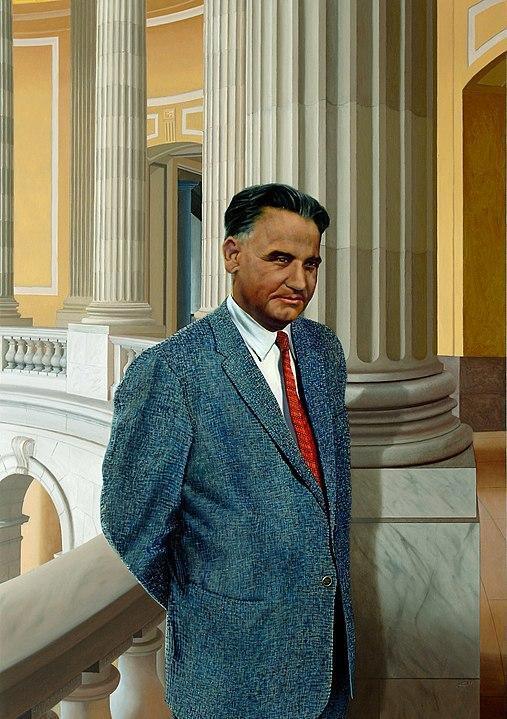
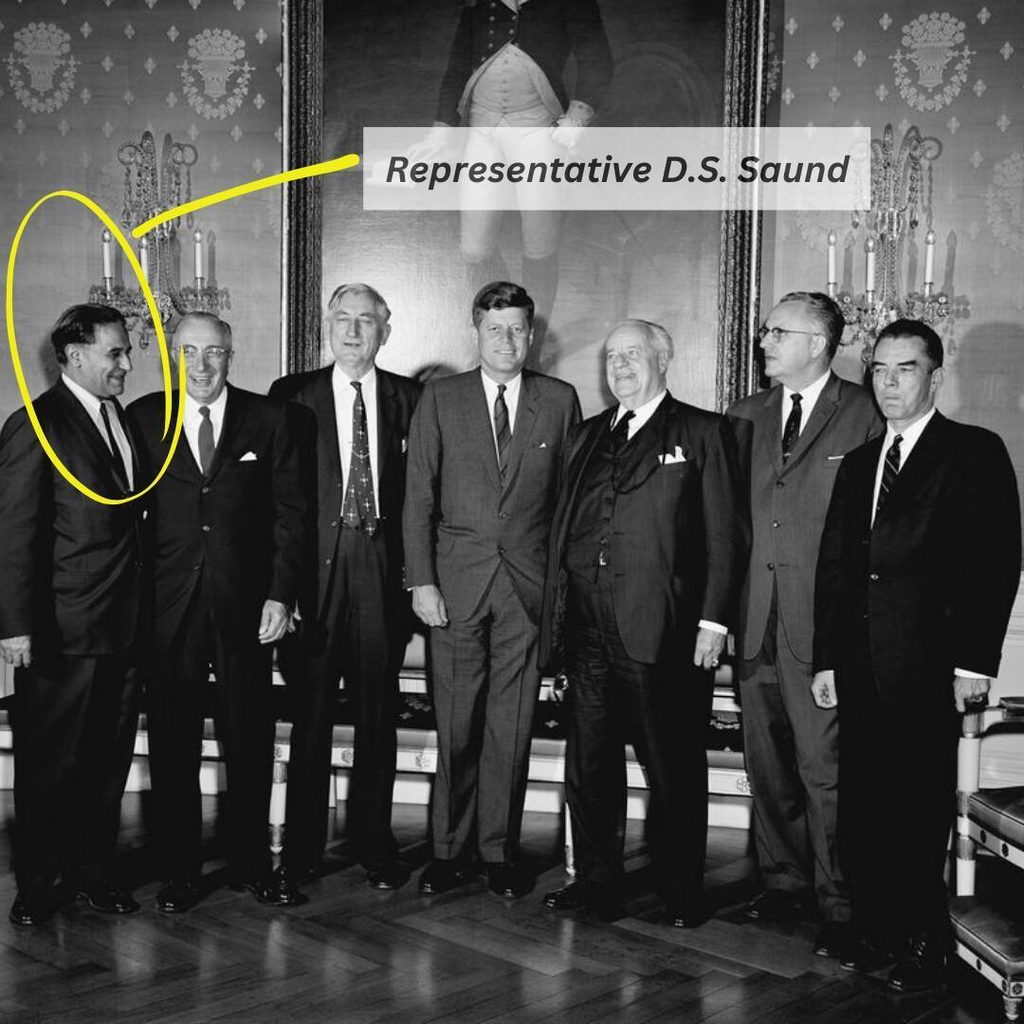
Dalip Singh Saund was one of the first to benefit from this law, naturalizing and later making history as the first Asian American elected to the U.S. Congress in 1956.
Once elected, Saund worked to fight the kind of discrimination he had faced firsthand. His time in Congress was marked by his dedication to civil rights and the immigrant cause, proving that once given the chance, immigrants could contribute not just economically but politically and culturally.
His legacy is a testament to the power of perseverance and the ability to challenge unjust systems.
Yet, today, millions of immigrants, particularly from India, find themselves in a similar situation: stuck in a system that prevents them from fully integrating into American society.
Though they are eligible for green cards and have lived here for years, they face decades-long waits due to an outdated immigration system.
The Green Card Backlog: A Crisis in Need of a Hero
America’s employment-based immigration system is broken, particularly for skilled workers from India. The green card backlog for Indian nationals has swelled to over a million people.
These individuals work in essential sectors like technology, medicine, and engineering, but their contributions are not enough to overcome the bureaucratic bottleneck they face.
Due to the outdated per-country cap system, which limits the number of green cards issued to any one country to 7% of the total, Indians in particular suffer.
Despite their large numbers and essential contributions to the U.S. economy, they face disproportionately long wait times, sometimes spanning decades.
Many live in limbo, unable to fully commit to their futures in the U.S., despite having spent years, even decades, working here.
Why Dalip Singh Saund’s Spirit Is Needed
1. A Leader Who Understands the Pain of Immigration Struggles
Dalip Singh Saund knew the struggles of being an immigrant excluded from the system, just as those in the green card backlog know the pain of living in limbo.
He personally experienced the harsh realities of discriminatory policies that kept Indian immigrants from becoming citizens. Similarly, the United States needs someone who has firsthand experience with the green card backlog—someone who has endured the seemingly endless wait, who has felt the anxiety of uncertain status, and who has triumphed over it to become a citizen.
It’s not just about securing citizenship, though. This leader needs to channel their personal struggles into political action, following in Saund’s footsteps.
Saund fought for the very rights he was once denied, and America now needs someone who has navigated the green card system, experienced its pitfalls, and emerged determined to fix it for future generations.
Unfortunately, many individuals, once they obtain their green cards and citizenship, lose sight of the struggles they endured.
They get caught up in their careers and daily lives, and the fight for reform fades into the background. But what the system needs is someone who, after achieving citizenship, steps into a political role and strategically fights for those still stuck in the backlog.
The pain of the green card backlog should not be forgotten but used as fuel to drive meaningful change.
2. A Voice for the Voiceless
Like Saund, who spoke out for immigrants when they were a marginalized group in the political landscape, we need a leader who can raise their voice for the Indian nationals trapped in the green card backlog.
Saund’s election to Congress was groundbreaking not just because of his identity, but because he was a tireless advocate for immigrant rights.
The people stuck in the green card backlog need a leader who can articulate their struggles to lawmakers, media, and the public at large—someone who will keep their issues at the forefront of political conversations.
3. A Courageous Reformer
Saund was a man who didn’t shy away from difficult battles. He fought against racial prejudice and discriminatory laws, despite knowing how deeply embedded those biases were in the system.
America needs someone with that same courage today—someone willing to challenge the outdated immigration laws that create backlogs and keep talented, hardworking people from fully participating in American life.
Whether it’s eliminating the per-country caps, increasing the number of employment-based green cards, or clearing the existing backlog, this leader must push for reforms even when the political climate is resistant to change.
4. A Bridge Builder
In a highly polarized political landscape, change cannot happen without building coalitions. Saund understood the value of collaboration, working across party lines to achieve meaningful reform.
Today’s immigration system needs a leader who can do the same. Someone who can rally not just the immigrant community, but lawmakers, businesses, and the public to recognize the necessity of immigration reform. Immigration should not be viewed as a divisive issue but as one that strengthens the country.
5. A Humanitarian Focus
Above all, Dalip Singh Saund never lost sight of the human beings behind the policies he was fighting for. He knew that immigration reform wasn’t just about laws and quotas; it was about real people and their families.
The green card backlog isn’t just a bureaucratic issue—it’s a human crisis. Thousands of families live in a constant state of uncertainty, and many children of green card applicants age out of their parents’ applications, leaving them in legal limbo.
A leader like Saund would remind us of the moral and humanitarian urgency of fixing the system.
Conclusion: A New Dalip Singh Saund for Today
America’s immigration system, particularly for Indian nationals, is in desperate need of reform. With wait times for green cards stretching into decades, the dream of citizenship is slipping further and further away for many.
The U.S. must do better, not just for the economy, but for the people whose lives are trapped in uncertainty.
Dalip Singh Saund’s legacy shows us that change is possible, but it requires bold leadership. We need someone who has lived the experience of navigating the green card backlog, who understands the pain and frustration of being stuck in the system, and who is willing to fight for those who are still struggling.
Like Saund, this leader must take that personal struggle and turn it into political action—becoming a voice for the voiceless, a bridge builder, and a courageous reformer.
America needs another Dalip Singh Saund, someone who will not forget the fight, but instead use it as a driving force to push for the reforms that are long overdue.
The green card backlog is not just a policy issue—it’s a human issue, and we need leaders who will fight for the rights and dignity of those still waiting for their chance to fully realize the American Dream. The time for action is now, and we need bold leadership to make it happen.
Mandavi holds a master’s degree in English literature and is passionate about exploring the intersections of politics, culture, art, and literature. With a curious and analytical mind, she is drawn to storytelling and crafting narratives that capture the complexity of the human experience.
Imagine this: Forget about green card backlogs and immigration delays. Imagine you’re a legal immigrant in America, working hard, building a life, but there’s one catch—you’re not even allowed to become a U.S. citizen. No matter how long you’ve lived in the country, how much you’ve contributed, the law simply says, “No.” This was the reality faced by countless immigrants like Dalip Singh Saund in the early 20th century, a time when racial barriers stood tall.
Now picture Saund—an Indian immigrant, determined and undeterred—taking on this challenge and going beyond just becoming a citizen. He would rise to break barriers and make history as the first Indian-American Congressman.
Dalip Singh Saund’s story is one that defies the ordinary. Born in a small village in Punjab, India, in 1899, his journey from a rural farming background to becoming the first Indian-American elected to the U.S. Congress is nothing short of extraordinary. Saund’s life is a vivid testament to perseverance, hope, and the belief that even in the face of insurmountable challenges, one person can truly make a difference.
A Humble Beginning in Punjab
Growing up in British India, Saund was raised in a Sikh family rooted in the values of hard work, community, and education. His early years in the village of Chhajjal Wadi, Punjab, were steeped in the agricultural traditions of his ancestors. But Saund was destined for more.
His family, despite their humble means, prioritized education, sending him to schools where he developed a passion for learning. His intellectual spark led him to the University of Punjab, where he studied mathematics and agriculture.
It was during his youth in Punjab that Saund was first drawn to the fight for justice. He actively participated in India’s growing independence movement, inspired by leaders like Mahatma Gandhi. However, he was also inspired by the opportunities that awaited in the West. In 1920, with a spirit of adventure and the determination to seize new opportunities, Saund made the life-altering decision to move to the United States.
Navigating the American Dream
Landing in California, Saund enrolled at the prestigious University of California, Berkeley, where he pursued a Ph.D. in mathematics. But academic achievements were not enough to shield him from the harsh realities of life as an immigrant in the early 20th century.
The racial barriers in America were high, especially for Asians. At the time, U.S. laws like the Immigration Act of 1917 explicitly barred Asian immigrants from becoming citizens. Despite these barriers, Saund made a life for himself, finding work in the agricultural heartlands of California.
He settled in the Imperial Valley, where he worked as a farmer. It was a challenging time. The Great Depression hit rural communities hard, and Saund witnessed firsthand the struggles of fellow farmers and laborers, many of whom were also immigrants. These experiences not only solidified his belief in the values of fairness and equality but also spurred him toward activism. Saund’s determination wasn’t just for his own success; it was for the countless others who were similarly marginalized by systemic racial and social discrimination.
Overcoming Immigrant Barriers
Saund’s political awakening came as he realized that laws needed to change for immigrants to thrive in America. For years, Indian immigrants were unable to become U.S. citizens due to discriminatory laws.
Saund, along with others in the Indian community, actively campaigned for change. His involvement with the Indian Association of America was instrumental in pushing for the passage of the Luce-Celler Act of 1946, which finally granted citizenship rights to Indian immigrants.
In 1949, after nearly three decades in the U.S., Saund became a U.S. citizen. This was a defining moment not just for him, but for all Indian-Americans in the country. Saund wasted no time in putting his newfound citizenship to use. He quickly dove into local politics, becoming a key figure in the Democratic Party in California’s Imperial Valley.
The Road to Congress
Saund’s entry into politics wasn’t smooth, but his resilience saw him through. In 1952, he ran for and won a position as a judge in California, despite racial attacks from opponents who questioned his background and religion. His calm, witty responses to such prejudice endeared him to many, setting the stage for a much larger political leap.
In 1956, Saund achieved the unimaginable: he ran for Congress in California’s 29th District. The race was fierce, not just because of his political inexperience but also because of entrenched racial biases. His Republican opponent, famed aviator Jacqueline Cochran, played heavily on his ethnicity, but Saund remained undeterred.
He mounted a grassroots campaign that focused on engaging small farmers and business owners, many of whom had come to know and respect him through his years of local service. His relentless efforts paid off, and he became the first Indian-American and the first Asian-American ever elected to the U.S. Congress (Source: The HISTORY Channel).
A Champion for Civil Rights and Farmers
Saund’s time in Congress was marked by his tireless advocacy for the causes closest to his heart: civil rights, immigration reform, and support for farmers. He was a passionate supporter of civil rights legislation and played a pivotal role in advocating for immigration policies that would offer more inclusive pathways to citizenship for immigrants, particularly those from Asia. His experiences as an immigrant gave him a unique perspective in Congress, and he consistently fought for the rights of those who had been marginalized.
Saund also worked to foster stronger U.S.-India relations, understanding that diplomacy was key to building a peaceful world. His contributions to international diplomacy laid the foundation for the strong U.S.-India ties we see today (Source: Encyclopedia Britannica and Eric Saund).
Lasting Legacy
Saund’s political career was tragically cut short when he suffered a stroke in 1962, just before he could run for a fourth term. He passed away in 1973, but his legacy endures. Dalip Singh Saund’s life remains a beacon of hope and inspiration, particularly for immigrants and minorities in the U.S. His story demonstrates the power of resilience, the importance of representation, and the belief that one person’s courage can change the course of history.
In the decades since his time in office, Saund’s influence has continued to grow. His groundbreaking achievements have inspired generations of Indian-Americans to enter public service. Figures like Bobby Jindal and Kamala Harris owe part of their political journeys to the path that Saund blazed. His legacy also serves as a reminder of the importance of diversity and inclusion in American politics—a fight that continues to this day.
Conclusion: A Legacy of Courage and Determination
Dalip Singh Saund’s life is more than a historical footnote. It is a vibrant example of how one man’s courage, intelligence, and relentless drive for equality reshaped American politics. His legacy as the first Indian-American Congressman is a powerful reminder of the impact immigrants can have in shaping the future of a nation.
Saund’s story, from a small Punjabi village to the halls of the U.S. Capitol, continues to inspire those who seek justice, fairness, and equality in all walks of life.
Mandavi holds a master’s degree in English literature and is passionate about exploring the intersections of politics, culture, art, and literature. With a curious and analytical mind, she is drawn to storytelling and crafting narratives that capture the complexity of the human experience.
The H4 visa, often called the “dependent” visa, might sound like a pathway to a promising new life in the United States, but for thousands of women, it’s become a trap—one that shackles them to a life of dependency, stifling their aspirations and potential. What was meant to unite families has turned into a slow, silent burn that echoes the haunting remnants of an age-old tradition: Sati.
An Unexpected Parallel: From Ancient Sati to Modern H4 Visa
Sati (or Suttee) was a brutal practice in ancient India where widows were expected—or sometimes forced—to self-immolate (burn) on their husband’s funeral pyre. It was seen as the ultimate act of devotion, but it was much more than that. It was a grim way to ensure that a woman’s life ended with her husband’s, leaving no room for her to remarry or claim his property.
In many ways, it was a cruel method of ensuring that women had no future without the men they had lost, reinforcing their dependence and erasing their identities.
The Harrowing Reality of Sati
Sati was often seen as a way to maintain the purity of lineage and reinforce male dominance by eliminating a widow’s independence. Widows who resisted Sati were often ostracized, stripped of their social standing, and condemned to a life of misery and isolation.
Reformers like Raja Ram Mohan Roy campaigned vigorously against this practice, ultimately leading to the British abolition of it in 1829. However, isolated incidents of Sati persisted well into the 20th century, revealing the depth of these beliefs in some communities.
It was about control, subjugation, and, most importantly, erasing women’s agency. While the physical practice of Sati has been abolished, its essence—placing women’s worth solely in relation to their husbands—seems to have found a subtle, modern reflection in the H4 visa.
A Modern Echo: H4 Visa as a 21st-Century Sati
Unlike the practice of Sati, the H4 visa doesn’t physically harm women, but it isolates and suppresses them, forcing many to remain in the shadow of their spouse’s career.
These highly educated, ambitious women are often barred from working and pursuing their own careers, making them economically dependent on their spouses. It’s a silent, unseen sacrifice—a metaphorical 21st-century Sati—where women’s ambitions are metaphorically burned in the flames of restrictive immigration policies.
The H4 Visa’s Impact: Loss of Identity and Self-Worth
Take Aarti, for instance. A young architect from Mumbai, she moved to the U.S. with her husband on an H4 visa, brimming with excitement about new possibilities. But that excitement quickly dimmed as she realized she couldn’t practice her profession, get a job, or even engage in meaningful hobbies and receive some money without work authorization.
Days turned into months, and months into years. Her career, which she had worked so hard to build, slowly faded away.
“I chose my husband, but not this life,” she would often say to herself. “What’s left of me now?”
Without her career, she felt like a shadow of her former self, aimlessly drifting in a foreign land. Her story is not unique—countless women on H4 visas are in similar predicaments, left to wonder what their worth is when their talents and skills are kept under lock and key.
The restrictions stripped Aarti of her professional identity, and as time passed, she started to question her value and place in the world. Aarti’s situation, like that of countless others, mirrors the plight of those women who, during the Sati era, were told that their lives held no meaning without their husbands.
Although today’s women on H4 visas are not expected to sacrifice themselves physically, they often sacrifice their personal and professional growth, leading to similar psychological trauma.
Invisible Scars: The Hidden Toll on Mental Health and Relationships
Beyond the obvious financial dependency, the impact of the H4 visa is deeper and more insidious. These women often find themselves trapped in an invisible cage, with walls built by cultural expectations, lack of social support, and a visa status that leaves them vulnerable.
For some, the inability to work or seek financial independence exacerbates the risk of staying in abusive or unhealthy relationships because they feel they have no way out. Without a work permit, they can’t legally support themselves. Without legal support, they can’t seek protection.
In essence, these women are “immigrants within immigrants”—stuck in a place where their voices go unheard, and their potential remains unseen. This enforced dependency creates a power imbalance that is all too easy to exploit.
Like the Sati practice, which sought to control women’s bodies and choices, the H4 visa controls their opportunities and options. Moreover, even when H4 visa holders finally receive EAD approval, many find that re-entering the workforce after years of forced unemployment is challenging, if not impossible. The professional and personal cost of this lost time is immense.
A Wasted Resource: The Cost to Individuals and Society
Let’s not forget the impact on the U.S. economy. These women are not just “dependents”; they are engineers, doctors, scientists, architects—highly qualified professionals who have been sidelined. Imagine having a room full of talented individuals but locking the door and throwing away the key.
That’s what the H4 visa does. There are over 100,000 H4 visa holders with advanced degrees who are either unemployed or underemployed due to visa restrictions. It’s a colossal waste of talent and potential.
A report by the Migration Policy Institute found that if H4 visa holders were allowed to work, they could fill critical skill gaps in STEM and healthcare, contributing billions of dollars to the U.S. economy. Yet, while American companies scramble to find skilled workers, these qualified individuals are confined to domestic roles that don’t use even a fraction of their capabilities.
The Struggle for Change: Legal Battles and Bureaucratic Nightmares
There was a glimmer of hope in 2015, when the Employment Authorization Document (EAD) was introduced, allowing some H4 visa holders to apply for work permits. However, this program has been fraught with legal challenges and bureaucratic backlogs, with many H4 holders waiting for months, even years, to get approval.
And when they do finally get it, they often find re-entering the workforce difficult after such a long hiatus. Skills go stale, confidence wanes, and the sense of being “left behind” becomes a daily reality.
Consider Meera’s story. A 32-year-old marketing professional from Chennai, Meera’s career was soaring until she moved to the U.S. with her husband. Eager to build a new life, she applied for an EAD. But what followed was years of uncertainty and waiting. By the time she finally got approval, the marketing world had moved on without her. Job offers were few and far between.
“I went from being a decision-maker in the boardroom to asking for an allowance to buy groceries,” she shared in a hushed tone, revealing the crushing weight of dependency.
A Call to Action: Breaking the Shackles
Much like the abolition of Sati required a movement and collective outcry against an inhumane practice, the plight of H4 visa holders demands a similar response. It’s time to recognize that these women are more than “dependents”—they are individuals with dreams, ambitions, and the potential to make significant contributions to society.
To truly empower H4 visa holders, the following reforms are essential:
Grant Automatic Work Authorization: Ensure that all H4 visa holders have access to an Employment Authorization Document (EAD) without lengthy approval processes.
Simplify the Bureaucratic Process: Streamline the application and approval processes for work permits, eliminating the uncertainty that keeps families in limbo.
Support Mental Health and Skill Development: Create mental health services and skill development programs tailored to H4 visa holders, allowing them to maintain and update their skills while navigating the uncertainties of their visa status.
Statistics: Numbers and Visuals:
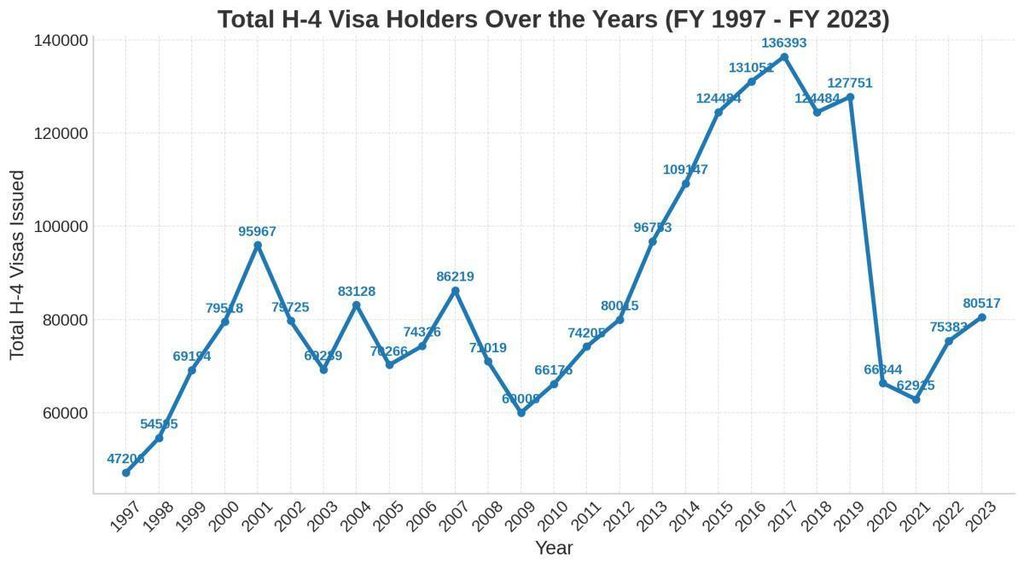
Total H-4 Visa Holders Over the Years (FY 1997 – FY 2023) Here is the visualization for Total H-4 Visa Holders Over the Years (FY 1997 – FY 2023); these numbers are sourced directly from the official Visa Statistics page of the U.S. Department of State.
Image Credit: Asia91.com
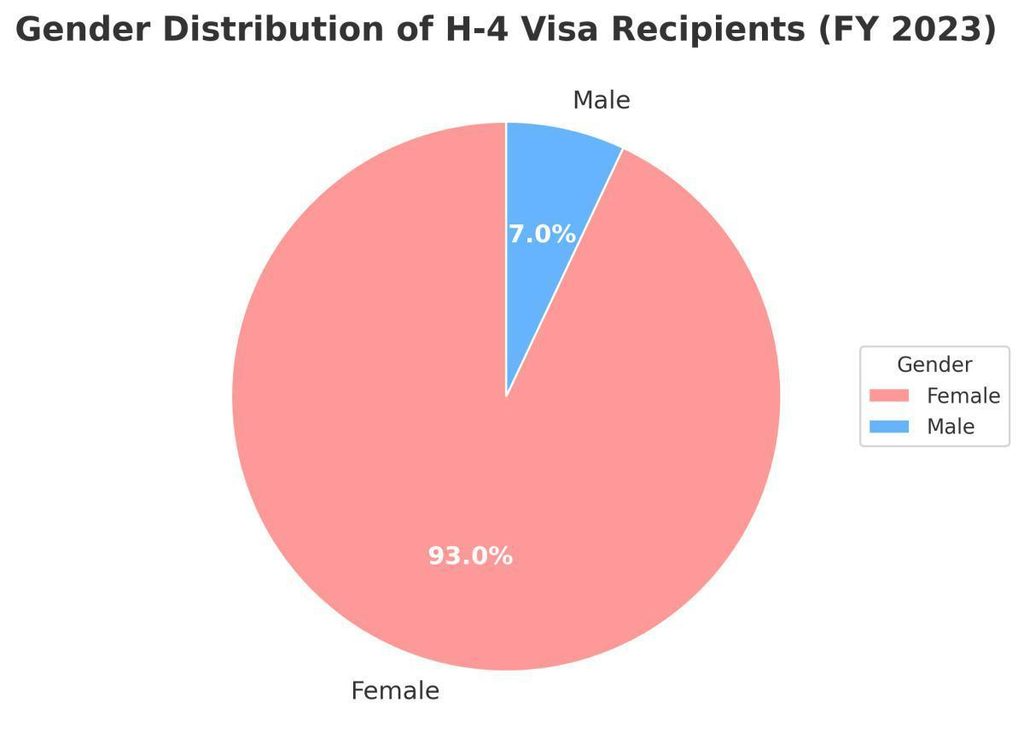
Characteristics of H-4 Visa Recipients The majority of H-4 visa holders are dependents of H-1B workers. Most H-4 recipients are women, as the visa category is primarily used by spouses. Data indicates that around 93% of H-4 visa holders are female, reflecting the dependent nature of the visa, whereas the primary H-1B visa holders tend to be male (Source: USCIS, 2023).
Image Credit: Asia91.com
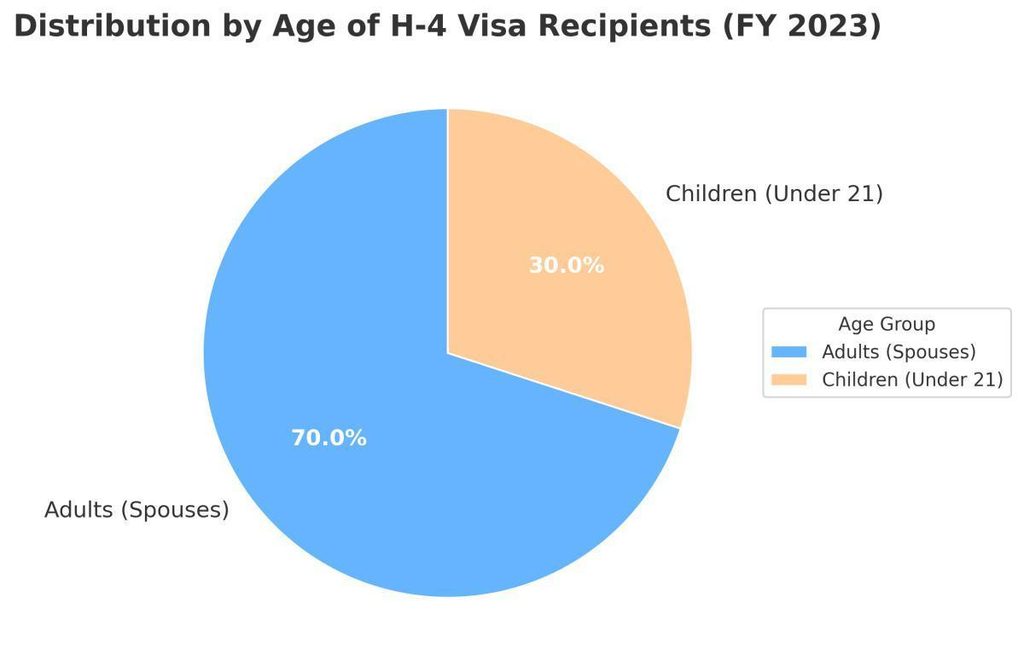
Distribution by Age While specific age group data wasn’t detailed, the visa generally applies to spouses and children under the age of 21. This indicates that a significant portion of H-4 holders are likely adults (spouses), with a smaller percentage being children under 21 accompanying the primary visa holder.
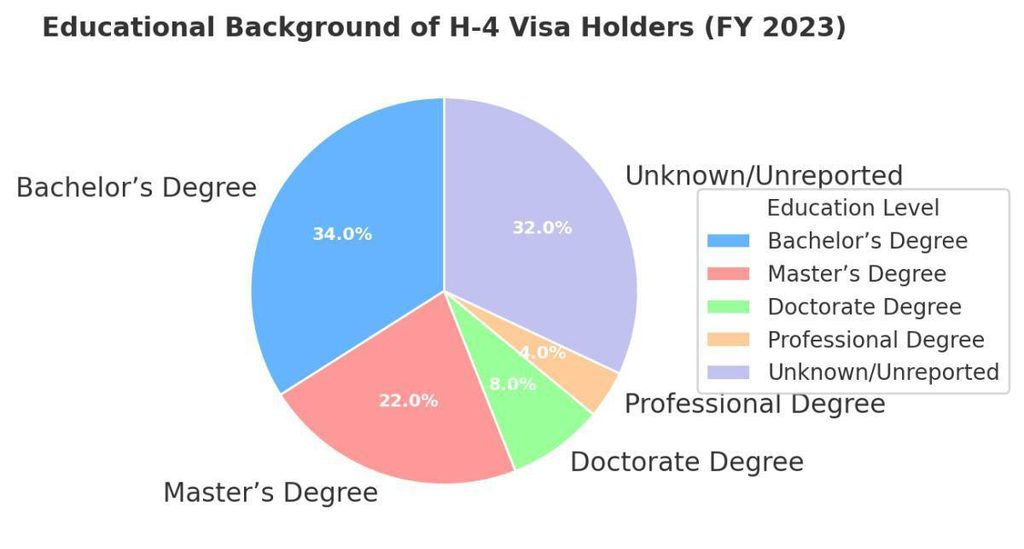
Educational Background of H-4 Visa Holders The educational background of H-4 visa holders reveals that the majority (68%) have at least a bachelor’s degree or higher, reflecting a highly educated group. Specifically, 34% hold a bachelor’s degree, 22% have a master’s degree, 8% possess a doctorate degree, and 4% hold a professional degree. However, 32% fall into the “Unknown/Unreported” category due to incomplete data. Compared to the general U.S. working population, where only about 35% hold a bachelor’s degree or higher, H-4 visa holders represent a significantly more educated demographic. This level of educational attainment highlights the potential of H-4 visa holders to contribute meaningfully to specialized fields within the U.S. workforce.
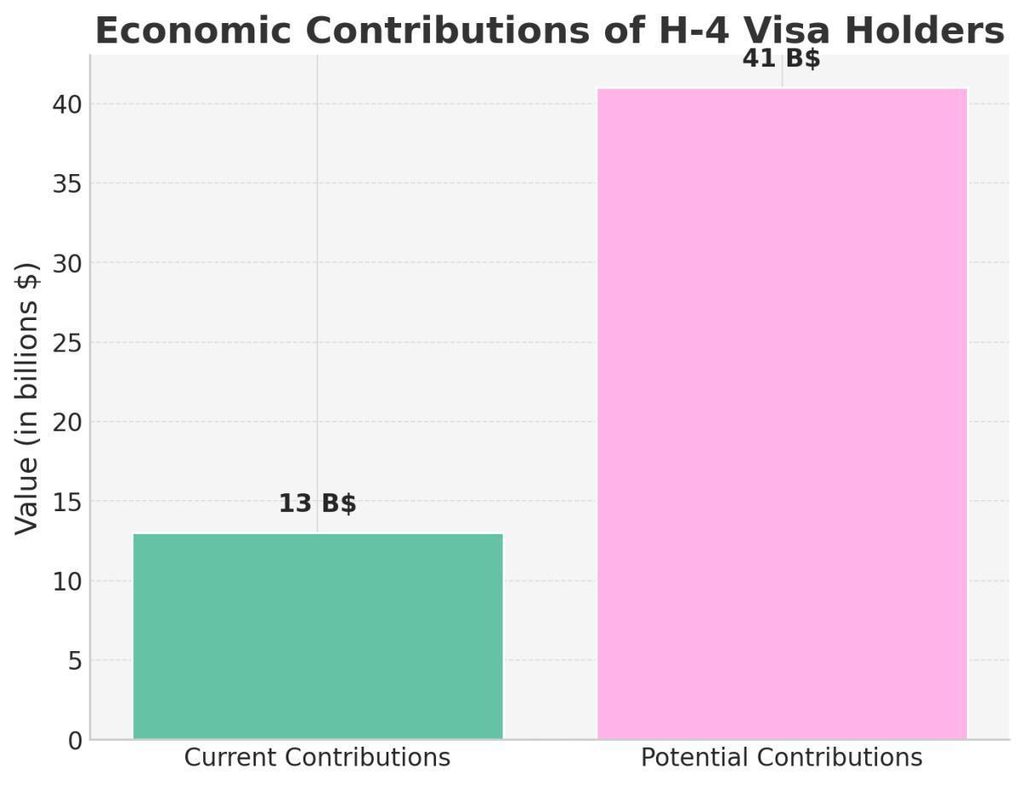
Economic Contributions H-4 visa holders contribute nearly $13 billion to the U.S. economy each year. If every eligible H-4 visa holder were granted work authorization, this number could rise to approximately $41 billion annually (AAF). This data highlights the significant economic impact that H-4 visa holders could make if given the opportunity to work.
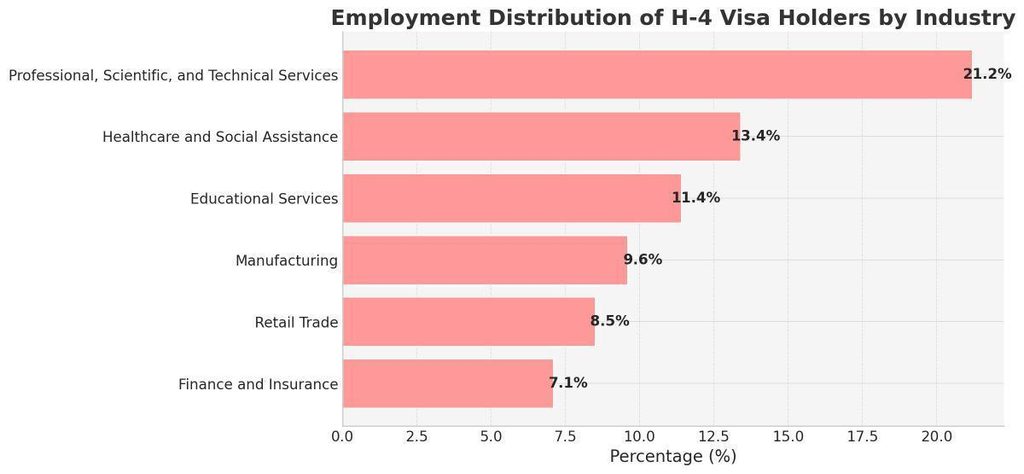
Employment Distribution The majority of H-4 visa holders are employed in high-demand fields such as professional, scientific, and technical services (21.2%), healthcare and social assistance (13.4%), and educational services (11.4%) (AAF). This demonstrates their potential to fill critical skill gaps in these industries.
Number of H-4 Visa Holders In FY 2017, a total of 136,393 H-4 visas were issued, with 86% going to family members of workers from India. The number of H-4 visa holders has been steadily increasing, reflecting the growing demand for skilled workers in the U.S. as per the American Immigration Council report.
Immigrants’ Economic Role Immigrant households, including H-4 visa holders, paid over $524.7 billion in taxes in 2021 and held $1.4 trillion in spending power. They also made up 20% of all U.S. entrepreneurs in 2021, showing their significant contributions as both workers and business owners .
Conclusion: From Silent Suffering to Empowered Voices
The H4 visa may not subject women to a literal pyre like Sati, but it certainly consigns them to a cycle of invisible suffering—slowly burning away their dreams and ambitions.
Reforming this visa category to include better work authorization policies can help end this modern-day constraint on women’s freedom, enabling them to thrive while contributing positively to society and the economy.
As we look ahead, we must learn from history. Just as Sati was abolished and recognized as an inhumane practice, let us acknowledge that the constraints of the H4 visa are a modern echo of that same oppressive legacy.
By making these changes, we can transform the H4 visa from a symbol of silent suffering into one of opportunity and empowerment for thousands of women, allowing them to reclaim their voices and destinies.
Mandavi holds a master’s degree in English literature and is passionate about exploring the intersections of politics, culture, art, and literature. With a curious and analytical mind, she is drawn to storytelling and crafting narratives that capture the complexity of the human experience.
“For thousands of skilled immigrants like Vijay Sharma, the H1B visa, once seen as a golden ticket to the American Dream, has turned into a living nightmare. Trapped by the very system that promised opportunity, these professionals find themselves in a cycle of exploitation and uncertainty, unable to break free.”
Vijay Sharma’s Story: A Dream Deferred
Vijay Sharma (name changed for privacy) arrived in the U.S. in January 2011 on an H1B visa, full of hope and ambition. His employer, a software giant based in India and the USA, offered him a salary of $56,000 per year to work in Dallas, Texas. A figure that matched the bare minimum required by the Labor Condition Application (LCA).
This LCA document is supposed to ensure employers pay foreign workers fair wages appropriate to their job role and region.
For Vijay, this salary was a start. Little did he know that his pay would stagnate for two years, leaving him trapped. Like many H1B visa holders, Vijay found it nearly impossible to switch jobs due to visa sponsorship requirements. The promise of a green card, the ultimate goal for many, felt like a distant dream.
On a different path but facing similar hurdles, Vamshi Reddy came to the U.S. for his master’s degree, hoping to secure an H1B visa and eventually a green card.
As his Optional Practical Training (OPT) period neared its end, Vamshi struggled to find a job with H1B sponsorship. Desperate, he turned to a desi IT consultancy, a common route for many international students.
The consultancy took 30% of his earnings as a fee. Though it seemed reasonable initially, Vamshi soon realized he was trapped in a low-paying job for years, unable to leave due to visa constraints.
Vijay and Vamshi’s experiences highlight the systemic issues plaguing many H1B visa holders in the U.S. From wage stagnation and job immobility to long green card backlogs, thousands of skilled professionals find themselves trapped in a complex and exploitative system.
Their stories are just part of a larger narrative, one that reveals how the H1B visa system has, for many, become a form of modern-day slavery.
The H1B Visa: Origins and Intentions
The H1B visa program was established under the Immigration Act of 1990 to address critical labor shortages by allowing companies to hire foreign professionals in specialized fields like technology, healthcare, and engineering.
The aim was to help the U.S. maintain its competitive edge by filling skill gaps with global talent, benefiting both the U.S. economy and the foreign workers who could gain valuable experience.
But the program’s initial promise has largely fallen short for many, as it has now become a mechanism for labor exploitation, particularly in the tech industry.
Silicon Valley’s Dependence on H1B Workers
The tech industry, particularly Silicon Valley, has long been one of the biggest beneficiaries of the H1B visa program. Giants like Google, Microsoft, and Apple rely heavily on foreign talent to fill critical skill shortages and sustain rapid innovation.
Indian professionals, who dominate the H1B applicant pool, have been instrumental in driving the U.S. tech sector’s success.
However, critics argue that this reliance has led to wage suppression and worker displacement. The system, designed to bring in specialized talent, has instead fostered a cycle where many foreign workers, particularly from India, are overworked and underpaid.
An infographic showing how the U.S. tech industry relies on H1B visa holders, juxtaposed with a wage disparity chart comparing H1B workers and U.S. workers.
Employer Dependency: The Golden Cage
H1B visa holders are legally tied to their employers, meaning their visa status—and their ability to remain in the U.S.—is directly linked to their employment.
Changing jobs is a complex and uncertain process that involves finding a new employer willing to sponsor their visa, navigating bureaucratic procedures, and dealing with potential delays. This system creates a significant power imbalance, trapping workers in their roles.
Infosys, one of the largest users of H1B visas, has faced allegations of discouraging workers from leaving by creating additional hurdles for those seeking to transfer their visas.
H1B workers report long hours and tight deadlines, fearing that non-compliance or performance issues could result in termination—and the loss of their visa.
Key Data: The Economic Policy Institute (EPI) reports that H1B visa holders earn 17% less on average compared to their American counterparts. This wage suppression is enabled by the dependency visa holders have on their employers, knowing that any attempt to negotiate better pay could jeopardize their immigration status .
The Exploitation by Desi Consultancies
Desi consultancies, or Indian-owned staffing firms, play a significant role in placing Indian professionals in U.S. jobs—but often at a high cost. Commonly referred to as ‘tech body shops,’ these consultancies take a substantial portion (up to 30-40%) of the worker’s salary as fees.
Despite these deductions, workers are often placed in roles with minimal benefits and job security, frequently enduring 12-14-hour workdays to meet client demands.
In one notable case, Cognizant was fined $34 million for wage violations and visa misuse , highlighting the exploitation faced by visa holders who feel powerless to seek better opportunities.
Wage Disparities and LCA Misuse
The Labor Condition Application (LCA), meant to protect foreign workers by ensuring fair wages, is often circumvented.
Many H1B visa holders earn significantly less than their American counterparts, especially in roles within Indian outsourcing firms. According to a study by the Economic Policy Institute, over 60% of H1B workers are employed in roles paying below the prevailing wage level for their job titles .
Visual: A bar chart comparing wages of H1B visa holders in IT and engineering roles with their American counterparts, emphasizing the wage gap.
Psychological Toll: Fear of Visa Revocation and Job Insecurity
H1B workers live under the constant threat of losing their visa status. If an employee is laid off, they have just 60 days to find another sponsor—an almost impossible task in such a short period.
This uncertainty creates immense stress, particularly for those with families. For many, losing their visa means uprooting their children from school and returning to India, an emotional and financial burden.
Key Data: The Migration Policy Institute reports that nearly 40% of H1B visa holders experience intense psychological stress due to job insecurity and fear of visa revocation .
The Green Card Backlog: Living in Limbo
For Indian nationals, the wait for a green card can last up to 50 years due to per-country caps. This backlog leaves thousands of skilled professionals in immigration limbo, forcing them to continuously renew their H1B visas while living in constant fear of policy changes that could disrupt their lives.
Key Data: According to the Cato Institute, there are currently over 200,000 Indian nationals stuck in the green card backlog , unable to secure a stable future despite working in high-demand professions.
Impact on Families: The H4 Visa and Children’s Struggles
Spouses of H1B visa holders, typically on H4 visas, face severe employment restrictions. Though a 2015 rule allowed some H4 visa holders to work, this option is limited, leaving many highly educated spouses unable to pursue careers.
Children of H1B holders also face challenges. When they turn 21, they must switch to F1 student visas, which often disrupts their education and limits their access to financial aid.
Key Data: The National Foundation for American Policy reports that over 20,000 children of H1B visa holders struggle with this transition, leading to significant financial and emotional strain on families .
The Hidden Psychological Cost: Modern-Day Slavery
The power imbalance, constant stress, and lack of job security for H1B visa holders have created conditions that resemble modern-day slavery.
Workers are exploited for their skills but denied the freedom to seek better opportunities. Many experience depression, anxiety, and burnout due to the uncertainty of their visa status.
Key Data: A survey by the International Labor Organization found that 35% of H1B workers report deteriorating mental health due to job insecurity and fear of visa revocation .
Conclusion: A Call for Urgent Reform
For too many H1B visa holders, the American Dream has become a nightmare. Highly skilled workers, many of whom contribute significantly to the U.S. economy, are trapped in a system that limits their growth, exploits their labor, and strains their mental well-being.
It’s time for meaningful reform. The U.S. must implement policies that reduce the power imbalance between employers and visa holders, increase job mobility, and address the green card backlog.
Without reform, the H1B visa will remain a system that promises opportunity but delivers exploitation.
Reference Sources:
Economic Policy Institute Report – Wage Disparities
Migration Policy Institute – Psychological Stress 【8†source】
Cato Institute – Green Card Backlog
National Foundation for American Policy – Children of H1B Visa Holders
International Labor Organization – Survey on Mental Health
Mandavi holds a master’s degree in English literature and is passionate about exploring the intersections of politics, culture, art, and literature. With a curious and analytical mind, she is drawn to storytelling and crafting narratives that capture the complexity of the human experience.
A teddy bear sits beside an empty plate with crumbs, accompanied by a fork and knife on a dark wooden table.
TRIGGER WARNING: This article contains disturbing descriptions of child neglect, including police reports of extreme malnourishment. Reader discretion is advised.
In the quiet town of Morrisville, North Carolina, where neighbors greet each other warmly and the streets are often filled with the laughter of children, an unthinkable tragedy has shaken the community to its core.
Just days before Christmas, on December 20, 2023, a mother called 911 with a chilling report—her son was unresponsive.
When authorities arrived, they found not a sick child in need of help, but the lifeless body of a young boy in a state of advanced decomposition. Officers reported finding a home with virtually no edible food and a child whose emaciated condition showed clear signs of prolonged starvation.
The child, just 9 years old, appeared so severely malnourished that one investigator described it as “one of the worst cases of neglect I’ve seen in my career.” His body was in such an advanced state of decomposition that the medical examiner initially struggled to determine the exact cause of death.
His name was Aarav (name changed to protect his identity), a bright, sweet soul born on September 8, 2014. He loved simple joys—crisp parathas, special treats from KFC, and cuddling with the family dog, Gucci.
Neighbors remember his smile and presence with great fondness. He was, as one person described, “a ray of sunshine.” And now, he is gone.
His mother, Priyanka Tiwari, 33, has been charged with first-degree murder and felony child abuse. She remains in custody without bail.
Her husband, Shashikant Tiwari, 40, was charged in February 2024 with felony child abuse for allegedly failing to remove Aarav from the home despite knowing of Priyanka’s deteriorating mental state.
He was later released on $30,000 bail while Priyanka faces life in prison or the death penalty if convicted.
Mandavi holds a master’s degree in English literature and is passionate about exploring the intersections of politics, culture, art, and literature. With a curious and analytical mind, she is drawn to storytelling and crafting narratives that capture the complexity of the human experience.
Indian mother with her two daughters sharing a joyful moment at home, reflecting family love and cultural warmth.
In an age of globalization, mobility, and shifting cultural values, many Indian Americans find themselves at a crossroads—torn between two homes, two generations, and two deeply important responsibilities.
A recent post on social media ignited a heartfelt discussion around a difficult and deeply personal question: Should Indian Americans move back to India to care for their aging parents, or should they stay in the U.S. to secure a brighter future for their children?
This question may seem straightforward at first glance, but peel back the layers, and it reveals a complex web of emotional, practical, financial, and philosophical considerations.
The online debate drew hundreds of comments—each reflecting lived experiences, sacrifices, regrets, and resilience. Here’s a deeper dive into this multilayered issue, capturing voices from both sides and shedding light on a choice that resonates with countless families.
The Case for Returning: Reclaiming Presence and Purpose
For many who have made the move back to India, the choice was not just logical—it was emotional, spiritual, and profoundly satisfying. They speak of reconnecting with aging parents in a way that transcends weekly calls and annual visits.
Physical presence, they argue, allows them to be part of their parents’ daily rhythms, provide real-time medical and emotional support, and rediscover the family fabric they grew up with.
Gayathri, who relocated from Seattle to Bangalore after more than a decade in the U.S., describes the move as “the best decision ever made.” She no longer worries about emergency phone calls in the middle of the night or coordinating long-distance caregiving through intermediaries.
“I felt like I had been absent during their silent years of decline,” she shares. “Now, I’m there—not just to help, but to live alongside them.”
Another poignant account came from a user who wrote, “I gave my father-in-law 20 years of a respectful life and my mother 15 years. No regrets.” These narratives underscore a sense of closure, honor, and duty fulfilled—values deeply embedded in Indian culture.
From Afar with Love: The Power of Virtual Presence and Financial Support
Yet, returning to India isn’t the only form of caregiving. A growing number of Indian Americans believe it’s possible—and sometimes preferable—to support parents from a distance.
With technology bridging many gaps, children and grandchildren can stay connected through daily video calls, online medical consultations, and even remote home monitoring systems.
Mihir, who resides in Boston, explains, “Most parents actually prefer staying in India, in their own homes, surrounded by familiar people, language, and food. As long as they are financially secure and connected emotionally, they don’t necessarily want us to uproot our lives.”
Moreover, India has seen a significant rise in private eldercare services, retirement communities, and domestic support networks.
For families who can afford it, these alternatives can provide comfort and care without requiring relocation. However, this route also demands meticulous planning and trust in local support systems.
The Balancing Act: Parents and Children
Caught between aging parents on one side and growing children on the other, many Indian Americans identify themselves as the “sandwiched generation.” One user vividly described this position: “You are the stuffing that holds this sandwich together, so your strength matters most.”
Parents with younger children may find the decision to move back easier—especially if children are still in elementary or middle school, when adaptation is smoother.
But for teenagers, the shift can be more turbulent. Educational alignment, social adjustment, and college entrance timelines in India and the U.S. differ significantly. “High school is going to be tricky, but doable,” one commenter said, encapsulating the uncertainty many feel.
This generation also grapples with time anxiety—feeling as though they’re racing against the clock with their parents’ health on one side and their children’s critical developmental years on the other.
Prioritizing the Next Generation: The Argument for Staying Put
While filial responsibility remains a powerful cultural anchor, many Indian Americans are rethinking what that responsibility should look like in a modern context.
Some argue that their children’s futures—particularly in terms of education, career opportunities, and mental health—should take precedence.
Antony, a father of two, expressed this evolving mindset clearly: “Just because you’re a parent doesn’t mean your kid should serve you throughout their life. Let them live and experience life.” His view reflects a generational shift from reciprocal duty to individual freedom—a hallmark of contemporary parenting.
For many, the idea of returning to India seems like stepping away from years of hard-won stability. Concerns about career trajectories, medical care standards, and loss of personal freedom in traditional family dynamics often outweigh the emotional pull.
The Social Fabric: Belonging and Identity
Beyond caregiving logistics, this dilemma also forces Indian Americans to confront a deeper question: Where do I belong? For some, returning to India revives a sense of social ease and cultural rootedness that they never fully found abroad.
Gayathri shared, “Life in Bangalore was vibrant. I didn’t need to make appointments for socializing. A social circle happened effortlessly.” In contrast, many feel isolated in the U.S., despite material comforts and professional success.
However, not all returns are smooth. Family politics, especially with in-laws or extended relatives, can sour the experience. “If your spouse’s family is supportive, India is heaven. If not, you’ve just chosen one hell over another,” one person candidly observed.
Cultural Philosophy: What Do We Owe Our Parents?
Some commenters invoked Hindu philosophy to guide this decision. A recurring idea was the concept of “PitR RuNa”—the debt to one’s parents. According to Hindu tradition, every individual bears three sacred debts:
Deva RuNa – debt to the God,
Rishi RuNa – debt to the learned, and
PitR RuNa – debt to one’s parents and ancestors.
One user suggested, “Our obligation to parents is not just caregiving—it’s raising the next generation well, with values and strength. That is how we repay them.”
This perspective reframes the decision: perhaps the true tribute to our parents is not geographical, but intentional—anchored in how we live, love, and lead our lives.
No One-Size-Fits-All Answer: Embracing Personal Truth
In the end, there is no universal solution—only personal resolutions that reflect each family’s unique landscape of health, relationships, finances, and dreams.
Some find peace in returning to India, reclaiming roots and reconnecting with parents. Others choose to remain abroad, nurturing the next generation while honoring their elders in meaningful, albeit distant, ways.
The most empowering realization? You are allowed to change your mind. Life is fluid, and so are your options. Perhaps caregiving evolves over time—first from afar, then up close. Perhaps what matters most is not location, but connection.
Whatever the choice, it’s a profound one—and deserves to be made not out of guilt or fear, but from a place of clarity, compassion, and care.
Mandavi holds a master’s degree in English literature and is passionate about exploring the intersections of politics, culture, art, and literature. With a curious and analytical mind, she is drawn to storytelling and crafting narratives that capture the complexity of the human experience.
Indian American parents coping with loneliness and redefining their lives, highlighting emotional challenges.
When their daughter left for college in San Diego, Sunitha and Vijay Rao felt proud and excited for her. But once she was gone, the house felt unusually quiet. Meals were smaller, weekends felt slower, and little things—like her music in the background or her shoes by the door—were suddenly missing. “We knew this day would come, Sunitha said, “but we didn’t expect how empty it would feel.”
When children grow up and move out, it’s often seen as a milestone—a success story of parenting well done. But for many Indian American parents, this transition brings more than just an empty room; it brings an emotional void, a quiet kind of heartbreak. Beneath the surface of cultural celebrations and career achievements lies a quieter story—of parents learning to let go in a land where family structures look very different from those they once knew.
This article explores Empty Nest Syndrome (ENS) through the lens of Indian American parents, highlighting the cultural, emotional, and psychological impacts of children leaving home. It delves into why ENS feels especially profound in this community and offers actionable strategies to help parents rediscover identity, joy, and purpose in their evolving lives.
Introduction
Empty Nest Syndrome (ENS) is a psychological condition characterized by feelings of loneliness, sadness, and a loss of purpose when children leave home for education, work, or marriage. While this phenomenon is experienced globally, it takes on a unique cultural dimension within the Indian American community, where family bonds and intergenerational living are traditionally strong.
For many Indian American parents, raising children in the U.S. has meant balancing Indian traditions with American ideals of independence. When children move out—whether for college, careers, or marriage—parents often struggle with the abrupt shift in household dynamics. While some adapt by pursuing new interests, others find themselves battling depression, loneliness, or a sense of purposelessness.
The Cultural Context of Empty Nest Syndrome Among Indian Americans
Deep Emotional Ties and Expectations
Indian parenting is deeply rooted in emotional involvement. Unlike Western cultures, where children are encouraged to be independent early, many Indian American parents maintain a strong presence in their children’s lives—from helping with schoolwork and managing extracurricular activities to guiding career choices. The idea of joint families, where multiple generations live together, remains an ideal, even if not always practical in the U.S.
When children move out, it can feel like an emotional vacuum. The absence of daily interactions, shared meals, and celebrations can be profoundly unsettling. Some parents struggle to accept their children’s newfound independence, especially when they move far away for education or work.
Marriage and Distance
Traditionally, Indian parents expect their children to live close by even after marriage. However, in the U.S., young Indian Americans often relocate for career growth and many choose partners from different cultural backgrounds. This adds an extra layer of emotional distress for parents who envisioned a future where family remained geographically close.
A case in point is Meena and Rajesh Patel, an Indian American couple in California, whose only son moved to the East Coast for work and later married a non-Indian spouse. “It was hard at first,” Meena recalls. “We had always imagined a future where he would settle nearby. When he moved, our house felt empty, and we felt left behind. The loneliness was overwhelming.”
Why Empty Nest Syndrome Feels Stronger for Indian American Parents
1. Loss of Purpose and Identity
For many Indian mothers, raising children is central to their identity. Their days are filled with routines—helping with homework, attending school functions, cooking family meals, and celebrating festivals together. When children leave, it can feel as though their primary role in life has disappeared.
Fathers, too, experience ENS, though they may express it differently. Many immigrant fathers worked tirelessly to provide a better life for their children, often sacrificing personal hobbies and friendships. When children move out, some fathers struggle with the realization that their efforts were for a phase that has now ended.
2. Social Isolation
Unlike in India, where neighbors, extended families, and community gatherings provide a built-in support system, Indian American parents often experience a lack of social engagement once children leave. Many have spent years focusing on their families and careers, leaving little time to build personal friendships.
3. Generational and Cultural Gaps
Indian American children, growing up in a culture that emphasizes independence, may not fully understand their parents’ emotional struggles. While they may call or visit occasionally, the gap between expectations and reality can be distressing for parents who had envisioned a different family dynamic.
The Psychological Impact: When ENS Leads to Depression
For some, ENS can lead to depression, anxiety, or even physical health issues. Studies indicate that parents who experience severe ENS report symptoms such as:
Feelings of worthlessness or loss of identity
Persistent sadness or crying spells
Sleep disturbances
Lack of motivation or interest in activities
Increased dependence on social media or excessive communication with children
A 2018 study on ENS among Indian parents found that those with limited social interactions and hobbies outside of parenting were more prone to depressive symptoms. The study emphasized the need for parents to build independent lives before their children leave home.
How Indian American Parents Can Cope
1. Strengthen Social Circles and Community Engagement
Building a strong social network is crucial. Indian American communities often have cultural associations, religious groups, and hobby clubs that can provide companionship. Volunteering at temples, participating in cultural events, or joining yoga or reading groups can help fill the emotional void.
Example: When her children moved out, Sunita Sharma, a 55-year-old mother in Chicago, found solace in teaching Hindi at a local community center. “It gave me a sense of purpose again,” she says. “I wasn’t just sitting at home waiting for my kids to call.”
2. Reconnect as a Couple
Many Indian American couples, after decades of focusing on their children, realize they need to rediscover their relationship. Traveling together, trying new hobbies, or simply spending quality time without family obligations can help rekindle companionship.
3. Embrace Technology for Staying Connected
While nothing replaces in-person interactions, regular video calls, shared family WhatsApp groups, and online activities (such as watching a movie together virtually) can help maintain emotional bonds with children.
4. Focus on Personal Growth
This stage presents an opportunity to explore personal interests that may have been neglected. Parents can take up online courses, pursue part-time work, or engage in fitness and wellness activities.
5. Consider Downsizing or Relocating
Some empty nesters find it helpful to downsize their homes or move closer to their children. This decision depends on individual financial and emotional considerations.
The Long-Term Perspective: The Role of Grandchildren
Interestingly, many Indian American parents find a renewed sense of joy when grandchildren arrive. Some choose to become full-time caregivers, while others take a more balanced approach.
However, experts caution against using grandchildren as an emotional crutch. Instead, maintaining a life outside of caregiving ensures that parents continue to feel fulfilled even when children and grandchildren have their own commitments.
Conclusion
Empty Nest Syndrome is a reality for many Indian American parents, but it doesn’t have to be a negative experience. By preparing in advance, engaging in social activities, and redefining their roles beyond parenting, parents can transition into this phase with a sense of fulfillment rather than loss.
The key lies in embracing change, maintaining emotional connections, and building a life that remains meaningful even when children move away. Just as they once guided their children toward independence, it’s now time for them to rediscover their own.
Mandavi holds a master’s degree in English literature and is passionate about exploring the intersections of politics, culture, art, and literature. With a curious and analytical mind, she is drawn to storytelling and crafting narratives that capture the complexity of the human experience.
 Skip to content