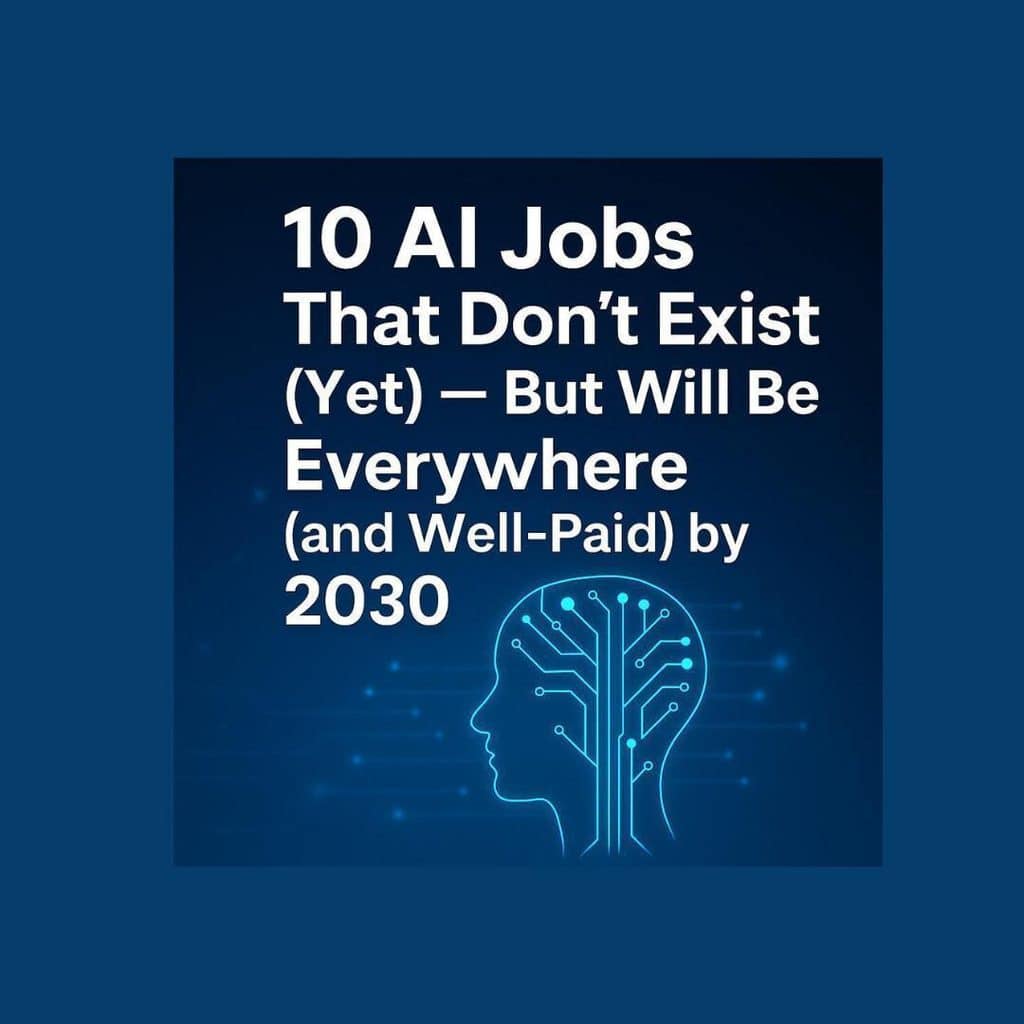
10 AI Jobs That Don’t Exist (Yet) — But Will Be Everywhere (and Well-Paid) by 2030

Illustration of a human head with a digital circuit brain for AI job trends.
Exploring 10 AI jobs that are expected to be widespread and well-paid by 2030.

Artificial Intelligence (AI) is transforming how we live and work – and it’s not just automating tasks, it’s creating entirely new careers.

In fact, experts estimate that a large share of the jobs we’ll hold even a decade from now haven’t been invented yet. According to the World Economic Forum, roles for AI and Machine Learning Specialists are projected to increase 40% by 2027​ (Source : linkedin.com ).

As AI takes over routine work, demand is surging for human talent to build, manage, and guide AI systems in almost every industry.

This is especially true in tech-forward economies like the United States and India, where companies are rapidly adopting AI solutions.

Below, we explore 10 exciting future jobs born from the AI boom – what they involve, why they’ll be needed, the industries that will seek them out, the skills you’ll need, and projected salary ranges in the US and Indian markets.

1. Human-Machine Integration Specialist

This role will focus on fusing humans with AI-powered technology. By 2030 and beyond, people may regularly use AI-driven exoskeletons, smart implants, or augmented reality (AR) gear to enhance their abilities.

A Human-Machine Integration Specialist will oversee the seamless blending of human and machine capabilities.

For example, they might manage projects that equip construction workers with robotic exosuits or help integrate brain-computer interfaces for knowledge workers.

These specialists ensure that technology augments humans safely and effectively, enhancing productivity and even physical or mental performance.

Why it will be in demand: As AI and wearable tech advance, many industries will look to boost human capabilities. Making sure this integration is smooth and ethical will be critical.

People in this job will be on the frontline of cyborg-style enhancements, ensuring devices work with our bodies and daily routines.

The AI boom means devices like smart prosthetics, AR glasses, and brain-interface sensors will become more common – and experts are needed to customize and maintain these for users.

Industries: Healthcare (for advanced prosthetics and patient aids), Manufacturing and Construction (powered exoskeletons for heavy labor), Defense and Space (augmented soldiers or astronauts), and Tech/Product Design companies developing wearable AI gadgets.

Skills Required:

  • Technical: Biomedical engineering, robotics, and AI programming; knowledge of human anatomy and ergonomics; proficiency in sensor and wearable technology.
  • Non-Technical: Strong communication (to work with doctors, engineers, and end-users), ethics and empathy (to address human concerns and safety), problem-solving and adaptability to tailor tech for individual needs.

2. Virtual Environment Designer

As virtual and augmented reality become mainstream, someone will need to build the digital worlds where we’ll learn, work, and play.

Virtual Environment Designers will create immersive, hyper-realistic simulations for uses far beyond gaming. By 2030, the “metaverse” and other virtual spaces will be used for education, corporate training, social gatherings, and even therapy.

These designers combine creativity with AI tools to construct entire digital environments. For example, a virtual environment designer might craft a 3D replica of ancient Rome for history students to explore in VR, or design a virtual office where remote teams on different continents can meet as if they’re in the same room.

Why it will be in demand: With more people and companies operating remotely and online, there’s a booming need for engaging virtual spaces.

AI can generate realistic graphics and even NPC (non-player character) behaviors in these worlds, but humans are needed to imagine the scenarios, define the rules, and ensure these virtual environments serve their purpose (be it teaching effectively or facilitating business collaboration).

The AI boom provides powerful tools to create these worlds – speeding up rendering and populating scenes – but it takes human designers to guide the vision.

Industries: Education (virtual classrooms and training simulations), Entertainment/Gaming (next-gen video games and virtual theme parks), Corporate and Remote Work Solutions (virtual meeting rooms, conferences), Healthcare (therapeutic environments for mental health or rehabilitation).

Skills Required:

  • Technical: 3D modeling and design (using engines like Unity/Unreal), programming for AR/VR, knowledge of AI graphics tools and procedural content generation (letting AI fill in realistic details).
  • Non-Technical: Creativity and storytelling (to craft compelling experiences), understanding of psychology/user experience (so environments are intuitive and engaging), collaboration (working with educators, business leaders, or doctors to tailor the space to their needs).

3. AI-Assisted Healthcare Technician

Medicine is being revolutionized by AI – from AI-powered diagnostics to robotic surgeons. An AI-Assisted Healthcare Technician will be the professional connecting the high-tech tools with frontline healthcare needs.

Think of them as specialized medical technicians who operate and manage AI-driven equipment.

They might run an AI diagnostic machine that can scan for diseases faster than any doctor, or oversee robotic surgical systems in operating rooms.

Their job is to ensure the AI tools are used correctly, interpret the results, and hand off insights to human doctors and nurses.

For instance, such a technician could manage a suite of AI monitors that track patients in real time, flagging issues like heart irregularities before they become critical.

Why it will be in demand: Healthcare systems in both the US and India are stretched – there are simply not enough doctors to go around.

AI offers a way to handle routine analyses (like scanning X-rays or monitoring vital signs), but these systems can’t run on autopilot without human oversight.

Hospitals and clinics will need technicians who ensure AI is functioning properly and safely, and who can interpret AI findings within a medical context.

With AI enabling earlier diagnoses and personalized treatment plans, this role is key to actually implementing those advances on the hospital floor.

Moreover, in India, where rural areas face doctor shortages, AI health tools (overseen by these technicians) could dramatically expand access to care.

Industries: Hospitals and Clinics, Telemedicine providers, Diagnostic labs, Medical device companies (deploying AI-driven devices), Elder care and rehabilitation centers (for patient monitoring).

Skills Required:

  • Technical: Medical technology proficiency (imaging machines, patient monitoring systems), understanding of AI diagnostics and health informatics, ability to troubleshoot software and hardware issues quickly.
  • Non-Technical: Basic medical knowledge or training (to understand conditions and communicate with doctors), attention to detail (since lives are at stake if an alert is missed), communication skills (explaining AI findings to medical staff or patients in plain language), and empathy (working with patients who may be nervous about AI involvement).

4. AI Ethicist (Algorithm Bias Auditor)

As AI systems become ubiquitous, ensuring they behave ethically and fairly will be paramount. An AI Ethicist (also known as an Algorithm Bias Auditor or AI Ethics Officer) is a professional who examines AI decisions and policies to ensure they align with human values and legal standards.

This job involves reviewing AI models for biases (e.g., making sure a loan approval AI isn’t unfairly favoring one group over another), creating guidelines for responsible AI use, and working with engineers to fix any ethical issues.

They effectively serve as the conscience and quality controller for AI deployments, catching problems that purely technical teams might overlook.

For instance, an AI Ethicist in a social media company might audit the recommendation algorithm to ensure it’s not promoting harmful misinformation, or in a hiring software firm to ensure the AI isn’t discriminating by gender or race in screening candidates.

Why it will be in demand: Public trust and legal compliance are on the line. Unchecked AI can inadvertently cause scandals or harm – such as biased hiring tools or unsafe self-driving car decisions.

Companies in the US are already hiring AI Ethics Officers as they realize ethical lapses can mean lawsuits and PR disasters​ (Source: linkedin.com).

In India, the government and IT sector are also paying attention to AI ethics as they deploy AI in sensitive areas like healthcare and finance.

With new regulations emerging worldwide around AI (for example, the EU’s AI Act), organizations will need in-house experts to navigate these rules. Ensuring AI is fair, transparent, and respects privacy isn’t just altruism – it’s critical for success, making this role highly valued.

Industries: Tech companies (Big Tech, AI startups), Finance (banks using AI for credit or trading), Healthcare (AI diagnostics must be unbiased), Government and Public Sector (using AI in policy or surveillance – needing oversight), and any large enterprise deploying AI at scale (retail, education, etc.).

Skills Required:

  • Technical: Solid understanding of how AI and machine learning models work, data analysis skills to detect bias or errors, familiarity with AI regulations and standards, and possibly some coding or data science background to prototype and test algorithm changes.
  • Non-Technical: Ethics and philosophy background (to reason about fairness and moral implications), policy or legal knowledge (for compliance with laws), strong communication (to draft guidelines and explain issues to both engineers and executives), and attention to detail paired with a big-picture mindset (seeing both the specific bias in a dataset and the broader social impact).

5. Human-Machine Teaming Manager

Even as AI and robots become capable colleagues, humans and machines won’t automatically work together perfectly – that’s where a Human-Machine Teaming Manager comes in. This futuristic manager’s job is to design and oversee workflows where humans and AI collaborate as a team.

They might define which tasks are best handled by AI and which by people, set up communication channels between employees and AI systems, and ensure that the “teaming” is efficient. Essentially, they manage a hybrid workforce: part human, part machine.

For example, at a large e-commerce warehouse, a Human-Machine Teaming Manager could coordinate human workers and AI-driven robots – assigning who does what and adjusting processes if, say, the robots are faster at some tasks but need human assistance in exceptions.

They also help train employees to work comfortably with AI tools and adjust the team dynamics as the AI evolves.

Why it will be in demand: Within the next decade, it will be common for almost every team to have some AI or automation element.

However, effective collaboration between people and AI isn’t guaranteed – cultural resistance, communication gaps, or poorly integrated systems can reduce the benefits.

Companies in the US and India alike will want specialists to maximize productivity by blending human creativity with AI efficiency. This means new management approaches. Additionally, as remote and global teams use AI translators or virtual assistants, someone needs to orchestrate these interactions.

Organizations that invest in human-machine teaming are likely to outperform those that don’t, so this managerial expertise will be highly valued.

Industries: Manufacturing and Logistics (where robots work alongside people on assembly lines or in warehouses), Corporate Offices (teams using AI software or decision-support tools), Customer Service (human agents teamed with AI chatbots), and even Military/Defense (soldiers working with AI drones or decision aids).

Skills Required:

  • Technical: Basic understanding of AI/robotics capabilities (so they know the tech’s strengths and limits), process optimization and systems engineering (to redesign workflows), and data analytics (to measure team performance and identify bottlenecks).
  • Non-Technical: Strong leadership and change management (helping human workers adapt to new AI teammates), communication skills (translating between “AI speak” and human concerns), training and coaching abilities (to upskill staff on using AI tools), and a creative mindset for problem-solving (figuring out novel ways to pair tasks between humans and machines). A background in organizational psychology or HR combined with tech know-how could be ideal.

6. AI Business Development Manager

While AI is powering new products and services, businesses still need humans to drive strategy, sales, and partnerships. An AI Business Development Manager will be the person who identifies market opportunities for AI solutions and drives their adoption.

This job involves working with product teams to shape AI offerings, pitching those to clients or partners, and forging collaborations (for instance, an AI startup partnering with a healthcare provider to deploy a new diagnostic AI).

The role is part strategist, part salesperson: they understand what AI can do and find ways to translate that into business growth.

For example, an AI Business Development Manager at a software company might strategize how to enter the Indian healthcare market with an AI tool for patient management, negotiating deals with hospitals and ensuring the product meets market needs.

Why it will be in demand: AI won’t sell itself. Organizations are investing heavily in AI development; to get returns, they need savvy business development pros who can connect these innovations with customers.

In the US, where startups and tech giants are racing to monetize AI, these managers ensure that AI products actually solve real problems and get widely adopted.

In India, with its booming tech scene and large markets in finance, healthcare, and retail, there’s huge scope to apply AI solutions – an AI BDM knows the local context and can drive adoption in diverse industries. As AI continues to boom, every tech company (and many non-tech ones) will need people to commercialize and integrate AI solutions effectively.

Industries: Technology (AI product firms, cloud providers), Consulting (advising businesses on AI integration), Healthcare, Finance, Retail, and Manufacturing (any sector where AI products are being rolled out – from AI analytics platforms to smart automation tools).

Essentially, any industry adopting AI will have demand for business development roles to implement it.

Skills Required:

  • Technical: Good understanding of AI and data analytics (so they can credibly discuss the product capabilities), market research and analytics to spot opportunities, and possibly knowledge of specific domains (e.g. knowing healthcare processes if selling an AI healthcare product).
  • Non-Technical: Sales and negotiation skills (closing deals, forming partnerships), strategic thinking (planning market entry or product positioning), networking and relationship-building, and cross-cultural communication (especially important in a global role – e.g., a US company’s AI BDM working in India needs to bridge business cultures). An MBA with focus on technology or experience in product management plus a passion for AI could be a great fit.

7. Data Detective

“Data Detective” is a catchy name for what is essentially a data investigator – someone who digs through the digital clues to solve business mysteries.

In the future, organizations will gather data from countless sources: smart devices, sensors in cities, biometric wearables, you name it.

A Data Detective’s role is to examine data from multiple, disparate sources and find meaningful insights or answers. Unlike a traditional data analyst who might focus on a defined dataset, the Data Detective roams across various data streams to connect the dots.

For example, if a city government faces an odd traffic problem, a Data Detective might combine traffic sensor data, public transit records, weather information, and social media posts to figure out what’s happening.

They don’t just crunch numbers – they sleuth around for the why and how behind the trends.

Why it will be in demand: By 2030, data will truly be everywhere – but making sense of it will be like finding a needle in a haystack. Companies will need people who can ask the right questions and follow the data trail to actionable conclusions.

AI will help by quickly processing large datasets, but it takes human curiosity to formulate hypotheses and interpret results in context.

In the US, businesses and law enforcement already talk about needing “digital detectives” to handle cybersecurity or fraud analysis. In India, with Smart Cities initiatives and the growth of IoT (Internet of Things) in agriculture and logistics, Data Detectives could help translate vast data into solutions (like improving crop yields by analyzing sensor data across many farms).

The AI boom means more tools for analysis, but also more data deluge – feeding the demand for these detectives.

Industries: Analytics and Consulting firms, Smart City and urban planning departments, Cybersecurity and Fraud Investigation units (tracing digital evidence), Healthcare (mining patient and public health data for patterns), and any large enterprise with big data lakes (retailers analyzing consumer behavior, banks investigating transaction anomalies, etc.).

Even law enforcement and intelligence could use data detectives for complex cases that involve digital evidence.

Skills Required:

  • Technical: Data science and statistics (to crunch and model data), familiarity with data mining tools and possibly AI algorithms, knowledge of databases and how to pull data from various sources (SQL, Python, etc.), and maybe domain-specific knowledge (e.g., understanding finance if investigating banking data).
  • Non-Technical: Investigation skills and curiosity (a detective mindset – persistence in chasing leads in the data), critical thinking, attention to detail, and storytelling (once they find an insight, they must explain the narrative of what happened and why). A background blending technology with something like forensic accounting or law enforcement can be useful – it’s about the mindset of relentlessly asking questions and verifying evidence.

8. AI Trainer (AI Training and Safety Specialist)

Even the smartest AI needs human guidance. AI systems, especially machine learning models, learn from data – but humans often need to train, fine-tune, and monitor them.

In the future, an AI Trainer (or AI Training and Safety Specialist) will be the person who teaches AI systems how to behave and ensures they keep improving safely​ (Source :linkedin.com).

This can involve curating and labeling training data, writing effective prompts or queries to get desired outputs (a skill known today as “prompt engineering”), and providing feedback on AI outputs to refine them over time.

For instance, AI Trainers already work on conversational AI (like virtual assistants), rating the AI’s answers and correcting mistakes so that the next version is better.

In a more advanced scenario, an AI Trainer might oversee a personal AI for someone – adjusting its responses to align with the user’s preferences and values (almost like training a digital butler).

They also play a part in making sure the AI doesn’t go off the rails – catching things like inappropriate or dangerous responses and correcting them.

Why it will be in demand: AI models don’t come out perfect right away. They require continuous tuning and responsible guidance.

As AI systems become more complex (think of autonomous vehicles or advanced chatbots used by millions), the role of human trainers and moderators will be crucial to avoid errors and abuses.

In the US, companies are already hiring “prompt engineers” and human feedback providers for AI like ChatGPT to fine-tune responses. By 2030, this could mature into a well-recognized career.

India, being a hub for IT and back-office services, may see a surge of AI Trainer roles – for example, teams in India might remotely train and supervise AI systems used globally (much like how content moderation for social platforms often involves teams in India).

Moreover, AI safety is a growing concern; having specialists to train AI on what’s acceptable or not (aligning AI with human values) will be essential.

Industries: Technology (AI labs and service providers – from big ones like Google/OpenAI to smaller AI startups), Enterprise software companies (training domain-specific AIs, like an AI that assists in legal research or customer service), Autonomous vehicle companies (training car AIs on edge cases), Gaming (training AI characters or testers for AI in games), and even Education (developing AI tutors that need careful training).

Virtually any industry deploying AI at scale will include roles for continuous training and oversight.

Skills Required:

  • Technical: Understanding of machine learning basics, data annotation techniques, and AI model behavior; ability to use AI training interfaces and tools; some programming or scripting to manage data; and knowledge of the specific AI domain (e.g., if training a medical AI, you need some medical context).
  • Non-Technical: Patience and diligence (training AI can be repetitive and requires consistency), critical thinking and ethical judgment (knowing when an AI’s output is wrong or harmful and how to correct it), communication skills (to document issues and communicate with developers), and adaptability (AI models evolve, so methods to train them will too). Essentially, part teacher, part quality inspector for AI behavior.

9. AI Lawyer (AI Law Specialist)

As AI permeates every sector, it’s also introducing novel legal questions and challenges. An “AI Lawyer” or AI Law Specialist is a legal professional who focuses on issues surrounding artificial intelligence.

This can range from handling cases of liability (for example, who’s at fault if a self-driving car has an accident?) to advising companies on AI regulations and intellectual property (like who owns an artwork created by an AI).

This is a hybrid of law and technology expertise. We’ve already seen early instances: when an autonomous Uber vehicle tragically hit a pedestrian, it raised unprecedented legal questions – was it the fault of the car’s AI, the car owner, or the manufacturer? There was no clear answer, highlighting the need for legal minds in this space.

AI Lawyers will help define accountability in such scenarios and draft new policies. They might also deal with data privacy laws, AI use in employment decisions, and even “AI rights” issues in the future (e.g., can an AI be an inventor on a patent? This has been debated in courts).

Why it will be in demand: Laws and regulations are always playing catch-up with technology. By the late 2020s, virtually every major company will either use AI or be affected by someone else’s AI. The US is already seeing increasing regulation – for instance, discussions of federal AI laws and many states looking at frameworks.

Every company will need legal guidance to ensure they comply and to navigate disputes involving AI. It’s predicted that every competitive law firm with tech clients will launch an AI practice group to handle these issues​ (Source: natlawreview.com).

In India, the IT ministry and courts are also starting to explore AI oversight, and as one of the world’s largest tech hubs (with massive amounts of user data and many AI developers), India will need lawyers well-versed in both AI tech and local/international law.

This spans everything from AI in finance (ensuring algorithms don’t break trading laws) to AI in consumer apps (making sure they follow data protection rules).

Industries: Law firms (especially those serving tech, automotive, healthcare, and finance sectors), Corporate legal departments in AI-focused companies, Government and regulatory bodies (to draft and enforce AI laws), and international organizations (for treaties or guidelines on AI use).

Even legal aid organizations might need AI law experts, as AI-related issues impact society (for example, if AI decision systems deny someone a job or loan unfairly, an AI-aware lawyer could help seek justice).

Skills Required:

  • Technical: No, a lawyer doesn’t need to code, but an AI Lawyer should understand how AI systems work at a high level (machine learning fundamentals, data usage, etc.), and stay updated on technological advances. Knowledge of cybersecurity and data privacy is also important since it overlaps.
  • Non-Technical: A law degree and expertise in relevant areas of law (technology law, intellectual property, liability, privacy law). Excellent analytical skills (to interpret new scenarios not covered by precedent), policy drafting skills (they might be writing the first versions of AI usage policies or guidelines), and communication, of course (translating legalese to engineers and vice versa). They also need a forward-thinking mindset – a bit of a futurist – to anticipate what legal dilemmas might arise from emerging AI tech.

10. Autonomous Vehicle Fleet Manager

In the coming years, we’ll have fleets of self-driving cars, trucks, drones, and delivery robots crisscrossing our roads and skies. An Autonomous Vehicle Fleet Manager is the professional who oversees the operations of these fleets of autonomous machines​ (Source: linkedin.com).

Think of it as a tech-enabled evolution of today’s fleet managers or dispatchers. Instead of human drivers reporting in, it’s AI-driven vehicles.

This manager ensures the vehicles are running safely and efficiently, coordinates their routes or missions, schedules maintenance (even autonomous vehicles need tune-ups and software updates!), and steps in when human decision-making is required.

For example, if a self-driving delivery van encounters an unusual situation, the fleet manager might receive an alert and remotely assist or dispatch a human crew.

They also handle the logistics of scaling the fleet – adding new vehicles, monitoring performance metrics, and complying with transportation regulations.

Why it will be in demand: Companies like logistics providers, ride-hailing services, and e-commerce giants (imagine Amazon or Flipkart’s future delivery drones and robots) are investing heavily in autonomous vehicles. But no fleet can run entirely on autopilot.

Human oversight is essential for safety, accountability, and optimization. In the US, we might soon see autonomous trucks on highways and drone deliveries in cities – each deployment will need managers to orchestrate the complex dance of vehicles, handle emergencies (like a drone losing connection), and interact with authorities or customers.

In India, where traffic conditions are very dynamic, having autonomous delivery robots or shuttles will require careful management to integrate with traditional vehicles and pedestrians. Moreover, regulations will likely mandate a human responsible for autonomous operations.

This means lots of new jobs for those who can blend transportation know-how with AI savvy. It’s not just tech, but also understanding routes, weather impacts, local laws – a truly cross-disciplinary challenge.

Industries: Transportation and Logistics (delivery companies, trucking companies), E-commerce and Retail (autonomous delivery bots and drones for last-mile delivery), Ride-sharing and Taxi services (companies running self-driving taxis), Warehousing and Manufacturing (managing fleets of autonomous forklifts or warehouse robots), and even Public Transportation (cities deploying autonomous buses or shuttles).

Additionally, Defense and Security might use autonomous patrol drones or vehicles that need managing.

Skills Required:

  • Technical: Knowledge of autonomous vehicle systems and software, proficiency with fleet management platforms (which often involve AI for scheduling routes), data analysis to monitor vehicle performance, and understanding of maintenance for robotics (knowing when sensors or components might fail). Some background in automotive engineering or robotics is very useful.
  • Non-Technical: Logistics and operations management skills (scheduling, resource allocation), problem-solving and quick decision-making (to respond to real-time incidents), knowledge of transportation regulations and compliance (both traffic laws and airspace rules for drones, for example), and communication skills for coordinating with any human support teams or reporting incidents. Essentially, this person needs to be part traffic controller, part tech support, and part operations manager.

The AI boom is not just about technology – it’s about people. Each of these future jobs highlights how human skills will remain essential, even as we delegate more tasks to algorithms and robots.

From ensuring ethical AI behavior and translating data into stories, to building bridges between technology and society, these roles will be in high demand in the coming decade.

The United States and India, as global leaders in technology and innovation, are poised to be at the forefront of this job evolution.

For software engineers, students, and professionals reading this, it’s a glimpse of how you might shape your career in the age of AI.

Gaining a mix of technical know-how and soft skills like communication, creativity, and ethical reasoning will prepare you for these emerging opportunities.

The future job market will reward those who can adapt and carve a path where humans and AI together achieve what neither could alone.

It’s an exciting time to imagine, learn, and get ready for the jobs of tomorrow – because they’re coming faster than we think, and they’ll be crucial for guiding AI to make our world better.

“You Indians Need to Go Back”: Indian Family Targeted — Mother Slapped, Daughter Attacked in California McDonald’s Hate Crime

McDonald's fast food restaurant exterior with logo and signage.
McDonald’s restaurant exterior with signage and parking lot in front.

FREMONT, CALIFORNIA – A horrifying incident at a Fremont McDonald’s has shaken the Indian and Desi diaspora in America. A peaceful family lunch turned into a moment of terror when a stranger slapped an Indian mother in front of her children, hurled racist abuse, and threw sauce at her young daughter telling them: “You Indians need to go back to your country.”

The attacker, Marcus Harper, 22, of Union City, is now facing hate crime and battery charges after this unprovoked and public act of violence against a family of Indian origin.

It was supposed to be just another casual meal for a hardworking Indian family at a Fremont McDonald’s. Instead, it turned into a nightmare that has shaken the Indian and Desi community across the United States.

Around 2:15 p.m. on April 5, 2025, a Union City man which has now been identified as Marcus Harper, 22 walked straight up to the family’s table, where a mother, father, and two young children were quietly eating.

Without a word, Harper grabbed a handful of their French fries, shoved them into his mouth, and locked eyes with the stunned family. He sauntered away briefly. Moments later, he returned with a terrifying escalation: he slapped the 36-year-old Indian mother across her face from behind.

As if the assault wasn’t enough, he then shouted racial slurs loud enough for the whole restaurant to hear:

“You Indians need to go back to your country.”

Before storming out, Harper hurled a packet of sauce at their 9-year-old daughter, staining her sweater and leaving her terrified.

Shocked diners watched in horror. By the time police arrived, Harper was long gone.


The Hunt for the Attacker

But Harper hadn’t been careful enough.
Outside, officers found a 2003 Honda Accord parked suspiciously close to the McDonald’s. A quick check revealed it was registered to Marcus Harper. Inside the restaurant, surveillance cameras captured everything including the theft of food, the slap, the shouting, the sauce-throwing.

Police wasted no time. Detectives from the Fremont Crimes Against Persons Unit reviewed the footage, matched Harper’s 2024 mugshot to the suspect, and issued a warrant for his arrest.

After a tense 10-day search, officers finally found Harper alone inside his car near Marshlands Road and Thornton Avenue.
He was arrested without incident perhaps realizing the net had closed in.

Costco Gold Bars, Digital Dhanteras, and How Desis Scored 80% Gains

Gold bar with PAMP Suisse packaging and trading chart background.
Gold bar from PAMP Suisse with trading chart background, highlighting precious metal investments.

In America, fortunes are often built in the most unlikely places: a garage in Silicon Valley, a food truck on a Miami street in 2023, the fluorescent aisles of Costco.

For Desis, gold is never just an investment. It’s memory, security, and celebration. So when word spread that Costco was quietly selling pure 24-karat gold bars online which are Swiss-minted, one ounce each, priced tantalizingly closer to the global rate and it wasn’t just a shopping tip. It was a call to action.

Those who answered that call turned a $2,000 bet into a $3,500 windfall in just 18 months.

The Great Gold Bar Chase

You’re sipping your morning chai, phone in hand, refreshing Costco’s website.
Suddenly, the gold bars are in stock.
Your heart skips.
You click. Add to cart, checkout, fingers trembling.
Blink, and they’re gone. Sold out in minutes.

This isn’t an exaggeration. Since Costco started selling Swiss-made gold bars in 2023, they’ve been vanishing almost instantly, with sales topping $200 million a month.

It’s a digital Dhanteras, a modern-day treasure hunt and only the fastest (and luckiest) score.

The Struggle Is Real: Why It’s So Hard to Buy

If you’ve tried to buy, you know the struggle.

Gold bars are limited to two per member, and they are non-refundable. No returns. No price adjustments.
Once they’re listed, they’re snapped up in minutes.

Families strategize like it’s an Olympic sport: alarms set at odd hours, cousins coordinating across states, browsers refreshing at lightning speed.
For others, it’s pure luck.

And even after scoring, selling isn’t instant. Physical gold can be harder to liquidate than stocks that you’ll need a trusted local dealer or a willing buyer.

Still, for those who get their hands on a bar, the reward speaks for itself.

Costco’s Special Nod to Desi Buyers

Recognizing the growing Desi demand, Costco introduced a special edition: the PAMP Suisse Diwali Lakshmi 1 oz gold bar.
Featuring Goddess Lakshmi which is the symbol of wealth and fortune and the bar was launched to align with Diwali celebrations, offering Indian Hindu customers a culturally resonant, modern way to honor tradition.

It wasn’t just smart business. It was a full-circle moment of tradition meeting technology.

Why More NRIs Are Dying on Hiking Trails

Hikers trekking through mountain landscape with snow-capped peaks.
Hikers exploring the scenic mountain trail in the Himalayas, emphasizing adventure and nature.

On May 11, 2025, Vishnu Irigireddy, a 48-year-old tech executive, fell 400 feet to his death while descending the North Early Winters Spire in Washington’s North Cascades. His anchor failed during descent as a storm approached.

Irigireddy’s death highlights a growing concern: hiking fatalities among Indians and NRIs are rising, even as the activity becomes more popular than ever.

This tragedy raises important questions about why hiking incidents are increasing, particularly among NRIs, and whether the growing popularity of adventure tourism is outpacing safety awareness.

The Deadly Romance with Dirt and Danger

We’ve turned hiking into the ultimate lifestyle brand. It’s not just exercise anymore—it’s rebellion against cubicle culture, a rejection of the digital prison that modern work has created. 

Every weekend warrior with a $300 hiking boot collection and a Patagonia jacket has become an amateur philosopher, preaching the gospel of “getting back to nature.”

And honestly? It makes perfect sense. After spending days debugging code or sitting through soul-crushing Zoom meetings, the idea of earning those summit moments through sweat and suffering feels intoxicating. 

The mountains don’t care about your quarterly targets or your Slack notifications. They’re the ultimate meritocracy—you either make it to the top, or you don’t.

But here’s the problem: social media has Instagram-ized the wilderness. Those perfectly curated posts—the golden hour shots, the triumphant summit selfies, the “challenging myself” captions—they’re selling a dangerous fantasy. 

They show you the postcard, not the avalanche that buried three hikers the day before, or the helicopter that couldn’t reach the stranded climber because of weather.

For Indians and NRIs especially, hiking has become the new status symbol. It’s replaced the luxury car photos and five-star vacation posts. 

Now it’s all about that authentic, rugged, “I-survived-altitude-sickness” credibility. People are chasing experiences that make them feel alive, but they’re doing it with the same competitive spirit that drives corporate ladder climbing.

The Numbers Don’t Lie (And They’re Terrifying)

Let’s rip off the Band-Aid: between 2013 and 2023, 312 Indian and Indian-origin hikers died on trails around the world.

That’s not just a statistic—that’s 312 families destroyed, 312 dreams cut short, 312 people who thought they were just going for a really long walk.

The International Mountain Safety Council found that Indians represent 4.3% of all non-local hiking deaths globally. Think about that. These are people who flew thousands of miles to die on someone else’s mountain.

Here’s what killed them:

Vishnu Irigireddy (2025): North Cascades, Washington. Equipment failure during storm descent. Fell 400 feet.

Aakash Mehta (2024): Kedarnath, India. Heart attack at altitude. His body couldn’t handle the thin air his mind was determined to conquer.

Rhea Kapoor (2023): Inca Trail, Peru. Severe altitude sickness. She probably felt invincible until her brain started swelling.

Rohit Subramanian (2022): Banff, Canada. Avalanche during solo hike. One wrong step on an unstable slope.

Neha Dandekar and her group (2021): Himachal Pradesh. Landslide. Nature’s reminder that it doesn’t negotiate.

The worst part? These are just the headline cases. How many others died quietly, their stories buried in local news, their families left to grieve without the world ever knowing their names?

Recently, a social media post highlighted the personal toll of these tragedies: “SOS: Urgent – my niece passed away (high altitude related death) while visiting Titicaca in Peru with her husband and 9-year-old son. Her husband is distraught and needs help/support bringing her body back to India…”

This message reveals the harsh reality behind adventure tourism. Families are left dealing with language barriers, legal complications, and astronomical repatriation costs in foreign countries when these tragedies occur.

The Data Behind the Danger: Hiking Deaths Are Rising Globally

Hiking and mountaineering fatalities have increased worldwide as participation has surged.

United States Data

According to the U.S. National Park Service:

• Over 300 search and rescue deaths occur annually in U.S. parks
• Thousands more rescues happen each year
• The majority involve hikers aged 30–55
• Common causes:

  • Falls
  • Altitude sickness
  • Weather exposure
  • Medical emergencies

Washington State alone reports dozens of serious hiking accidents every year.

Why We’re All Rushing to Die in Peru

Peru has become a top destination for NRI adventure seekers, and it’s not hard to see why. 

The country offers everything our community craves: ancient history that rivals our own civilizations, Instagram-worthy vistas that make your friends jealous, and spiritual energy that promises to heal whatever corporate America broke inside you.

Plus, it’s relatively cheap. You can feel like an adventurer without breaking your tech salary budget. 

The Inca Trail costs less than a weekend in Napa Valley, and the photos are infinitely more impressive.

But Peru is also where dreams go to die—literally. The altitude hits you like a truck. One day you’re fine, the next you’re vomiting blood because your lungs are drowning in fluid. 

The weather changes faster than your iPhone can update its forecast. And if something goes wrong, you’re really, truly alone.

The Mountain Doesn’t Care About Your LinkedIn Profile

The real dangers of hiking extend far beyond dramatic falls. Altitude sickness is a silent killer that creeps up on even experienced hikers. Above 8,000 feet, your body starts struggling to get enough oxygen. What begins as a mild headache can escalate into cerebral edema—your brain literally swelling inside your skull.

Then there’s the weather. Mountain conditions change in minutes, not hours. A sunny morning can turn into a whiteout blizzard by afternoon. Hypothermia doesn’t need freezing temperatures—it can set in at 50 degrees Fahrenheit if you’re wet and tired. Your body temperature drops, your thinking becomes clouded, and you start making the kind of poor decisions that turn a difficult situation into a fatal one.

Dehydration and exhaustion compound everything. At altitude, you lose water through breathing at twice the normal rate. Your judgment suffers, your coordination fails, and suddenly that easy scramble over rocks becomes a deadly obstacle course.

Even something as simple as getting lost can be life-threatening when you’re miles from cell service, carrying limited supplies, and facing an unexpected night in the wilderness. GPS devices fail, trails get obscured by weather, and what seemed like a straightforward day hike becomes a survival situation.

So Should You Hang Up Your Hiking Boots?

Hell no.

But maybe—just maybe—there’s a need to stop treating the wilderness like it’s another consumer experience to be conquered and Instagrammed. Maybe it’s time to remember that hiking used to be about actually experiencing nature, not just documenting it.

If you’re going to risk your life on a mountain, at least do it for the right reasons. Do it because you love the burn in your lungs and the ache in your legs. Do it because silence at sunrise actually heals something broken inside you. Do it because pushing your limits teaches you something about who you really are.

Don’t do it because you need content for your feed or because everyone else in your friend group has summit photos. Don’t do it because you think suffering makes you special or because you’re trying to prove something to people who wouldn’t even notice if you disappeared for a month.

The Real Adventure Starts with Respect

The mountains will always be there. They’ve been there for millions of years, and they’ll be there long after we’re gone. They don’t need us to validate them with our presence or our posts.

But if you’re going to visit them, do it right. Train properly. Learn to read weather patterns. Understand altitude sickness before it understands you. Hire guides who know the terrain better than you know your commute. Tell people where you’re going and when you’ll be back.

Most importantly, remember that the goal isn’t to conquer anything—it’s to come home with stories, not become one.

The mountains are calling, sure. But they’re not always calling you to the summit. Sometimes they’re calling you to turn around, to try another day, to choose survival over glory.

Listen carefully. Your life might depend on hearing the difference.

Why Was Revanth Reddy’s US Trip Denied Clearance? Routine Procedure or Political Vendetta?

Revanth Reddy smiling with US flag background and Statue of Liberty.

Telangana chief minister, Revanth Reddy, was scheduled to go on a 10-day visit (beginning 20 August) to the UK and the US as part of the rising Telangana delegation. The primary purpose of this two-country visit was to strengthen Telangana’s education and skill development sectors.

An unusual twist to this story came when the Telangana government sent a request for approval of the same visit to the centre on August 16, only to find that the request for the US visit was denied clearance by the Ministry of External Affairs.

Although the visit to the UK was approved, the MEA explained that it did not clear the much-crucial US visit because the proposed US program was not appropriate to the office he holds and the purpose of the visit.

Reddy learned of the cancellation of the US visit after he had already reached London and was planning to travel to Boston from there. However, instead of completely scrapping the visit, he instructed the rest of the delegation members to visit us, and fulfil the proposed task.

Reason behind reddy’s US visit

CM Revanth Reddy was scheduled to start his 10-day visit to the UK and US from August 20, as part of the Rising Telangana delegation. The main aim of this delegation was to solidify education and skill development sectors of Telangana by meeting top educational institutions and exploring partnerships that could bring international universities and educational opportunities to the state.

His delegation was expected to propose key MOU’s ( memorandums of understanding) to famous and respected institutions like:- Harvard University, Massachusetts Institute of Technology (MIT), Northeastern University, Virginia Tech.

The vision at large was to to turn Hyderabad into a global knowledge and education hub by bringing prestigious educational institutions and their elite courses to Telangana, rather than having always Indian students bear the effort and expense to travel abroad to study.

How does clearance for such official visits work?

Before a Chief Minister or any other government official can undertake an official foreign visit, they need what is known as “political clearance” from the Ministry of External Affairs (MEA). This is a routine requirement for government officials travelling abroad in an official capacity, and the MEA receives hundreds of such requests every month.

The process is fairly simple. When a state government plans an official foreign visit, it submits the details of the proposed trip to the Centre. This includes the purpose of the visit, the countries and institutions being visited, and the meetings planned during the trip. The MEA then examines whether the proposed programme is appropriate for the position held by the official and whether the nature and level of the meetings fit the stated purpose of the visit.

If the visit is official, which means that the individual is visiting as the representative of the country, the matter of political clearance is not simply about whether an official wants to travel abroad. The Centre also evaluates who the official is expected to meet and why those meetings are taking place

Reactions from the opposition 

Chief Minister Revanth Reddy and the Congress have been heavily critical of this decision, with Reddy also going on to say that nation-building and the future of Telangana’s youth should be kept above politics and elections.

The Congress party and Reddy also called out the alleged “double standards” of the central government by citing that Gujarat Chief Minister Bhupendra Patel had been allowed to travel to the US and Canada for investment-related roadshows. 

Ultimately, the question remains: was Revanth Reddy’s canceled US visit merely a routine government procedure, or was it a political vendetta disguised as one?

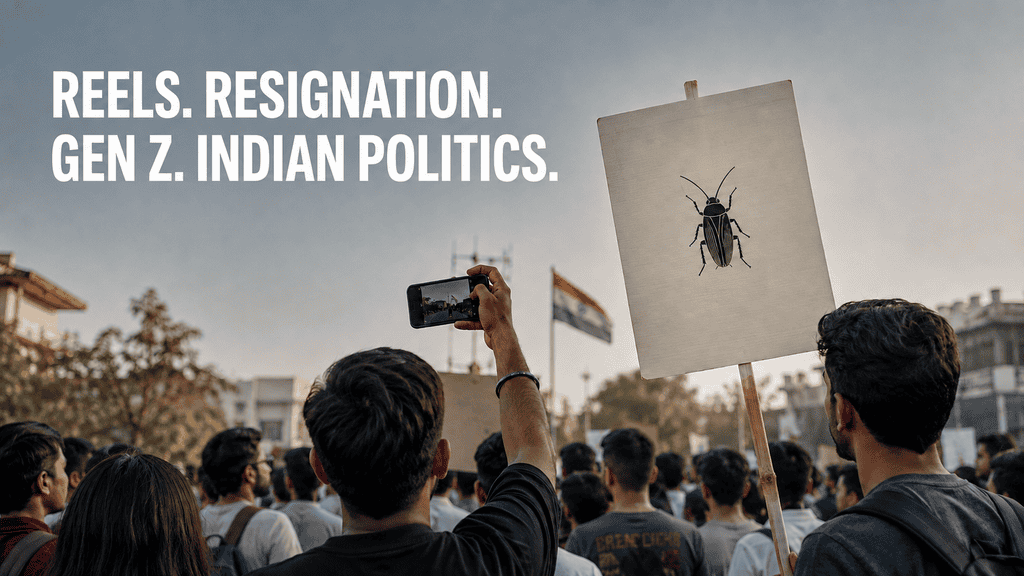
From Reels to Resignation: How Gen Z Is Rewriting Indian Politics

Crowd protesting with a sign showing a bug, capturing the event on a smartphone.
Protesters gather in India, holding signs and capturing the moment during a political demonstration.

Dismissed as distracted and unserious, India’s youngest political generation turned memes, masks and short videos into a national movement powerful enough to force a rare cabinet exit.

Dismissed as distracted and unserious, India’s youngest political generation turned memes, masks and short videos into a national movement powerful enough to force a rare cabinet exit.

Gen Z has heard all the accusations before: too distracted, too comfortable, too addicted to phones and too unserious to care about politics.

Then India’s young people locked in.

In July 2026, weeks of youth-led demonstrations over examination paper leaks, education reform and shrinking job prospects culminated in the resignation of Union Education Minister Dharmendra Pradhan. What began online through satire and memes had grown into a nationwide movement that placed the Narendra Modi government under unusual public pressure.

The movement did not abandon seriousness; it repackaged it. Cockroach masks, superhero costumes, Instagram Reels and sarcastic placards captured public attention, while marches, a prolonged hunger strike and negotiations created political pressure.

The result challenged one of the most persistent stereotypes about Gen Z: that a generation fluent in memes cannot also be politically committed.

From an Online Joke to a National Movement

Gen Z is generally understood to include people born after 1996, although definitions vary. Only its older members can currently vote, but the generation’s political influence extends far beyond the ballot box. It can shape narratives, create pressure and move an issue from a social-media feed to the national agenda.

The Cockroach Janta Party, or CJP, demonstrated that power.

The satirical movement was founded by political communications strategist Abhijeet Dipke after controversial remarks comparing unemployed young people to “cockroaches” and “parasites” sparked widespread anger. Rather than reject the insult, supporters reclaimed the cockroach as a symbol of survival: difficult to silence, difficult to eliminate and impossible to ignore.

The humor attracted attention, but the grievances behind it were real. Students were angry about repeated examination irregularities, particularly the leak of a national medical entrance examination paper. The resulting retest affected approximately two million students. The protests also became an outlet for wider anxiety about unemployment, educational opportunities and government accountability.

Activist and education reformer Sonam Wangchuk emerged as one of the movement’s most visible supporters, completing a 26-day hunger strike. Protesters marched, faced police barricades, endured tear gas and demanded Pradhan’s resignation.

On July 25, Pradhan stepped down. The government also agreed to demands that included examination-system reforms, withdrawing police cases against protesters and compensating families of students who had died by suicide following the examination controversy.

Reuters described the confrontation as Modi’s biggest youth challenge since he became prime minister in 2014 and reported that Pradhan was only the second minister to resign following a scandal during Modi’s tenure.

That made the episode more than a viral moment. It became evidence that digital frustration, when connected to a concrete grievance and organized offline action, can produce a political result.

Gen Z Is Harder to Treat as a Permanent Vote Bank

Previous generations are often described as “legacy voters”—people whose political loyalties are strongly influenced by family, caste, community or regional identity and remain relatively stable over time.

Gen Z has not eliminated those influences, and no generation should be treated as politically uniform. However, younger voters appear increasingly willing to make their support conditional. A political party may win their approval on one issue and face their anger on the next.

Many young voters who have supported the BJP, for example, can still criticize the government over examination leaks, unemployment or policies affecting their everyday lives. Supporting a leader does not necessarily mean adopting that leader as a permanent personal identity.

This makes Gen Z difficult to manage through personality-driven politics alone. Young people can instantly retrieve old speeches, promises and interviews. A statement made years ago can return as a split-screen Reel within hours, placed beside a politician’s latest claim.

The internet has given ordinary voters a searchable political memory.

Gen Z does not merely listen to leaders. It fact-checks them, remixes them, parodies them and sometimes trolls them.

That does not automatically make every criticism informed or fair. But it does make political communication more exposed. A carefully manufactured image can now be challenged by thousands of creators working from their phones.

The Algorithm Is the New Political Editor

For Gen Z, political information does not wait to be searched for. It arrives.

It appears between a comedy Reel, a fashion video and a friend’s holiday pictures. A 90-minute political speech may receive limited attention, while one 30-second segment from that speech can reach millions of people before the day ends.

This does not mean framing has become less important. In fact, it has become more important. The person who selects the clip, adds the caption and chooses the music can influence how an entire speech is understood.

Instagram Reels, YouTube Shorts, memes and independent digital creators have therefore become central players in political communication. They influence which moments become visible, which contradictions become embarrassing and which grievances become shareable.

The Cockroach Janta Party understood this instinctively. It did not begin with a traditional party office, television campaign or established political machinery. It began with an absurd symbol and a message that fit naturally into internet culture.

The symbol brought people in; the seriousness of the issue kept them involved.

Political information found Gen Z through its feeds. Gen Z then carried that information into the streets.

From Rallies to Reels

Political leaders have recognized the shift.

Following the youth protests, Prime Minister Narendra Modi increasingly appeared in selfie-style videos and informal, vertically filmed social-media content. His outreach included youth-oriented language, pop-culture references and encouragement for creators to use formats such as “Get Ready With Me,” commonly known as GRWM.

The broader BJP communication system also began experimenting with shorter, less polished videos designed for Instagram and other youth-focused platforms. According to Reuters, Modi urged ministers to become more active on platforms popular with young people and to make their videos appear less scripted.

Leader of Opposition Rahul Gandhi adopted a more interactive approach, inviting students and Gen Z users to participate in an Instagram “Ask Me Anything” session. Serious questions about education and politics appeared alongside lighter exchanges designed to make the politician seem accessible and human.

These efforts reveal the new competition taking place in Indian politics. Politicians are no longer competing only for votes. They are competing for attention, authenticity and relatability.

But views, likes and playful comments do not automatically translate into trust. Gen Z is deeply familiar with influencer culture and can quickly recognize communication that feels overly manufactured. A leader may speak the language of the internet and still become the subject of the internet’s jokes.

The politicians have entered Gen Z’s digital territory. That does not mean Gen Z will accept them there.

Tackling Serious Issues With “Unserious” Humor

Traditional protests are associated with speeches, slogans, marches and hunger strikes. The CJP demonstrations included all of those—but added a distinctly Gen Z layer.

Some protesters appeared dressed as Spider-Man, Batman, Iron Man and other pop-culture characters. Others wore cockroach masks, recorded GRWM-style videos before attending demonstrations or used trending sounds to document what was happening around them. Placards turned examination leaks, unemployment and political frustration into punchlines designed to travel online.

Even confrontations with police were narrated through irony and dark humor.

From the outside, this behavior can appear chaotic or even inappropriate. But humor was not evidence that protesters lacked seriousness. It was a communication strategy, a coping mechanism and a form of political resistance.

Memes lowered the barrier to participation. A young person who might never watch a television debate could understand a joke about a paper leak within seconds. A superhero costume could attract a camera, but the protester’s explanation could then carry the political message to millions.

Gen Z did not make protest less serious. It made seriousness shareable.

Behind the costumes was genuine anger. Behind the Reels were students worried about their futures. Behind the cockroach symbol were young people who believed institutions had stopped listening to them.

The Danger of Politics by Algorithm

The same tools that give young people political power can also create serious problems.

Short videos remove context. Algorithms reward outrage. False claims can spread faster than corrections, and a clever edit can make a misleading argument feel convincing. Online movements may also become trapped inside ideological bubbles in which popularity is mistaken for accuracy.

There is another challenge: sustaining attention. A movement can dominate social media for a week and disappear when the algorithm discovers a new controversy. Turning online enthusiasm into lasting reform requires organization, leadership, negotiations and measurable goals.

The CJP movement succeeded because it connected viral creativity with a specific demand and sustained offline pressure. Its longer-term test will be whether it can continue influencing public policy after the trending hashtags fade.

Why Indian Americans Should Pay Attention

This transformation matters beyond India.

For many young Indian Americans, Indian politics is experienced less through newspapers or evening television and more through Instagram, YouTube and videos forwarded by relatives on WhatsApp. A political moment in Delhi can enter a Dallas, New Jersey or Bay Area family conversation within minutes.

That creates a new kind of transnational political participation. Members of the diaspora may not vote in India, but they can amplify stories, influence family conversations, support causes and shape how events in India are understood abroad.

It also makes reliable reporting more important. When politics travels internationally through short clips, the distinction between verified information, satire and propaganda can quickly disappear.

Gen Z Has Locked In—But What Comes Next?

India’s Gen Z has not rejected politics. It has rejected the assumption that politics must always look and sound traditional.

This generation may organize through Instagram, speak through memes and arrive at a protest dressed as Spider-Man. None of that prevents it from understanding injustice, demanding accountability or sustaining a movement.

The Cockroach Janta Party protests showed that digital culture can become democratic power when humor is connected to a real grievance and online attention is converted into collective action.

Gen Z has not replaced rallies with Reels. It has made Reels the road to the rally.

And after a movement born from memes helped force a Union minister’s resignation, no political party can afford to dismiss the next viral joke as “just the internet.”

The Dirty World of AI Data Centers: Powering the Future or Consuming It?

Futuristic AI data center with cooling towers emitting smoke at sunset.
A person walking through a high-tech AI data center with cooling towers in the background at sunset.

A Gen Z girl stands at her bathroom sink, splashing water on her face.

She looks up at the camera, mock horror in her eyes: “Oh my god. I just used water that was supposed to go to AI. Jeff Bezos is going to be so mad at me.”

The reel got millions of views. So did a hundred versions of it — people apologizing to their showers, their swimming pools, their water bottles.

Here’s the twist: the Bezos quote everyone was mocking — that water should be prioritized for AI over human needs — was never real. Fact-checkers traced it to a satire post after his appearance at VivaTech in Paris. He never said it.

But notice what happened. Millions of people saw a billionaire supposedly telling them to drink less water so machines could think more — and believed it instantly. No hesitation. No fact-check needed.

That instant believability is the real story.

Because while the quote was fake, the anxiety behind it is very real. AI data centers do drink billions of gallons of water. They do consume electricity on the scale of entire cities. And communities across America are genuinely asking whether their resources now come second to server farms.

So let’s talk about what’s actually happening — because the truth is stranger than the meme.


“A facility that uses a city’s worth of electricity and millions of gallons of water might employ thirty to a hundred people. That’s it. No jobs boom. No middle-class revival. Just a handful of high-skill technicians and security guards.”

“Water and power constraints — not chip shortages — are now the primary bottlenecks for expansion.”

“Data centers are becoming an important issue in local, state, and potentially federal elections because it is an important subject for voters.”


Have you ever imagined that every time you ask an AI chatbot a question, generate an image, or use a smart assistant, somewhere a building the size of several football fields springs into action?

Imagine a modern-day gold mine.

Except instead of miners digging for precious metal, thousands of processors are digging through data. Instead of pickaxes, there are GPUs. Instead of dynamite, there is electricity.

And instead of gold, the commodity is intelligence itself.

Hidden behind the excitement of artificial intelligence is a rapidly expanding network of AI data centers — vast industrial facilities quietly reshaping economies, politics, energy systems, and even local elections.

While AI is often discussed as software, its real foundation is brutally physical: land, power, water, and money.

And the scale is staggering. The International Energy Agency’s satellite tracking shows that “AI factories” — cutting-edge data centers built specifically for AI — have more than tripled in capacity in just 18 months. Electricity consumption by AI-focused data centers surged 50% in 2025 alone.

The question is no longer whether AI will transform society.

The question is: who will bear the cost of building the infrastructure that makes it possible?


What Exactly Are AI Data Centers?

At their simplest, data centers are buildings filled with servers that store, process, and transmit information.

AI data centers are a different breed altogether.

Unlike traditional facilities that handle websites, emails, and cloud storage, AI data centers are designed to train and operate large artificial intelligence models. They contain thousands of specialized chips working simultaneously, processing oceans of information around the clock.

Here’s one number that captures the leap:

A conventional server rack consumes 5 to 15 kilowatts of electricity. A modern AI rack? 30 to over 100 kilowatts.

That’s not an upgrade. That’s a different species — up to twenty times hungrier, rack for rack.

The result is a new class of infrastructure that demands:

  • Massive electricity supplies — often with dedicated substations
  • Advanced cooling systems — increasingly liquid-cooled, chip by chip
  • High-speed fiber networks
  • Large land parcels — hundreds of acres at a time

These facilities have become the factories of the AI age.


America’s New Gold Rush

If the nineteenth century was defined by railroads and the twentieth century by oil, the twenty-first may be defined by compute power.

Technology giants — Microsoft, Google, Amazon, and Meta — have collectively committed hundreds of billions of dollars toward AI infrastructure, with combined annual capital spending now rivaling the GDP of mid-sized nations.

The United States government and many state governments see these projects as strategic assets.

Why?

Because AI leadership increasingly depends on compute capacity. The US already accounts for roughly 45% of global data center electricity consumption — the largest market on Earth. Countries that control advanced AI infrastructure gain advantages in:

  • Economic competitiveness
  • Military applications
  • Scientific research
  • Cybersecurity
  • Technological innovation

To win these projects, states across America are rolling out the red carpet:

  • Property tax exemptions
  • Sales tax incentives
  • Fast-track approvals
  • Infrastructure support packages
  • Favorable zoning policies

The result? What many analysts call a new real estate rush.

Large tracts of land with access to power and fiber are suddenly worth multiples of what they fetched a few years ago. Rural counties that once competed for factories now compete for AI campuses.

But beneath the promises of investment and innovation lies a more complicated story.


What Lies Beneath the AI Boom?

Supporters portray data centers as engines of economic development.

Critics see something very different.

Across Virginia, Texas, Georgia, Michigan, Arizona and beyond, residents are increasingly organizing against proposed projects. And Virginia shows why the stakes feel so personal: data centers already consume an estimated 26% of the state’s electricity — more than one in every four kilowatt-hours.

The concerns are not ideological. They are practical:

  • Rising electricity demand — and rising residential bills
  • Pressure on local water supplies
  • Industrial noise, humming 24/7
  • Land consumption
  • Limited long-term employment
  • Increased strain on infrastructure

The community argument is simple: the benefits flow to large technology companies and investors. The costs stay local.

This is why data centers have begun appearing in election campaigns and local political debates — and why the coalitions opposing them look so unusual.

Environmental activists, farmers, suburban homeowners, and fiscal conservatives are finding themselves on the same side, for different reasons.

Some oppose the environmental footprint. Some oppose public subsidies. Some simply ask: does a facility employing a small workforce justify hundreds of millions in tax incentives?

For many Americans, AI is no longer an abstract technology debate.

It’s a line item on the utility bill. A water table. A changed skyline.


The Hidden Costs of the AI Race

The AI revolution is often told as a story of algorithms.

Increasingly, it is a story of resources.

⚡ Electricity

Perhaps the greatest challenge facing AI expansion is power.

A single large AI campus can consume hundreds of megawatts — comparable to a small city.

Zoom out and the numbers get dizzying. The IEA projects global data center electricity consumption will roughly double from about 485 TWh in 2025 to 950 TWh by 2030 — nearly 3% of all electricity on the planet. In the US, data centers consumed about 4.4% of national electricity in 2023; federal researchers project that share could hit as much as 12% by 2028.

One January 2026 industry forecast put it vividly: US data center demand is set to jump from 80 to 150 gigawatts between 2025 and 2028 — like adding an entire Spain to the grid in three years.

Utilities now face an impossible-sounding question: How do you power AI growth while pursuing clean energy goals?

The answer remains uncertain — and the scramble is real.

Some companies are betting on nuclear: hyperscalers locked up over 10 gigawatts of new or restarting nuclear capacity in just 18 months, and the pipeline of small modular reactor agreements nearly doubled to 45 GW by early 2026.

Others are building natural gas generation. Renewables continue to grow — but the sheer scale of demand has sparked concerns that fossil fuel dependence could persist far longer than climate plans assumed.

💧 Water

Cooling advanced AI systems requires serious resources.

In many regions, data centers depend on water-intensive cooling. US data centers drew an estimated 17 billion gallons of water directly in 2023 — with over 200 billion more consumed indirectly through the power plants feeding them.

In drought-prone areas like Arizona, that math has become a flashpoint between communities and developers. Newer liquid-cooling technology can cut direct water use dramatically — but it doesn’t touch the electricity, which remains the dominant cost.

🏗️ Land and Infrastructure

Data centers occupy enormous footprints.

Unlike manufacturing plants or corporate headquarters, they may generate relatively few permanent jobs after construction ends — often just that thirty-to-a-hundred headcount.

This raises hard questions about land-use priorities and what a community actually gets for what it gives up.

🔒 Privacy and Centralization

Beyond environmental concerns, some critics worry about concentration of power.

The same infrastructure that enables AI innovation can also support increasingly sophisticated data collection, analytics, and digital services.

Whether these developments ultimately enhance convenience, efficiency, and security — or create new concerns about surveillance and control — remains an ongoing public debate.


Why Indian-Americans and Investors Are Paying Attention

The AI infrastructure boom is deeply connected to the Indian and Indian-American technology ecosystem.

Indian-origin executives lead major technology firms across cloud computing, semiconductors, and AI development. Indian-American engineers, researchers, and entrepreneurs are designing the software and hardware these facilities run on.

At the same time, infrastructure funds, pension funds, and institutional investors increasingly view data centers as premium long-term assets.

Investors describe them as the “digital equivalent of toll roads” — critical infrastructure that businesses depend on regardless of economic cycles.

India itself is pursuing the same path.

The country’s AI ambitions, exploding digital economy, and expanding cloud market are driving heavy investment in domestic data center capacity.

Yet India faces the very questions confronting America:

  • Can electricity generation keep pace?
  • How will water resources be managed?
  • Where should large facilities be located?
  • Who benefits most from the economic gains?

The Real Battle May Not Be AI — It May Be Energy

For years, the AI conversation was about software breakthroughs.

Today, a different reality is emerging.

The limiting factor may not be algorithms. It may be energy.

Industry analysts increasingly agree: the binding constraint on AI is no longer silicon. It’s sites, grid interconnections, power procurement, and politics.

The countries that can build reliable generation, modern transmission, and resilient infrastructure may hold the decisive advantage in the AI era.

In this sense, the race for artificial intelligence increasingly resembles earlier struggles over oil, railways, and industrial capacity.

Compute is becoming a strategic resource.

And every AI query ultimately traces back to a power plant somewhere.


The Questions We Haven’t Answered Yet

A century ago, people looked at smokestacks and saw progress.

Only later did they begin asking what was entering the air.

Today, many look at artificial intelligence and see limitless possibility.

But behind every AI response stands a warehouse of servers, a flow of electricity, a source of water, and a chain of political and economic decisions.

Are AI data centers the power stations of a new digital civilization?

Or are they the first signs of a resource-intensive future whose costs are still hidden from view?

When the AI age is finally written into history books, will these facilities be remembered as the foundations of unprecedented innovation — or as monuments to a technological race that consumed more than it created?

The machines are learning.

The data centers are growing.

The power meters are spinning.

The rest of the story is still being written.


Key figures sourced from the International Energy Agency, Lawrence Berkeley National Laboratory, and industry research published through mid-2026.

Not a New Hero — The King India Never Forgot.

Statue of Shivaji Maharaj with flag at Chhatrapati Shivaji U.

The New York Times article is under scrutiny for reducing Chhatrapati Shivaji Maharaj’s legacy to contemporary politics.

If someone told an Indian that Chhatrapati Shivaji Maharaj is India’s “new hero,” the reaction would probably not begin with agreement — it would begin with confusion.

That is exactly why a recent New York Times article sparked such intense discussion online.

Titled around the idea that India’s right wing has embraced a 17th-century king as a modern symbol, the article explored how Chhatrapati Shivaji Maharaj’s public visibility has expanded in recent years and argued that his image is increasingly being linked with Hindu nationalism and contemporary politics.

But the controversy that followed was not simply about politics. It was about something deeper: who gets to define historical memory, and whether global media sometimes oversimplifies how India remembers its own icons.

What the New York Times article argues

The central argument of the New York Times article is not that Shivaji Maharaj suddenly became important. Rather, it suggests that in recent years his image has been elevated nationally and increasingly connected with modern political identity — especially under the current political environment.

The article points to visible examples:

– more public statues and memorials,

– stronger national references to Shivaji beyond Maharashtra,

– political speeches invoking his legacy,

– and the broader use of historical figures in shaping public identity.

The article appears to frame this growth as part of a larger political and cultural movement in India — particularly linked to Hindu nationalism and the rise of the BJP over the last decade.

The underlying implication is that historical figures are being reintroduced into national consciousness through contemporary politics.

That argument is not entirely unusual. Governments around the world often draw inspiration from historical personalities to create national narratives. But where the article became controversial was in how many readers interpreted its framing.

The political usage of Shivaji in contemporary India

There is little debate that Chhatrapati Shivaji Maharaj occupies an increasingly visible place in national political language today.

Prime Minister Narendra Modi has repeatedly referenced Shivaji Maharaj in speeches and public events, often presenting him as a symbol of courage, governance, strategic thinking and civilizational confidence.

Large memorial projects and public commemorations have also gained visibility in recent years.

At the same time, Shivaji’s national reach today is wider than before. Historically associated most strongly with Maharashtra and Maratha identity, his symbolism now appears more prominently across different parts of India.

Supporters of this trend argue that this is not political manufacturing but broader recognition of a historical figure whose influence deserved greater national attention.

Many also point to the fact that Shivaji’s memory was never restricted only to one region.

His name has existed for decades in public life — across roads, institutions, airports, textbooks, public celebrations and popular culture.

Supporters of broader recognition also argue that institutions have drawn lessons from his military and administrative thinking.

For example, Shivaji’s emphasis on naval strength is often referenced in discussions around India’s maritime traditions, and his strategic use of terrain and fort systems is frequently discussed in military history and leadership contexts.

However, whether such references amount to historical appreciation or political symbolism depends largely on perspective.

The backlash: “Shivaji was never a new hero”

One of the strongest criticisms of the article came from social media users who argued that the headline itself created a misleading impression.

Among the widely circulated responses was a thread by commentator Indu Viswanathan.

Her central criticism was straightforward:

Shivaji Maharaj was never a forgotten figure waiting to be rediscovered.

She argued that presenting him as a “new hero” creates a false impression for international readers — as if modern politics created his relevance.

Her comparison was striking: describing Shivaji as a new hero, she argued, would be similar to calling George Washington a new hero for Americans.

She also criticized the article’s language choices.

One example she highlighted was describing Shivaji statues as “rising across India.”

Her argument was that such wording subtly changes perception.

Instead of describing public commemoration, she argued, language like “rise” can create associations of political movements, social threat, or ideological expansion.

Her larger point was not that political usage does not exist.

Her argument was that political usage and historical significance are not the same thing.

According to this view, political parties may amplify Shivaji’s visibility, but they did not create his importance.

My view: where the New York Times article feels incomplete

The strongest limitation of the article is not that it discusses politics.

Political usage of historical figures is a valid topic and governments across the world do it. But the article, in my view, underestimates how deeply embedded Chhatrapati Shivaji Maharaj already was in Indian public memory long before the current political environment.

Shivaji’s popularity is not recent.

His symbolic importance did not emerge in the last 10–12 years, nor can it be understood mainly through the rise of one political party.

For generations, Shivaji Maharaj has occupied a major place in Indian public consciousness through education, literature, public institutions, regional identity, cultural memory and political discourse.

His influence has also existed in Indian politics for decades across different periods and movements. References to Shivaji appeared during parts of the Independence movement as a symbol of resistance and self-rule, and later his legacy became strongly associated with regional political mobilisation in Maharashtra, including through parties such as Shiv Sena long before the current government came to power.

This is why reducing his present visibility mainly to recent political promotion feels incomplete.

The article appears to move too quickly from observing increased public celebration of Shivaji to suggesting that his prominence is primarily a result of BJP-era political messaging.

That connection, in my view, overlooks an important distinction:

Political amplification is not the same as political creation.

A government or political movement can elevate, nationalise, or emphasise a historical figure — but that does not necessarily mean it created that figure’s relevance.

This is where I think the article lacks deeper engagement with the historical and emotional impact Shivaji Maharaj has had on Indian society over centuries.

To many Indians, Shivaji is not viewed as a newly constructed political symbol but as a historical personality whose relevance already existed and continues to evolve.

Similarly, the article’s framing risks presenting Shivaji’s growing visibility mainly as evidence of Hindu nationalism or minority marginalisation.

That framing may resonate with a familiar international narrative, but it can also simplify a far more layered reality.

Understanding Shivaji primarily through the lens of contemporary political gain may miss why his image continues to resonate so strongly across generations and regions in the first place.

Conclusion

The New York Times article raises an important discussion about how historical figures continue to shape modern politics. But in doing so, it appears to miss a much deeper reality — Chhatrapati Shivaji Maharaj is not a newly elevated political symbol, but a figure who has occupied a powerful place in India’s historical and political consciousness for generations.

His influence did not begin with the current government, nor can it be explained only through contemporary political narratives. While political parties may amplify his legacy, they did not create it.

The article’s framing may fit a narrative that is easier for Western audiences to understand — one centred on Hindu nationalism and political symbolism — but in doing so, it risks overlooking the historical depth, emotional connection, and long-standing public memory associated with Shivaji Maharaj in India.

Shivaji was never waiting to be rediscovered. And regardless of political cycles, his impact on Indian society and public imagination is likely to continue for generations to come.

The Young Champion serving “Chai” with “Change”

Young boy brewing masala chai for Cancer Council fundraiser at Asia91 event.
Child preparing masala chai for Cancer Council fundraiser at Asia91, promoting awareness and community support.

With the right mindset into reality you can turn one vision by developing a pioneering business idea. This line demonstrates the power of empathy and humanity, this exemplifies the story of a young chai champion of Australia, Prahar. The young boy Who raised dollar 5163 for the cancer council not just by breathing homemade masala Chai but more than that providing an supporting a living structure tailored for individuals battling cancer paragraph change

The generation has become added that to their phones and it is not just about Gen Z but also people from older generation. This is one of those problems that is not half solved by simply identifying it. Amid the difficult to break cycle comes a story which is a beacon of hope. The initiative started with the idea that a simple cup of Chai could tie people together and that child would ultimately support people who have lost their smile facing this life deadly disease.

The story began put the heart at the age of 5 when he watched Harry to meta his mother host cancer council biggest morning tea event and that was struck his mind and he understood then even he could support Cancer Research and patient services.

 With determination in his heart he registered for Australia’s biggest morning tea event he reached out to the family and friends and ask them to encourage him to support his cause he also prepared a heartfelt speech that he gave at his father’s office explaining why he wanted to raise funds for cancer patients will stop the highlight of the campaign came when guests gathered on May 24 add 4th Kingsgrove Scout Hall  to savour the authentic masala Chai wild country grouping for Prahar ‘s  shared vision not be hard .

Prahar  said he simply loved making tea for people and every compliment that came from it made him feel like a superstar. One of the most memorable movements of the event came when a single cup of his masala Chai was auctioned for an impressive 101 Australian dollars.

 The now replaced lemonade stand tradition

Children in Western countries for generation have been encouraged to develop a sense of independence. One of the most iconic  symbols of this culture is lemonade stand which might appear as a simple roadside stall but it was a child’s first lesson in entrepreneurship. Children have children used to set up small tables design poster calculate cost manage profits and they learned to talk with strangers over time.

The stands became more than a summer pastime but a base for young minds to learn business fundamentals “I want to be the boss t” these were  the words of an 8 year old Flannery Partain who confidently declared while preparing to learn her lemonade stand during the American entrepreneurship initiative lemonade day.

The same spirit can be seen in the story of young  desi entrepreneurs stop the now thriving chai  stalls is India’s version of classic lemonade stand the spirit demonstrates and entrepreneurship is not restricted to geography and culture the story is a reminder that people grow and achieve incredible things when given the right support an age does not matter for that using that success to help others change their lives is even more interesting this story equals powerful message from the best selling book by William Kakamwaba” The Boy Who Harnessed the Wind” . In the book, Kakamwaba recounts how, as a teenager in rural Malawi, he taught himself engineering from library books and built a windmill from scrap materials to bring electricity and hope to his village during a devastating famine. His story became an international symbol of youthful ingenuity, resilience, and problem-solving.

In a world full of stories heard , written , spoken this story of a young boy felt deeper. This story is not about the lemonade , not the chai not the charity itself but because of the lessons it holds the conviction and willingness to create a change that is small yet meaningful.

Beyond Remittances: Why Karnataka Wants an NRI Department — And Whether It Could Become a New Political Power Centre

Map of Karnataka with NRI route and airplane icon for connectivity.

The Karnataka government’s proposal to create a dedicated mechanism for Non-Resident Indians (NRIs) has sparked a wider debate about how Indian states engage with their overseas communities.

In recent weeks, overseas Kannadigas organisations have intensified their demand for a dedicated institution to handle the concerns of the state’s global diaspora. A delegation led by entrepreneur and philanthropist Dr. Ronald Colaco met Karnataka leaders and called for a separate ministry, secretariat and directorate to address issues ranging from welfare and legal assistance to investment facilitation and student support.

The discussion gained momentum after Karnataka Deputy Chief Minister D. K. Shivakumar announced plans to establish a dedicated NRI-focused government department aimed at strengthening engagement with overseas Kannadigas and attracting investment into the state. However, subsequent reports indicate that the government is still evaluating the proposal and examining whether a new department would overlap with existing agencies involved in investment promotion and administration. As a result, it remains unclear whether the final structure will be a full-fledged ministry, a department, a secretariat or another institutional arrangement.

The debate reflects a broader trend across India: states increasingly see their overseas populations not merely as emigrants sending remittances home, but as investors, skilled professionals, entrepreneurs and influential global networks.

What Karnataka Is Proposing

According to government announcements and diaspora representatives, the proposed NRI mechanism would focus on:

  •  Grievance redressal for overseas Kannadigas.
  •  Assistance in legal and property-related matters.
  • Support for overseas students and workers.
  • Emergency coordination during crises abroad.
  • Investment facilitation through a single-window system.
  • Stronger links between the state government and the global Kannadigas community.

Supporters argue that Karnataka, despite having one of India’s largest overseas professional communities, lacks a dedicated institutional framework comparable to those operating in several other states.

At the same time, the proposal appears to be evolving. While diaspora groups have demanded a separate ministry, government discussions have increasingly focused on the practical structure and whether existing departments can already perform some of these functions.

Other States Have Already Built Similar Institutions

Karnataka would not be the first state to create a dedicated diaspora-focused institution.

Kerala: India’s Most Developed NRI Model

The benchmark remains Kerala’s Non-Resident Keralites Affairs Department (NORKA), established in 1996 as the first state-level NRI department in India.

Over the years, NORKA has developed into a comprehensive system that includes:

  • Grievance redressal services.
  • Welfare programmes.
  • Insurance schemes.
  • Overseas recruitment support.
  • Assistance during emergencies.
  • Rehabilitation and entrepreneurship support for returning migrants.
  • Dedicated coordination with Indian missions and central government agencies.
  • Kerala has continued expanding these efforts. In recent years, it launched additional welfare and insurance initiatives for expatriate Malayalis and strengthened support systems for overseas workers and returnees.

Because of its institutional depth and longevity, NORKA is often cited as the model that other states seek to emulate.

Punjab maintains a dedicated Department of NRI Affairs along with a State Commission for NRIs.

The department has historically concentrated on:

  • Property disputes involving overseas Punjabis.
  • Legal assistance.
  • Complaint redressal.
  • Coordination with police and district administrations.

Punjab’s model emerged largely because of the large Punjabi diaspora in countries such as Canada, the United Kingdom, the United States and Australia.

Rajasthan: The Newest Entrant

Rajasthan recently established the Department of Domestic and Overseas Rajasthani Affairs (DORA).

The department focuses on:

  • Engagement with overseas Rajasthanis.
  • Investment promotion.
  • Diaspora outreach.
  • Grievance handling.

Because the initiative is relatively new, it is still too early to assess its long-term effectiveness.

Other States

Several other states have diaspora-focused bodies, though not always full ministries or departments.

These include:

  • Gujarat’s Non-Resident Gujarati initiatives.
  • Andhra Pradesh’s overseas Telugu engagement programmes.
  • Telangana’s NRI cell and migrant welfare efforts.
  • Tamil Nadu’s Overseas Tamils Welfare mechanisms.
  • Uttar Pradesh’s Pravasi engagement programmes.

The structures differ significantly, but the common goal is to maintain stronger links with overseas communities.

Why Governments Want Dedicated NRI Institutions

Supporters of dedicated NRI departments argue that they serve practical administrative needs rather than purely political objectives.

Millions of Indians live and work abroad. Many encounter challenges involving:

  • Labour disputes.
  • Immigration issues.
  • Property conflicts.
  • Documentation problems.
  • Fraud and recruitment scams.
  • Emergency evacuations.
  • Repatriation after deaths or crises.

Because responsibility for these issues is often spread across multiple agencies, a dedicated department can act as a single point of contact.

Investment and Economic Benefits

States also view their diasporas as valuable economic partners.

NRIs frequently invest in:

  • Real estate.
  • Healthcare.
  • Education.
  • Startups.
  • Infrastructure projects.

A specialised institution can reduce bureaucratic hurdles and provide a single-window mechanism for investors.

For Karnataka in particular, this argument carries weight because many overseas Kannadigas work in technology, engineering, medicine and business sectors that align closely with the state’s economic priorities.

Emergency Response

Events such as the COVID-19 pandemic, conflicts in West Asia and sudden labour crises have demonstrated the importance of organised communication channels between governments and overseas citizens.

Departments like NORKA have often played an important role during such emergencies by coordinating with Indian embassies and helping affected expatriates.

The Limits of State-Level NRI Departments

Despite their benefits, such institutions face significant limitations.

Foreign affairs remain the exclusive responsibility of the Union government.

State governments cannot:

  • Issue visas.
  • Conduct diplomacy.
  • Negotiate with foreign governments.
  • Directly intervene in immigration policies.

As a result, state NRI departments largely function as coordination and facilitation bodies.

Another challenge is administrative overlap. Many of the functions proposed for NRI departments are already handled by investment agencies, labour departments, revenue authorities, police departments or the Ministry of External Affairs.

This concern appears to be one reason Karnataka is reviewing its proposal before making a final decision.

Are NRIs Becoming a Political Constituency?

The Karnataka debate also raises a broader political question.

Traditionally, NRIs were viewed primarily through the lens of remittances and economic contributions. Today, they are increasingly recognised as influential global communities with financial resources, professional networks and significant social influence.

Although most overseas Indians cannot easily participate in elections without travelling to India, diaspora groups often influence public opinion through:

  • Community organisations.
  • Social media networks.
  • Business associations.
  • Philanthropic initiatives.
  • Political advocacy campaigns.

This has led some critics to question whether governments are creating NRI institutions primarily for welfare purposes or partly to cultivate influential support networks abroad.

Critics argue that if such departments are not carefully structured, they could evolve into:

  • Patronage networks.
  • Donation channels.
  • Elite lobbying platforms.
  • Preferential access systems for wealthy expatriates.

Supporters counter that these concerns should not overshadow the genuine administrative needs of millions of overseas Indians. They argue that transparency, independent oversight and clear accountability mechanisms can prevent misuse.

What Has the Central Government Done for NRIs?

The Union government has significantly expanded diaspora engagement over the past few years.

Key initiatives include:

  • Expansion of digital consular services.
  • Continued reforms under the e-Migrate system to protect overseas workers.
  • Pravasi Bharatiya Divas outreach programmes.
  • Increased focus on Overseas Citizen of India (OCI) services.
  • Measures to simplify investment and financial transactions for NRIs and OCIs.
  • Consular assistance and evacuation support during international crises.

The central government’s approach has generally focused on economic engagement, worker protection, cultural ties and strategic outreach rather than creating a separate political constituency.

A Test Case for the Future

Karnataka’s proposal comes at a time when states are increasingly competing for global capital, skilled professionals and diaspora engagement.

Whether the state eventually creates a ministry, department, secretariat or another institutional mechanism, the debate highlights a larger transformation in Indian governance.

Overseas Indians are no longer seen solely as remittance senders. They are increasingly viewed as investors, innovators, knowledge partners and global ambassadors for their home states.

The success of any future Karnataka NRI institution will ultimately depend on whether it delivers practical benefits—faster grievance redressal, better investment facilitation and stronger welfare support—or whether it becomes another layer of bureaucracy.

The larger question remains unresolved: are Indian states building these institutions because NRIs genuinely need them, or because overseas communities are becoming an increasingly valuable source of influence, funding and political capital?