I keep a low profile, but people say I’m kind of a big deal! You’ll often hear me bragging about being Substack’s first investor or telling stories about my prime years in my 20s. :) Haters will say my profile picture is fake—and they’re right, at least once in a lifetime. :)
Vanuja Jalimaga, 58, missing from Plano, Texas, last seen September 17, 2026, near her residence.
PLANO, Texas — Plano Police are asking the public’s help locating Vanaja Jaligama, 58, who was reported missing Thursday after leaving her Plano residence for a morning walk and not returning.
According to information released by the Plano Police Department, officers responded to a missing-person report in the 6200 block of Windhaven Parkway on September 17, 2026.
Jaligama reportedly left her residence at approximately 9:30 a.m. for a walk. Of particular concern, she was not wearing shoes when she left.
Family and Police Have Additional Concerns
Jaligama has reportedly been in Plano for only about two months and is still unfamiliar with the surrounding neighborhood.
There is also an urgent medical concern. Police said Jaligama has diabetes, does not have her medication with her, and had not eaten since the previous night.
She is described as approximately 5 feet 1 inch tall and 130 pounds, with dark hair and brown eyes.
At the time she disappeared, Jaligama was wearing a blue saree — the same saree shown in the photograph being circulated by police and the community.
Public Asked to Check and Share
Residents in and around the Windhaven Parkway area are encouraged to remain alert and share the missing-person information, particularly with people in nearby Plano neighborhoods.
Anyone who believes they have seen Jaligama or has information that could help locate her should call 9-1-1 immediately and reference Plano Police incident #2026-187535.
This is a developing missing-person case. Information may change as authorities continue their investigation.
I keep a low profile, but people say I’m kind of a big deal! You’ll often hear me bragging about being Substack’s first investor or telling stories about my prime years in my 20s. 🙂 Haters will say my profile picture is fake—and they’re right, at least once in a lifetime. 🙂
After a summer of visa-fraud scrutiny, Cognizant faces a PERM suspension. Here is the investigation timeline, the historical PERM data, and what employees need to know.
The U.S. government has suspended Cognizant’s PERM filings, blocking a key filing step the company uses to sponsor employees for green cards. Labor Department Inspector General Anthony D’Esposito announced the action on September 8. For workers relying on Cognizant to sponsor permanent residency, the immediate question is whether their case can move forward.
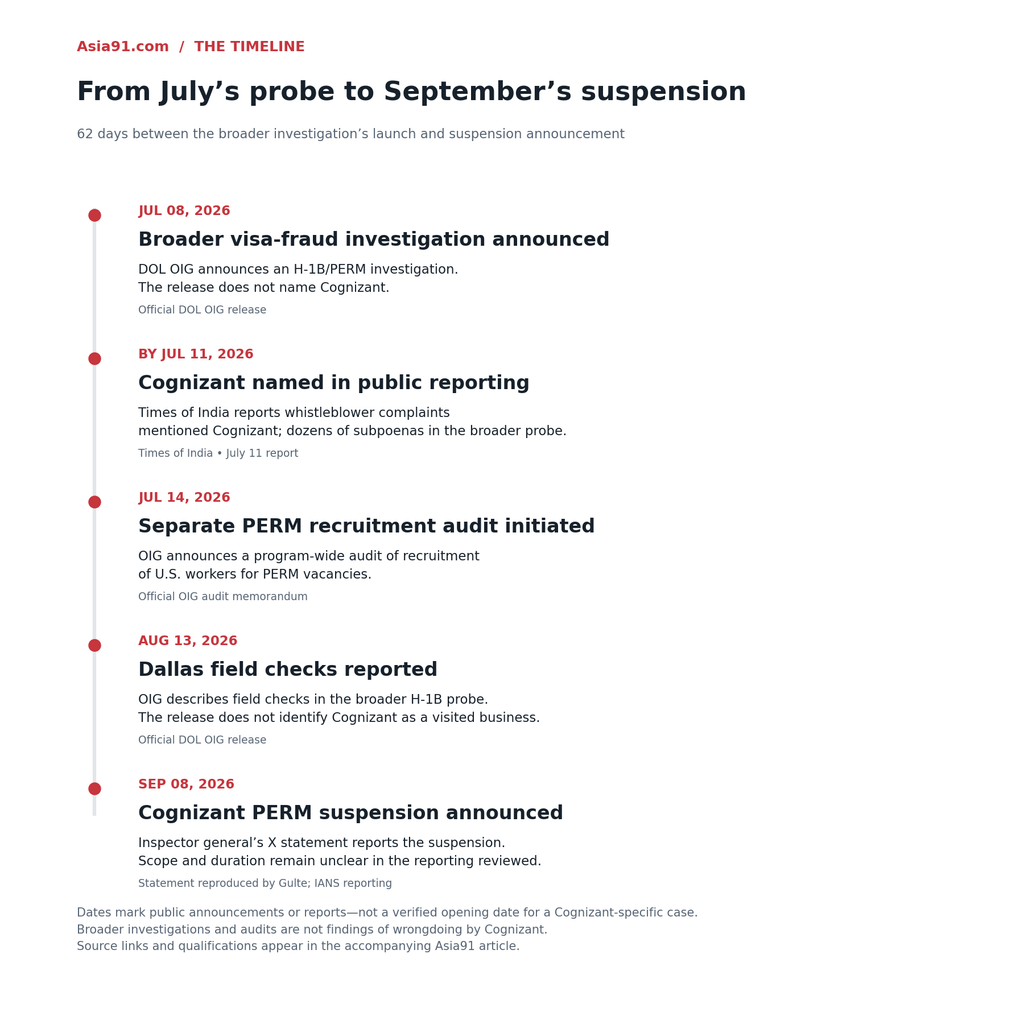
The move follows a summer of scrutiny. Federal investigators announced a broader H-1B and PERM fraud investigation on July 8. By July 11, public reporting had linked Cognizant’s name to whistleblower complaints discussed by the inspector general. The September announcement brings that scrutiny directly into the company’s PERM filings. July 8 government announcement, July 11 reporting
For Indian professionals, the stakes are clear: a potential interruption to green card sponsorship, with no announced end date in the reporting reviewed. The effect on applications already pending remains unclear. The announcement does not establish an H-1B ban or the cancellation of employees’ existing visas.
Fighting fraud is a TEAM SPORT.@Sonderling47 and I are for real.@Cognizant’s PERM filings are suspended. @DOLOIG is on the hunt.
Threats to American workers will NOT be tolerated.
Alongside @WHFraudTF, we’re following facts, fraud and finances.
Handcuffs await.
— Inspector General Anthony D'Esposito (@USLaborIG) September 8, 2026
What the government has—and has not—announced
D’Esposito’s reported statement says: “Cognizant’s PERM filings are suspended.” He links the action to an anti-fraud effort involving his office and the White House Fraud Task Force.
The IANS report says the material released did not disclose specific allegations, affected application numbers or a suspension period, and identified no criminal charges against the company. It included no Cognizant response. An investigation is not a finding of wrongdoing.
When did the investigation begin? The timeline
July 8, 2026 is the documented launch date of the broader government investigation. The sources reviewed do not establish the opening date of a separate Cognizant-specific case.
Date
What happened
What it establishes
July 8, 2026
DOL OIG announced an investigation into H-1B/PERM fraud and worker exploitation.
Broader probe; the release does not name Cognizant. Official release
By July 11, 2026
Times of India reported that D’Esposito discussed whistleblower complaints mentioning Cognizant and dozens of subpoenas.
Public reporting linking the company to scrutiny; the subpoena count concerns the broader probe.
July 14, 2026
OIG initiated a separate audit of PERM recruitment requirements.
Program-wide review of whether U.S. workers were recruited; not a Cognizant finding.
August 13, 2026
OIG reported Dallas field checks in its nationwide H-1B investigation.
The release does not identify Cognizant as a visited company.
September 8, 2026
D’Esposito announced Cognizant’s PERM suspension on X, according to reproduced reporting.
Company-specific suspension announcement.
62 days separate the broader probe’s July 8 launch and the September 8 suspension announcement. That interval describes the public timeline, not the length of a proven Cognizant-specific investigation.
What investigators are looking for
The July 8 announcement described suspected fraudulent applications, coercive wage kickbacks and exploitation of foreign workers across employment-visa programs. Those are allegations discussed in the broader investigation; the release does not attribute each practice to Cognizant. DOL OIG
The separate July 14 audit asks a more specific question about PERM: to what extent were U.S. workers recruited for the advertised vacancies? That matters because recruitment is central to the program’s purpose. OIG audit memorandum
Cognizant’s PERM numbers: historical records, not today’s affected cases
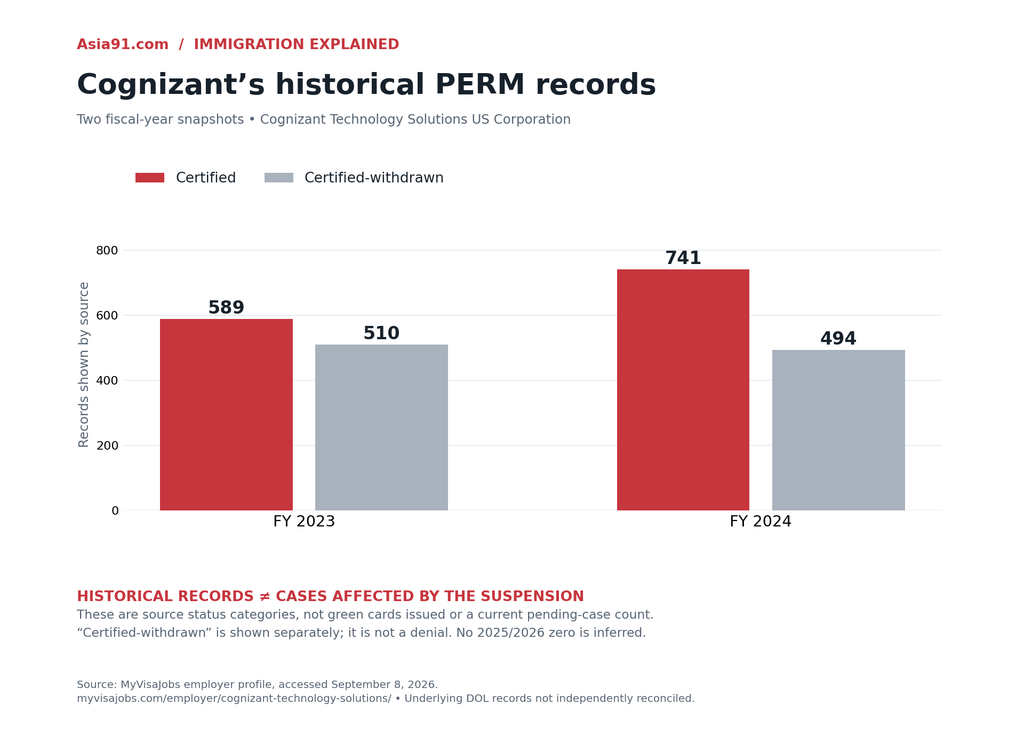
MyVisaJobs’ profile for Cognizant Technology Solutions US Corporation displays the following historical labor-certification status counts. These snapshots provide context; they do not reveal how many applications the September suspension affects.
Fiscal year
Certified
Certified-withdrawn
2023
589
510
2024
741
494
Source: MyVisajobs accessed September 8, 2026. Categories are reproduced as shown. “Certified-withdrawn” is separate from “certified” and is not a denial. These are historical database records, not green cards issued, unique affected employees or a verified count of new filings received in each year. The underlying DOL records were not independently reconciled, and no company-wide 2025 or 2026 zero is inferred.
The number that matters most right now—applications affected by the suspension—was not disclosed in the announcement as reported. Historical volumes cannot fill that gap.
What is PERM—and where does it fit in a green card application?
PERM is an employer-led labor certification process. Broadly, the employer must demonstrate that there are insufficient able, willing, qualified and available U.S. workers for the position, and that employing the foreign worker will not adversely affect comparable U.S. workers’ wages and working conditions.
For cases requiring this certification, the basic sequence is:
The employer completes the required preliminary steps and files its labor certification application.
After certification, the employer submits it with an immigrant worker petition, Form I-140, to USCIS.
The worker still needs to complete the applicable immigration process before becoming a permanent resident.
PERM approval is not a green card. It is an earlier step. DOL says a certified application must be submitted to USCIS within its 180-day validity period. The date DOL receives the labor certification application generally establishes the priority date for these cases.
That explains why a disruption here matters: it can interrupt a case before it reaches the next agency.
Does this mean Cognizant’s H-1B visas are suspended too?
The reported announcement does not establish an H-1B suspension. PERM concerns permanent labor certification; H-1B is a separate temporary employment program. The announcement does not indicate Cognizant’s H-1B program has been suspended.
Employees should therefore distinguish three questions: Can I continue working under my current authorization? Can my employer make a future visa filing? Can my green card sponsorship move forward? A headline about PERM does not answer all three.
There can, however, be a connection between green card progress and future H-1B extensions. USCIS describes circumstances in which a labor certification or I-140 filed at least 365 days before the requested extension start date can support H-1B extensions beyond the usual six-year limit. Eligibility depends on the case.
The practical implication is that a filing delay may deserve more urgent attention for someone approaching a deadline than for someone early in their U.S. employment. An immigration lawyer should assess that timing using the employee’s actual records.
What should Cognizant employees ask now?
The useful next step is to get a written, case-specific answer from the company’s immigration team or the attorney handling the sponsorship.
Ask:
What stage is my case at? Recruitment, PERM filed, PERM certified, I-140 pending or I-140 approved?
Has my case actually been affected? Request the relevant notice or written explanation.
Which deadline needs attention first? Ask about current status, any upcoming extension and any certification expiry.
What happens next? Is the team awaiting agency instructions, preparing a response or taking another step?
When will I receive another update? A clear follow-up date is more useful than an open-ended assurance.
These are questions to clarify the situation, not a recommendation to resign, switch employers or abandon an application. Those decisions require an assessment of the individual case.
Is Cognizant the only company named?
IANS also reports a Cloudera PERM suspension; it does not establish identical circumstances.
That makes this a story worth following beyond one employer. But it does not justify predicting which company will face action next.
What matters next
The next meaningful development will be documentation explaining how the suspension operates, along with any response from Cognizant. Employees need to know whether existing applications can proceed, what new filings face and when the position may change.
For Indian professionals following the story, the most useful distinction is between the announced action and its still-unclear effect on individual cases. The first is news. The second is what determines a family’s next decision.
Follow the immigration news that affects your life in America. VisitAsia91.comto download the Asia91 app for U.S. Desi community news, events and radio.
I keep a low profile, but people say I’m kind of a big deal! You’ll often hear me bragging about being Substack’s first investor or telling stories about my prime years in my 20s. 🙂 Haters will say my profile picture is fake—and they’re right, at least once in a lifetime. 🙂
We read 6,142 comments people sent to the government about this new visa fee. Here’s what’s actually in there.
The government wants to charge $103,265 every time a company hires a skilled foreign worker on an H-1B visa. Before that becomes final, anyone can write in and say what they think – and officials have to read it. In the first eight days, 6,142 people did. We read every one and pulled out the numbers, the arguments, and a few things nobody expected.
6,142
comments in 8 days
$103,265
the proposed fee
38%
oppose it outright
In this piece – 17 points
What’s actually happening
Who’s winning the comment war
The flip nobody saw coming
Two arguments, one number
Accusations of caste-based hiring
Actual lawyers showed up, with citations
This isn’t just a tech story
“AI is already doing the job”
15 people too scared to give their name
410 people brought up Canada, unprompted
The companies that got named
The AI prompt someone forgot to run
The copy-paste campaigns
From “Based.” to legal essays
People who think it should be higher
The part that isn’t funny
What happens next
Red = against the fee
Green = for the fee
Amber = neutral, just a number
Point 1
A fee, and a very short window to react
Quick version: the H-1B visa lets U.S. companies hire skilled foreign workers – engineers, researchers, doctors, and international students who studied here. The government now wants to charge $103,265 every time a company files one of these visas, on top of fees that already exist.
Before that becomes law, the public gets a chance to say something about it. Anyone can write in, and by law the government has to actually read what people say before finalizing anything. That window opened on August 25, 2026 and runs for 30 days. People used almost all of it in the first eight.
6,142 people wrote in. Almost all of them – 6,140 – typed a real, substantial comment. Not a form checkbox. Not a one-word reaction. Actual paragraphs.
Chart 1 – How fast comments came in
What you’re looking at: each dot is one day, and the number above it is how many comments arrived that day. The chart shoots up on day two – 1,863 comments landed in under 24 hours – then slowly tapers off.
Why it matters: a normal government rule doesn’t get noticed by 1,863 people overnight. Something – a Reddit thread, a WhatsApp forward, a lawyer’s newsletter – pushed people here fast, and they already knew which side they were on.
Source: DHS Docket USCIS-2026-0298, public comments Aug 25–Sep 3, 2026 · Analysis: Asia91
Point 2
For it, against it, or just venting
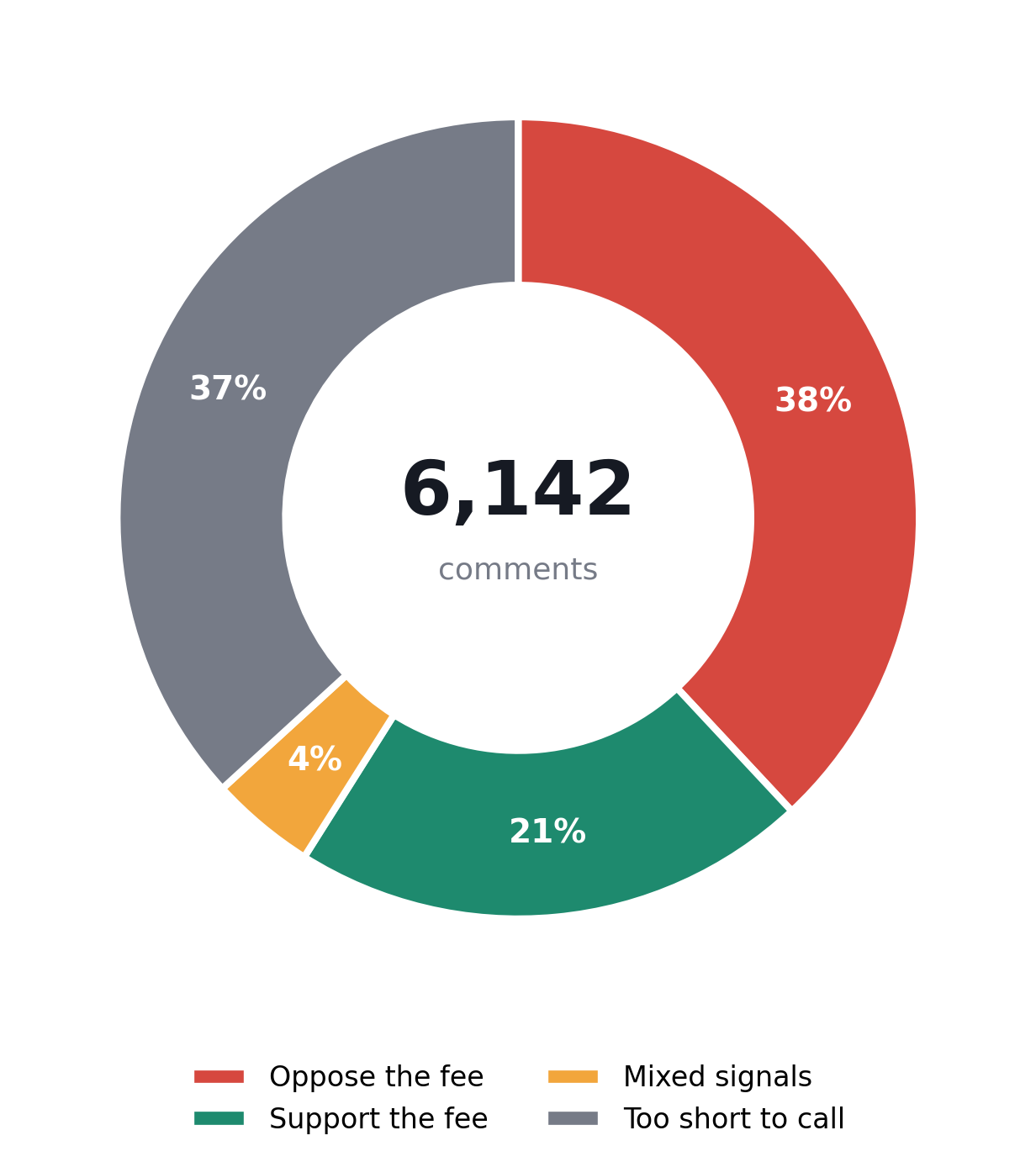
We read every comment and sorted them by tone: does it clearly support the fee, clearly oppose it, do both, or is it too short to tell? This isn’t a scientific poll – it’s a careful read of 6,000+ real comments, one at a time.
Chart 2 – Where everyone stands
What you’re looking at: the whole donut is all 6,142 comments. 38% (red) clearly oppose the fee. 21% (green) clearly support it. The rest are too short or mixed to score – things like “In favor” or a bare link to a file.
Why it matters: among people who took a clear side, opposition beats support by roughly 2 to 1. That’s the headline – but it hides something more interesting, which is what happened hour by hour. Keep reading.
Source: DHS Docket USCIS-2026-0298 · Analysis: Asia91 (keyword-based, not a scientific survey)
Point 3
Day one leaned one way. Every day after flipped.
On the very first day this went live, comments leaned in favor of the fee. Starting the next morning, that reversed hard – and stayed reversed.
Chart 3 – The overnight reversal
What you’re looking at: each bar is one day. The green part is the share who supported the fee that day, red is the share who opposed it. On Aug 25, green (support) was 71% of the bar. One day later, red (oppose) had taken over and never gave it back.
Why it matters: this looks like two different online communities racing to find the comment page. Whoever wanted the fee found it first – within hours. Then a much bigger, slower-moving group of H-1B holders, international students, and tech employers arrived and dominated every day after.
Two sides, arguing about completely different things
Forget “for” and “against” for a second. What are people actually typing about? We searched every comment for specific topics and counted how often each one came up.
Chart 4 – What people actually wrote about
What you’re looking at: each bar is one topic, and the number is what share of all 6,142 comments mention it. A comment can mention more than one topic, so these don’t add up to 100%.
Why it matters: “Wages / American workers” and “Innovation / competitiveness” are almost tied at the top – meaning both sides feel equally strongly, they’re just arguing about different things entirely.
International students who took out loans years before this fee existed. Small businesses that can’t afford a six-figure hire the way Google can. A legal claim that a court already struck down a similar $100,000 charge as an illegal tax.
The case for the fee
IT staffing firms accused of using the visa as cheap labor. Concern about American tech wages being undercut. A repeated (if fuzzy) claim that most H-1B workers come from one country.
Points 5–11
7 things people actually said in the comments
Beyond “for it” or “against it,” the comments contain some genuinely surprising, specific arguments. Here’s the full range – with the numbers to back it up.
Point 5
Accusations of caste-based hiring
264 comments raise some kind of bias or discrimination issue. Within that group, 22 comments go further than a general complaint – they specifically allege that Indian hiring managers, once promoted into a position to hire, favor candidates from their own caste or community. That’s a much sharper, more specific claim than plain “the system is unfair” venting, and it’s not just one person: several different comments make a similar claim independently.
Chart 5 – How often each bias claim came up (raw count)
What you’re looking at: out of all 6,142 comments, how many used each specific word or accusation.
Chart 6 – Casteism, sized against other bias claims (not against all 6,142 comments)
What you’re looking at: this time the percentages are out of the 264 comments that raised any bias claim, not out of all 6,142 – that’s the fair comparison. Casteism is 8.3% of that smaller group; plain nepotism is a much bigger 30.3%; general “discrimination” is the largest slice at 56.8%.
Why it matters: casteism is real and specific, but it’s the fourth-largest slice of a fairly small pie – context worth having before running a headline with just the number 22.
“Some Indian managers would rather hire a more expensive Indian of their caste” than a cheaper, equally qualified candidate, one commenter wrote, calling it a bigger problem than wages alone. — public comment, DHS Docket USCIS-2026-0298
A commenter who said they’d worked at Microsoft for nearly two decades wrote that “once an Indian was promoted, they began hiring more Indians” – something they said was well known internally, though no documentation was offered. — public comment, DHS Docket USCIS-2026-0298
What we’re not publishing
A small number of comments in this file went further than argument – they named specific private individuals and linked to their personal LinkedIn profiles as supposed “evidence.” We’re not repeating those names or links. That a federal comment box got used this way is itself worth knowing, which is why we’re mentioning it – but the specific targets don’t belong in any published piece.
A full breakdown of this finding – including the counter-argument for why these claims shouldn’t be taken at face value – runs in its own piece: “Is There a Caste Problem in Tech Hiring?”
Point 6
Actual lawyers showed up – with citations
553 comments – nearly one in ten – cite a specific U.S. immigration law by name, arguing the government doesn’t even have the legal authority to charge this fee. Others cite the exact court case that already struck down a similar charge. This isn’t public opinion, it’s a parallel legal argument, filed one comment at a time.
Chart 6 – Legal arguments, named specifically
What you’re looking at: how many comments name each specific law or legal precedent.
Why it matters: if this rule ever gets challenged in court, the arguments are already sitting right here, in public.
Chart 13 – Legal arguments, sized against each other
What you’re looking at: of the 696 comments that cite any legal argument, what share cites each one. INA §286(m) – the core question of whether DHS even has the authority to charge this fee – dominates at 79.5%.
625 comments mention STEM fields directly – but 82 specifically raise healthcare, including rural hospitals that rely on H-1B doctors. If this fee goes through, some small hospitals could quietly lose their only specialist. That’s a very different story than “tech worker visa fight.”
Chart 7 – Who this actually touches
What you’re looking at: how many comments mention each group or specific visa-cap number.
Why it matters: the popular image is “tech workers vs. American coders.” The comments say it’s bigger than that – hospitals, universities, and research labs are all in the mix.
What you’re looking at: of the 1,385 comments naming a sector or specific cap number, what share goes to each. STEM dominates at 45.1%, but healthcare still gets a real 5.9% – not nothing, for a “tech visa” fight.
“AI is already doing the job – why do we need the visa?”
A genuinely unexpected argument: 74 comments frame this as AI-versus-everyone, not immigrant-versus-citizen. Some say AI is already doing the technical work H-1B visas were meant for. Others say the opposite: losing global talent now is exactly how the U.S. falls behind China in the AI race – a country named in 165 separate comments.
Point 9
15 people were too scared to give their name
A small but real detail: 15 comments mention fear of getting in trouble with an employer just for commenting. This is supposed to be a safe, official way to speak up – and some people clearly didn’t feel safe doing it under their own name.
Point 10
410 people brought up Canada, unprompted
Nobody asked about Canada. 410 comments mentioned it anyway – almost always as “the job just moves there instead.” Add in 165 mentions of China and 54 direct references to “brain drain,” and there’s a real argument here: pricing out global talent doesn’t send the job to Ohio. It sends it to Toronto or Shenzhen.
Point 11
The companies that got named – for very different reasons
Microsoft, Google, and Amazon get named most – usually in arguments about AI and competitiveness. Cognizant, Infosys, and TCS – the outsourcing firms – get named specifically as the “problem,” almost never in a flattering way.
Chart 8 – Companies named by name
What you’re looking at: how many comments mention each company. Red bars are outsourcing firms named as part of the “problem.” Green bars are big tech, mostly named around AI and competitiveness.
Why it matters: this could be its own article – a scorecard of who got dragged and why.
Someone submitted the AI prompt instead of the answer
At least five different people submitted the exact same text into the official record. It wasn’t a form letter. It was a raw ChatGPT-style instruction – brackets and all.
“Write a short, persuasive public comment (150–250 words) opposing DHS Docket No. USCIS-2026-0298… include 3 concise points on how the fee hurts [insert your industry/perspective]… end with a clear call to withdraw the rule.” — submitted as an actual comment, five times, by five different people
Nobody filled in the bracket. Nobody ran the prompt. Someone shared an AI template in a group chat or on Reddit, and at least five people copy-pasted the raw instructions straight into the official government record – the same permanent file as the legal briefs above. Funny, and also a real look at what “organized advocacy” looks like in 2026.
Point 13
Form letters, from both sides
About 2% of all comments are near-identical to at least one other comment – meaning organized templates were circulating, not just individual people typing in the moment.
Chart 9 – The most-repeated comments
What you’re looking at: each bar is one specific piece of text that showed up more than once, and how many times it was copy-pasted.
Why it matters: some of these are clearly advocacy-group talking points dressed up as personal stories. The line between “one person’s real opinion” and “coordinated campaign” is blurrier than it looks.
The shortest comment is four characters. The longest hits the platform’s character limit. Both are in the same file.
Chart 10 – How long people’s comments were
What you’re looking at: comments grouped by length, from a single word (amber) to multi-thousand-character essays (red). The typical comment lands around 700 characters – roughly the length of this paragraph.
Why it matters: 801 comments run past 3,000 characters – long enough to cite specific laws and court cases. At the other end, people just typed “Based.” and moved on. Same file, wildly different effort levels.
Among people who support the fee, plenty didn’t just want the government to keep the number – they wanted it higher. Some by a little. Some by a lot.
Chart 11 – How high people want the fee to go
What you’re looking at: each bar is a fee amount someone proposed instead of $103,265, and how many comments proposed it.
Why it matters: seven separate people want the fee to be ten million dollars. That’s not really a policy position – it’s a way of saying “just end the program” without literally saying it.
What you’re looking at: of the 195 comments that proposed some number higher than $103,265, what share picked each tier. Most people who want it higher land in the “$200K or more” range – the $10 million asks are a small, loud minority within that group.
Most of this file is a genuine, real debate – real financial stakes, real frustration, both sides. But a small slice of the anti-immigrant comments cross from disagreeing with a policy into openly hostile language toward Indian applicants specifically, not just criticism of the visa program. It’s a small share of the total – well under 1% used explicit slurs – but it’s sitting in the same permanent government record as everything above. We’re not repeating that language here; the pattern is the point, not the words themselves.
Point 17
This is still open for comment
The public has until September 25, 2026 to weigh in – so everything above is a snapshot, not the final tally. Comment volume usually spikes again in the last 48 hours of any window like this, and given how fast this one started, the ending could be bigger than the beginning.
By law, the government has to review and respond to the substance of what people said before finalizing anything. Whatever number it lands on, it will have to answer to a record that includes rural hospitals, laid-off engineers, immigration lawyers, a leaked AI prompt, and seven people who think the fee should be ten million dollars.
This is still open for comment.
We’re tracking every new submission until the window closes September 25. Get the update on the Asia91 app before anyone else does.
I keep a low profile, but people say I’m kind of a big deal! You’ll often hear me bragging about being Substack’s first investor or telling stories about my prime years in my 20s. 🙂 Haters will say my profile picture is fake—and they’re right, at least once in a lifetime. 🙂
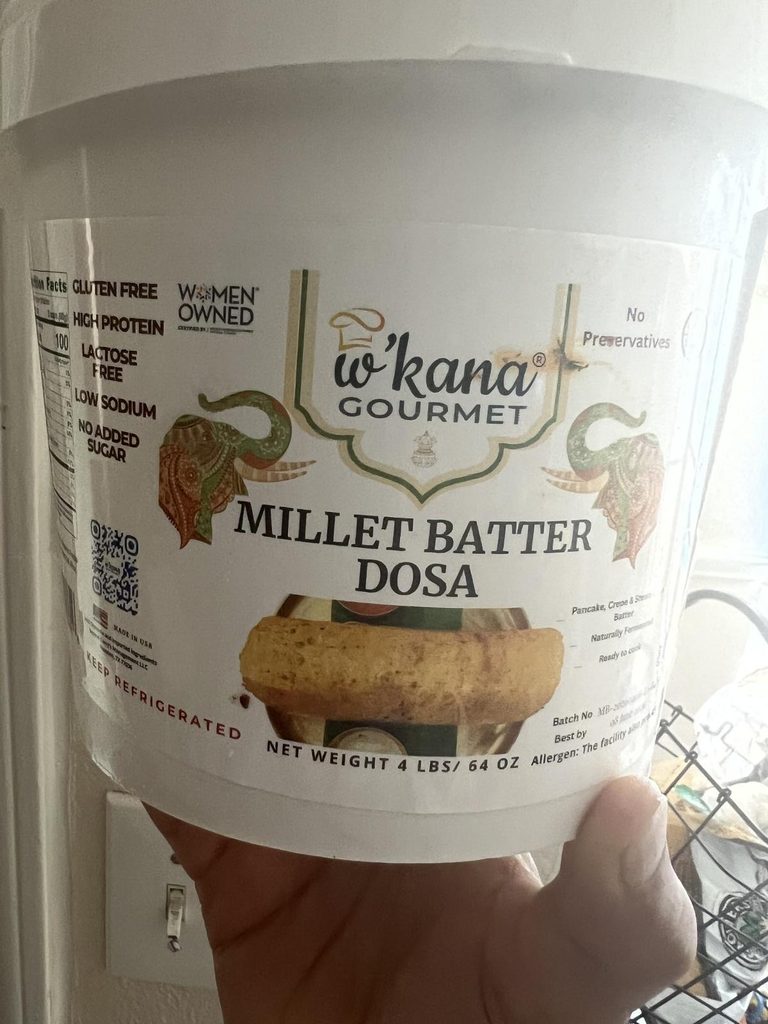
A popular Costco dosa batter has left one Frisco family asking a disturbing question: how can a refrigerated product appear spoiled before its best-by date?
The family regularly bought W’Kana Gourmet Millet Batter Dosa because it made breakfast easy—especially with children at home. But the convenience quickly turned into concern.
The first time, the customer noticed an unusual smell after opening the container. He had already eaten a few dosas before becoming suspicious. Thinking it might have been a bad batch—or perhaps because the batter had been left outside briefly while he was cooking—he threw it away.
Then he purchased a fresh container.
This time, he says the batter was kept refrigerated, and the best-by date had not passed. But when he opened it the next day, he found a disturbing gray, sticky mixture covered with pale, irregular patches.
Based on the photographs, the surface appears fungus-like and completely different from the normal smooth appearance consumers expect from dosa batter.
I keep a low profile, but people say I’m kind of a big deal! You’ll often hear me bragging about being Substack’s first investor or telling stories about my prime years in my 20s. 🙂 Haters will say my profile picture is fake—and they’re right, at least once in a lifetime. 🙂
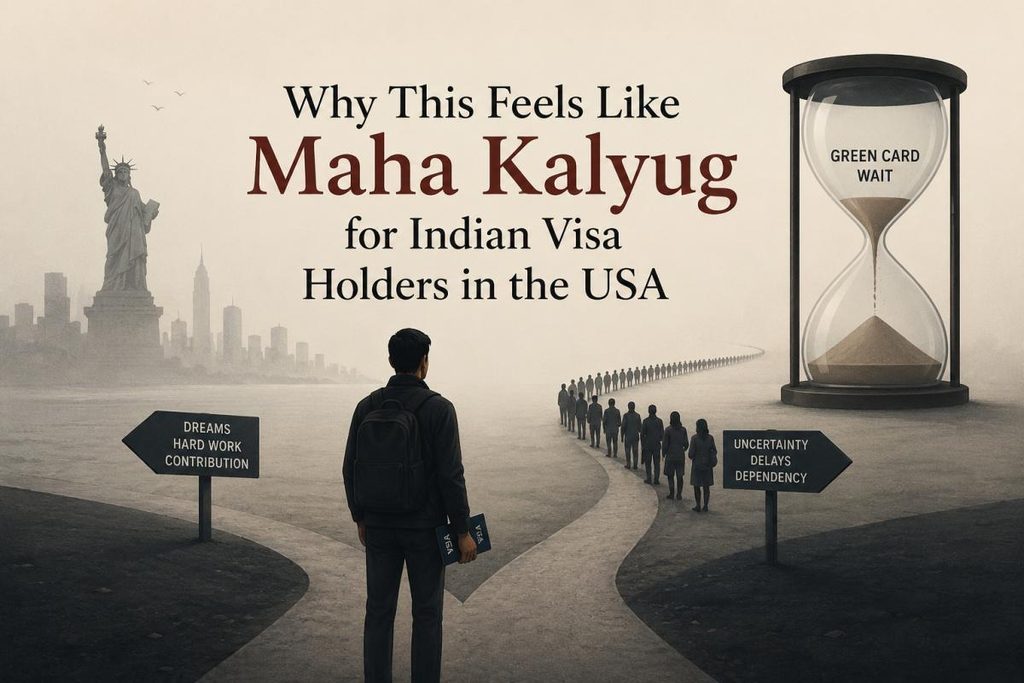
That’s how long the green card wait can stretch for an Indian on H-1B, according to recent backlog models.
Not 134 months. Years.
Your grandchildren could inherit your place in the queue.
If that number doesn’t stop you, this one will: a Cato Institute study estimates 424,000 people will die waiting for their employment-based green card. Over 90% of them will be Indian.
Our scriptures have a word for an age like this. An age where you do everything right — and the universe still moves the goalpost.
Kalyug.
And for Indian visa holders in America right now? This isn’t just Kalyug.
This is Maha Kalyug. Here’s why.
The Weekend America Panicked Its Best Engineers
September 19, 2025. A Friday.
President Trump signs a proclamation: $100,000 fee on H-1B petitions. Effective Sunday.
Forty-eight hours’ notice.
What happened next felt like a scene from a disaster movie. Engineers in Bengaluru for their sister’s wedding abandoned the reception and booked one-way flights back. Companies sent midnight emails: get on a plane, now. The Indian Embassy in Washington opened an emergency helpline — the kind of thing you do after an earthquake, not a visa memo.
India’s Ministry of External Affairs publicly warned of “humanitarian consequences.”
For a program where Indians hold roughly 71% of all visas, that fee wasn’t a policy tweak.
It was a wall — with our community’s name on it.
Then the Plot Twisted. Twice.
Nine months later, June 2026: a federal judge strikes the fee down. Judge Leo Sorokin rules the government had no authority to impose what was, in effect, a tax. Only Congress can do that.
Victory? The community exhaled for about a week.
Then DHS called the ruling “blatant judicial activism” — and appealed.
And just days ago, a new proposal surfaced at the State Department: a refundable bond of up to $100,000 for certain green card applicants.
Read that timeline again. In ten months, the same community was told:
The fee is $100,000. The fee is annual. No wait — one-time. It doesn’t apply to you. Actually, it’s illegal. Actually, we’re appealing. Actually… how about a bond?
That whiplash isn’t a side effect.
Functionally, it is the policy. Uncertainty makes people give up and leave on their own. No law required.
July 2026: The Month the Queue Simply… Closed
While the fee drama played out in court, something quieter and crueler happened.
The July 2026 Visa Bulletin — the monthly document that decides a million Indian futures — dropped two bombs.
EB-2 India: UNAVAILABLE. Not delayed. Not retrogressed. Gone. The annual quota for Indians exhausted, zero green cards issuable until October.
EB-1 India: moved BACKWARD — to October 2022. The “extraordinary ability” fast lane, the one for the geniuses and the award-winners? Now also a parking lot.
Why does this keep happening? One brutal piece of math.
US law caps every country at about 7% of employment green cards — roughly 9,800 per year for India. Against a backlog of 300,000+ Indian professionals (over a million once you count spouses and kids).
Pakistan? Somalia? Applicants from smaller-volume countries often wait two years or less.
Indians: 50 years. 80 years. 134 years.
Same degrees. Same taxes. Same rules followed. Different birthplace.
The Traps Inside the Trap
The backlog is the disease. But 2025-26 added infections on top. Each one deserves its own headline:
The lottery is being rewired. In December 2025, DHS moved to weight H-1B selection by wage level instead of random chance. Translation: fresh graduates, researchers, teachers — priced out. One expert called the new H-1B a “luxury work permit.”
Going home became a gamble. Dropbox (interview waiver) eligibility? Slashed. Most people now need in-person interviews, and appointment backlogs in India stretch for months — Delhi is the worst. The old hack of stamping in Canada or Mexico? Largely shut down.
So people skip weddings. Skip funerals. Skip a dying parent’s last days. Because leaving America means betting you can return.
Spouses are on the chopping block. Proposals would end automatic H-4 work-permit extensions. If USCIS is slow with a renewal — and it will be — thousands of spouses, many engineers and doctors themselves, must simply stop working. Mid-career. Mid-mortgage.
The system itself is drowning. USCIS backlog: a record 11.3 million pending cases. H-1B petition processing times up 80% year-on-year. Work-permit backlogs nearly doubled.
And the kids age out. Turn 21 while your parents are still in the queue? You fall off their application. A child who arrived at four, who knows no other home, becomes an “international student from India” overnight. Back of the line. Start again.
Even the entrance is narrowing: student visas issued to Indians fell by nearly a third in early 2025, then almost half by mid-year.
The pipeline is being squeezed at the entrance, the middle, and the exit. Simultaneously.
Why “Kalyug” Is Exactly the Right Word
Here’s the part that cuts deepest — and it’s not about any single rule.
Every Indian parent taught the same covenant: study hard, follow the rules, wait your turn, and the system will honor it.
No community honored that deal more faithfully. Front door. Every form filed. Every fee paid. Every tax on time.
Kalyug, in the scriptures, is the age when that covenant breaks. When dharma stands on one leg. When effort and outcome come unhooked from each other.
A doctor who’s saved American lives for 18 years — undone by a delayed receipt notice.
A family’s 25 years of perfect compliance — outweighed by a wage-band algorithm.
A queue you joined in 2012 — stamped “UNAVAILABLE” in 2026, through no act of yours.
That’s not a policy problem. That’s a cosmology problem. And the community feels it in its bones.
But Here’s What the Scriptures Also Say
Kalyug comes with a strange consolation: it’s the age when small acts of dharma count double.
Translated for 2026:
File everything early — processing time is now the enemy. Keep documents battle-ready — retrogression punishes the unprepared. Ask your attorney about EB-3 downgrades — some windows, the “slower” lane moves faster for Indians. Plan any India trip like a military operation. And if your I-485 is filed, breathe: retrogression delays approval, it doesn’t kill the application.
But the bigger truth is this.
None of it changes until the per-country cap does. The fix has a name — bills like the Equal Access to Green Cards for Legal Employment Act have been introduced again and again. And died. Again and again.
Five million Indian-Americans. The wealthiest, most educated immigrant community in US history. And the one lever that would drain the entire backlog remains unpulled.
The scriptures promise one more thing about the age of discord: it ends.
The only question is whether this community waits for the yuga to turn on its own —
— or turns it.
Developments current as of July 2026. This landscape is shifting weekly — consult a licensed immigration attorney before acting on anything here.
I keep a low profile, but people say I’m kind of a big deal! You’ll often hear me bragging about being Substack’s first investor or telling stories about my prime years in my 20s. 🙂 Haters will say my profile picture is fake—and they’re right, at least once in a lifetime. 🙂
Santhosh was on a Zoom call with his college buddy Rohan, now living in Texas, when the inevitable question came up:
“Bro, when are you going to India next? Can you bring me some Dolo 650 and Azithro?”
It wasn’t the first time.
Over the years, Santhosh’s suitcase had transformed into a mobile desi pharmacy—stocked not with souvenirs, but with strips of Azithromycin, Dolo 650, Hajmola, and yes, even chyawanprash. And he’s not alone.
For thousands of Indians living in the U.S., Azithromycin and Dolo 650 are more than just pills—they’re a piece of home. A warm memory of being wrapped in a blanket, sipping chai, and having your mom hand you the “magic tablet.” In a foreign land of Tylenol, Z-Packs, and CVS receipts, these Indian favorites carry a different kind of healing.
Let’s unpack this uniquely desi obsession with two tiny pills—and why they’ve earned VIP status in Indian-American households.
💊 Azithromycin: The Trusty Superhero
1. 🇮🇳 The “Z-Pack” with an Indian Twist
In India, Azithromycin is the antibiotic equivalent of cutting chai—widely available, widely loved. It’s the go-to fix for everything from sore throats to sinus infections. And unlike in the U.S., where you need a prescription, in India you can literally walk into any chemist and get it, no questions asked.
📊 In 2019, Indians consumed over 500 crore antibiotic tablets, with Azithro leading the list.
No wonder Indians treat it like medicine gold when flying back from home.
2. ⏳ The 3-Day Miracle
Azithromycin doesn’t believe in wasting time. While most antibiotics stretch out for 7–10 days, Azithro wraps up its business in just 3 to 5 days.
For Indian-Americans juggling grad school, H-1B stress, full-time jobs, and sub-zero winters, that’s a blessing in blister-pack form.
🗣️ “Why take a week off when three days can fix it?” laughs Priya, a software engineer in Seattle.
3. 📲 WhatsApp Medicine Culture
Indians trust their doctors—but they trust their WhatsApp groups just a bit more. If someone’s cousin in California says Azithro cured their cold in two days, that screenshot goes viral across friend circles.
🙋♂️ Santhosh’s “Suitcase Pharmacy”
“When I first moved to Chicago,” says Santhosh, “my mom packed 10 strips of Azithromycin. I thought she was being dramatic. But when a brutal Midwest cold knocked me out, NyQuil did nothing. My Indian roommate gave me Azithro—and I was back to normal in two days. That’s when I understood.”
💥 Dolo 650: The Magic Pill with Emotional Baggage
1. 💪 The “Indian Tylenol” That Packs a Punch
Dolo 650 contains 650mg of paracetamol—stronger than the standard 500mg acetaminophen you’ll find in most U.S. pharmacies. For Indians used to this extra strength, anything less feels like a downgrade.
🗣️ “Why settle for 500mg when 650 exists?” quips Anjali, who always brings back a Dolo stash from her India visits.
2. 🏠 Comfort in a Strip
For many, Dolo isn’t just medicine—it’s muscle memory.
Whether it was post-exam exhaustion, a wedding hangover, or monsoon-season fevers, Dolo was always there. So when Indians move abroad, it becomes part of their emotional luggage.
🗣️ “When I take Dolo, I feel like my mom’s looking after me,” says Riya, a nurse in Boston.
3. 💵 Cost & Convenience
In India, a strip of Dolo costs about ₹25–₹30 (less than 50 cents). In the U.S., generic acetaminophen feels expensive—and oddly ineffective by comparison. And thanks to desi grocery stores (and a few “under-the-counter” arrangements), Dolo is surprisingly easy to find.
🙋♀️ Anjali’s Winter Epiphany
Anjali moved to New York full of confidence—until her first American winter hit. Bedridden with fever, she tried Advil and Tylenol, but nothing worked. In desperation, she reached into her “India stash” and popped a Dolo 650.
“Within hours, the fever broke. I finally understood the hype.”
📚 Quick Bites: Fun Facts & History
Azithromycin
Discovered in 1980 by a team in Croatia; licensed to Pfizer as Zithromax.
Overuse in India has led to concerns around antibiotic resistance.
Known as the “3-day savior” in Indian homes.
Dolo 650
The COVID-era MVP in India—prescribed like water during the pandemic.
Became a household name, trending on Twitter during peak COVID waves.
Still widely preferred by Indians over American brands like Tylenol.
🧳 Conclusion: Medicine, Memory & Motherland
For Indian immigrants, Azithromycin and Dolo 650 aren’t just tablets—they’re time machines.
They take you back to rainy school days, cozy blankets, and a steaming cup of haldi doodh. They remind you of parents who cared, of a healthcare system you understood, and of home remedies that always seemed to work.
In a land of co-pays and cold pharmacies, they are warmth, trust, and familiarity rolled into a silver strip.
🗣️ “It’s like carrying your mom’s home remedies in your wallet,” says Santhosh. “You might not always need it—but just knowing it’s there makes you feel safe.”
So next time your Indian friend visits home, don’t be surprised if their luggage is heavier on the return flight. It’s not just the pickles and papads—it’s a little slice of home wrapped in foil, ready to heal with nostalgia.
I keep a low profile, but people say I’m kind of a big deal! You’ll often hear me bragging about being Substack’s first investor or telling stories about my prime years in my 20s. 🙂 Haters will say my profile picture is fake—and they’re right, at least once in a lifetime. 🙂
The growing popularity of prenuptial agreements within South Asian families, particularly those in the United States, can be attributed to a confluence of cultural shifts, financial considerations, and evolving relationship dynamics. Here are the main reasons for this trend:
1. Financial Protection and Clarity
Wealth Preservation: As South Asians in the U.S. accumulate wealth through entrepreneurship, professional careers, and family-owned businesses, there is a stronger need to protect these assets. Prenuptial agreements are seen as tools to preserve family wealth and ensure it stays within the family lineage, especially when marriages end in divorce.
Protection of Individual Assets: Many individuals enter marriage with personal assets, including property, savings, or inheritances. A prenup can clearly define which assets remain personal and which are shared, preventing disputes over asset division.
2. Changing Gender Dynamics and Professional Success
Economic Independence of Women: With more South Asian women achieving financial independence and professional success, there is a greater desire to ensure financial autonomy. Women, in particular, seek prenups as a way to safeguard their earnings and investments, reflecting the broader trend of shifting gender roles and expectations in marriage.
Dual-Income Households: As more South Asian families become dual-income households, with both partners contributing significantly to family finances, prenups are increasingly viewed as a fair way to ensure both parties’ contributions are recognized and protected.
3. Transparency and Prevention of Conflict
Setting Clear Expectations: A prenup can set clear expectations about financial responsibilities and asset division in the event of a divorce, reducing potential conflicts. This transparency is particularly valued in an era where relationship dynamics are becoming more complex and nuanced.
Avoiding Lengthy Legal Disputes: Prenups can prevent costly and emotionally draining legal disputes by outlining terms beforehand, making them appealing for families who wish to avoid public conflicts and maintain privacy.
4. Influence of Western Culture and Legal Practices
Western Influence: Exposure to Western legal practices, where prenups are relatively common, has made younger generations of South Asians more open to discussing and implementing these agreements. Many see prenups as a practical tool that aligns with their values of self-reliance and pragmatic financial planning.
Legal Education and Awareness: Increased awareness of legal rights and the implications of divorce in the U.S. legal system have contributed to the growing acceptance of prenups. Many South Asians, particularly those in professions like law or finance, recognize the value of legal protection and planning.
5. Safeguarding Family-Owned Businesses and Inheritances
Family Businesses: South Asian communities often have strong ties to family-owned businesses. A prenup can protect these businesses from being divided or sold off in a divorce settlement, ensuring their continuity and alignment with family goals.
Inheritance and Family Wealth: Many families encourage prenuptial agreements to safeguard family wealth and inheritance, ensuring that assets passed down through generations are not at risk of being lost in the event of a marital breakdown.
6. Rising Divorce Rates and Practical Considerations
Rising Divorce Rates: While traditionally South Asian communities have had lower divorce rates, these have been increasing, particularly among younger generations and in the diaspora. This shift has led to a more pragmatic approach to marriage, where planning for potential outcomes is seen as responsible rather than pessimistic.
Practicality Over Emotion: Younger generations often view marriage through a more practical lens, considering financial and emotional compatibility as equally important. Prenups are increasingly seen as a way to manage the practical side of relationships, balancing emotional commitment with financial responsibility.
These factors together highlight a significant cultural shift within South Asian families in the U.S., where modern legal practices are being harmonized with traditional values to address contemporary challenges and aspirations.
I keep a low profile, but people say I’m kind of a big deal! You’ll often hear me bragging about being Substack’s first investor or telling stories about my prime years in my 20s. 🙂 Haters will say my profile picture is fake—and they’re right, at least once in a lifetime. 🙂
Every time Vijay’s phone buzzed with a message from a friend, it was always the same — “Gold is back on Costco!” But by the time Vijay would scramble to the website, the gold bars were already gone.
It felt like a race against time, reminding him of his college days in India when booking a train ticket on IRCTC felt like trying to win a lottery.
If you’ve experienced similar frustration with Costco’s elusive gold bars, don’t worry — there are plenty of other reputable places to buy gold without needing lightning-fast reflexes.
Gold has always been a favored investment option due to its stability and value retention, especially during times of economic uncertainty.
According to the World Gold Council, global demand for gold in 2023 increased by 12% compared to the previous year, with North America seeing a significant spike.
While Costco’s limited gold supply may have grabbed headlines, there are numerous other trusted sources where you can secure gold bars, coins, or jewelry.
Here are the top 10 places to consider if you missed out on Costco’s gold bars:
1. Apmex
Why Apmex? Apmex, short for American Precious Metals Exchange, is one of the largest and most reputable online dealers for precious metals globally. With a well-established reputation and over two decades in the business, Apmex offers customers a wide selection of gold products, making it a go-to option for both novice and seasoned investors.
Product Variety: Their catalog features a comprehensive array of gold products, including gold bars and coins from well-known mints like PAMP Suisse, Perth Mint, and the U.S. Mint. You can choose from fractional bars for smaller investments to larger 1-kilo bars for bigger portfolio allocations.
Special Features: Apmex stands out with its user-friendly online platform and mobile app, allowing you to shop and manage your orders conveniently. They also provide transparent pricing and secure shipping, ensuring that you receive your purchases safely.
Official Website: www.apmex.com
2. JM Bullion
Why JM Bullion? Founded in 2011, JM Bullion has quickly become a trusted name in the industry due to its commitment to customer service and transparent pricing. Whether you’re looking to buy gold for an IRA or just adding to your personal collection, JM Bullion offers a seamless buying experience.
Product Variety: JM Bullion provides a diverse range of gold products, including bars and coins from prestigious mints like the Royal Canadian Mint and the Austrian Mint. You’ll find both standard investment-grade gold as well as unique, collectible items.
Special Features: In addition to their competitive prices, JM Bullion offers free shipping on orders over $199, making it a cost-effective choice for investors. They also feature a secure online platform with up-to-date market data, so you can make informed decisions.
Official Website: www.jmbullion.com
3. GoldSilver
Why GoldSilver? GoldSilver, established by renowned precious metals investor Mike Maloney, is a platform that not only sells gold but also offers an educational perspective on precious metal investments. It’s ideal for those who want to learn more about why investing in gold makes sense, thanks to their in-depth articles and videos.
Product Variety: They offer a range of products, including American Eagles, Canadian Maple Leafs, and a selection of gold bars from internationally recognized mints. Whether you want a small piece of gold or a more significant investment, GoldSilver has you covered.
Special Features: The educational resources on GoldSilver set it apart from other platforms. With a library of informative videos, newsletters, and market insights, they help investors understand the broader context of precious metals investing.
Official Website: www.goldsilver.com
4. SD Bullion
Why SD Bullion? SD Bullion is well-known for offering some of the most competitive prices in the precious metals market. Founded by two doctors with a passion for precious metals, SD Bullion provides a simple and straightforward buying experience with an emphasis on transparency and low premiums.
Product Variety: From small, fractional-sized gold bars to 1-kilo gold bars, SD Bullion caters to a range of investment needs. They also stock a variety of gold coins, such as American Eagles and South African Krugerrands, ensuring that buyers have ample options.
Special Features: SD Bullion provides additional savings for those paying via wire transfer and for bulk purchases. Their commitment to maintaining low premiums and offering discounts makes them an attractive option for budget-conscious investors.
Official Website: www.sdbullion.com
5. Money Metals Exchange
Why Money Metals Exchange? Money Metals Exchange is a trusted platform for gold buyers looking for a seamless, no-hassle experience. Founded by Stefan Gleason in 2010, the company has received several accolades for its customer service and transparency.
Product Variety: They offer a broad selection of gold bars and coins, including IRA-approved options. You can find everything from American Eagles to British Britannias, catering to various investment goals and preferences.
Special Features: What sets Money Metals apart is their monthly savings plan, which allows customers to automate their gold purchases. This feature is excellent for those who want to build their gold portfolio gradually. They also have a strong educational platform to guide new buyers.
Official Website: www.moneymetals.com
6. BullionVault
Why BullionVault? BullionVault is the largest online investment platform for physical gold, giving you the option to buy and store gold in high-security vaults across different countries. It’s a fantastic choice for those who want flexibility and security in their investments.
Product Variety: You can choose to buy gold in various forms, from small quantities to larger investments. BullionVault allows you to store your gold in secure vaults located in Zurich, London, New York, and other key financial hubs.
Special Features: Their low storage fees and real-time trading platform set them apart. You can buy and sell your gold instantly, making it feel more like stock trading. This feature is particularly beneficial for active investors who want the option to move quickly based on market trends.
Official Website: www.bullionvault.com
7. Kitco
Why Kitco? With over 40 years in the precious metals industry, Kitco is a well-established player known for its reliability and broad range of services. They have been trusted by institutional and individual investors alike, making them a top choice for gold purchases.
Product Variety: Kitco’s catalog includes everything from their own branded gold products to popular coins and bars from international mints. Whether you’re looking for investment-grade gold or collectible items, Kitco has a broad inventory.
Special Features: Kitco offers a range of unique services, such as live market data, price alerts, and secure storage options. Their comprehensive market insights make them a preferred choice for those who want to stay informed about precious metals trends.
Official Website: www.kitco.com
8. Local Coin Shops
Why Local Coin Shops? Sometimes, supporting your local coin shop can be a great way to buy gold without the hassle of shipping or waiting times. Local coin shops offer the advantage of immediate physical ownership and often provide personalized service.
Product Variety: While selection may vary depending on the shop, most local coin dealers carry a mix of modern bullion and historical gold coins. You can walk out of the shop with your purchase in hand and often get expert advice from shop owners.
Special Features: The opportunity to see and hold the gold before purchasing can provide peace of mind. Many local coin shops also buy back gold, making them a convenient option for both buying and selling.
Official Website: Dependent on your local shop listings.
9. U.S. Mint
Why U.S. Mint? If you’re looking for gold coins that are backed by the U.S. government, the U.S. Mint is the most direct source. They offer some of the highest-quality coins with a guarantee of weight and purity.
Product Variety: The U.S. Mint sells a range of gold coins, including the iconic American Gold Eagle and the American Buffalo. These coins are known for their purity and are widely accepted and trusted by investors.
Special Features: Buying directly from the U.S. Mint ensures authenticity, and you don’t have to worry about counterfeit products. The government-backed guarantee makes these coins a secure investment.
Official Website: www.usmint.gov
10. eBay
Why eBay? Although not a traditional gold retailer, eBay can be a good source for finding deals on gold products. However, it’s crucial to ensure you’re buying from reputable sellers with strong feedback ratings.
Product Variety: You’ll find a wide range of gold items on eBay, from small coins and bars to rare collectibles. It’s a versatile platform for those who want to explore different types of gold investments.
Special Features: The bidding process on eBay allows you to potentially purchase gold at a lower price. However, it’s essential to do thorough research and only buy from highly rated sellers to avoid any issues.
Official Website: www.ebay.com
Final Thoughts
With the rising demand for gold as an investment and a hedge against market volatility, it’s crucial to know where to buy this precious metal from reliable sources. While Costco’s gold bars were a sensation, numerous other options can provide just as much value, if not more.
Whether you’re looking for small gold bars, collectible coins, or larger investments, the top 10 sources listed above cater to a wide range of needs and preferences. Remember to always verify the authenticity of the seller, check customer reviews, and compare prices before making a purchase.
Investing in gold is not just about securing a tangible asset; it’s about building a future of financial security. So, take your time to explore these options, understand what fits your investment strategy, and make informed decisions that will benefit you in the long run.
I keep a low profile, but people say I’m kind of a big deal! You’ll often hear me bragging about being Substack’s first investor or telling stories about my prime years in my 20s. 🙂 Haters will say my profile picture is fake—and they’re right, at least once in a lifetime. 🙂
The Name Debate: Why Many South Asian Women Are Keeping Their Last Names After Marriage
In a Reddit thread last year, a user posed the question of whether she should change her last name after marriage, igniting a lively discussion.
One user reminisced about how, in ancient times, kings ensured their wives took their names as a mark of pride and power.
This conversation mirrors a growing trend among South Asian women today who are choosing to keep their maiden names.
Breaking Tradition: Embracing Maiden Names
More South Asian women are defying centuries-old customs by keeping their maiden names post-marriage. Traditionally, adopting the husband’s surname symbolized marital unity and family cohesion, marking a woman’s transition from her father’s household to her husband’s.
“My Name, My Identity”
Priya Patel, a marketing executive in New York, decided to keep her maiden name.
“My last name is a significant part of who I am. It’s linked to my cultural heritage, my career, and my family’s legacy. Changing it felt like erasing a part of myself.”
For many women, keeping their maiden name is a statement of personal and professional identity, representing continuity in their achievements, networks, and personal histories.
Professional Identity: “It’s More Than Just a Name”
In fields like academia, medicine, law, and business, a maiden name carries professional weight. It is the name under which women have published papers, built reputations, and established careers. Changing it can lead to confusion and disrupt professional recognition.
Dr. Anjali Sharma, a physician in San Francisco, chose to keep her maiden name for this reason.
“All my degrees, certifications, and professional licenses are under my maiden name. Changing it would have been a logistical nightmare and could have affected my professional standing.”
Legal Labyrinths: The Hassle Factor
Beyond personal and professional reasons, the process of legally changing one’s name is cumbersome. It involves updating numerous documents, from passports and driver’s licenses to bank accounts and social security records. The effort and expense are often not worth it.
Cultural Backlash: The Family Feud
Despite the growing trend, keeping a maiden name can invite cultural backlash from older generations and conservative segments of the community.
Nisha Singh, a software engineer in Toronto, faced pushback from her family.
“My parents were initially upset and thought it reflected poorly on them. They felt it was a rejection of our traditions. It took a lot of conversations to help them understand my perspective.”
Divorce and Separation: Minimizing Complications
Keeping a maiden name can simplify matters in cases of divorce or separation. When a woman retains her original name, it avoids the need for another legal name change post-divorce, reducing stress and bureaucratic hurdles during an already challenging time.
Immigration and Legal Issues: Consistency is Key
For South Asian women living abroad, maintaining a consistent name across all legal documents can streamline immigration processes and avoid complications with visas, work permits, and other legal matters.
A consistent name helps prevent issues that might arise from having different names on various legal documents.
The Future of Naming Conventions: A Shift in Mindset
As more South Asian women assert their right to choose their surname, societal attitudes are likely to continue shifting. Younger generations are increasingly supportive of individual choice and gender equality, recognizing that a name does not diminish marital commitment or familial bonds.
While there is no specific research on South Asian naming trends, we still want to highlight authoritative research conducted by Harvard before concluding this story.
The document “Making a Name: Women’s Surnames at Marriage and Beyond” by Claudia Goldin and Maria Shim examines historical and contemporary trends of women retaining their surnames after marriage.
It highlights the significant shifts in social norms and legal frameworks influencing women’s decisions to keep or change their surnames over time.
Key Points/Highlights OF Harvard Study:
Historical Context: Traditionally, few women deviated from taking their husband’s surname. Lucy Stone was one of the earliest known U.S. women to retain her surname after marriage in 1855.
Data Sources: The study uses New York Times wedding announcements, Harvard alumni records, and Massachusetts birth records to analyze patterns of surname retention.
Trends: The fraction of college graduate women retaining their surnames rose from about 2-4% around 1975 to just below 20% in 2001, with a slight decline in the 1990s.
Factors Influencing Retention: Legal, social, and economic changes in the 1970s, such as the introduction of the appellation “Ms.”, the increase in age at first marriage, and the rise in advanced academic degrees for women, contributed to the increase in surname retention.
Impact of Children: Among the Harvard class of 1980, 52% of women kept their surnames upon marriage, and only 10% changed their surname subsequently, often influenced by the arrival of children.
Racial Differences: African-American women, both college graduates and non-graduates, were more likely to retain their surnames compared to white women.
Marriage Age and Education: Higher education levels and marrying at an older age were associated with higher rates of surname retention.
Additional Details:
Legal Changes: Significant legal milestones, such as the 1975 Supreme Court of Tennessee decision in Dunn v. Palermo, helped remove state laws that pressured women to take their husband’s names.
Social Changes: The appellation “Ms.” became widely accepted in the 1970s, addressing the social issue of what to call a married woman who retained her surname.
Economic Factors: The diffusion of the oral contraceptive pill allowed women to delay marriage and pursue advanced degrees, thereby increasing the likelihood of retaining their surnames.
Professional Identity: Women in professions where they had “made a name” for themselves, such as academia and the arts, were more likely to keep their surnames.
Based on the Harvard research, here is a visual of the trend of surname retention among college graduate women over the years.
Chart Explanation
The chart above illustrates the trend of surname retention among college graduate women from 1975 to 2001. The data shows a significant increase in the fraction of women retaining their surnames from 2% in 1975 to around 33% in 2001, with notable peaks in the mid-1980s and early 2000s.
Chart Explanation
The second chart illustrates the fraction of women retaining their surnames in Massachusetts from 1990 to 2000, segmented by age groups. The data shows a decline in surname retention across all age groups over this period, with older women (ages 35-39) consistently having a higher retention rate compared to younger women (ages 25-29).
Conclusion:
Many South Asian women’s decision to retain their maiden names after marriage is a powerful assertion of identity and autonomy.
It reflects broader changes in societal attitudes towards gender roles and equality. While challenges remain, the trend is a step towards more inclusive and diverse expressions of cultural identity.
As these women navigate the delicate balance between tradition and modernity, they are paving the way for future generations to define their identities on their own terms, one name at a time.
I keep a low profile, but people say I’m kind of a big deal! You’ll often hear me bragging about being Substack’s first investor or telling stories about my prime years in my 20s. 🙂 Haters will say my profile picture is fake—and they’re right, at least once in a lifetime. 🙂
One morning, while driving to work and listening to my favorite radio show in DFW, I heard a South Asian host enthusiastically mention “Nanban Foundation, Nanban Ventures, Nanban ESG” company names that blurred together, leaving just “Nanban” stuck in my memory.
Little did I know, nearly a year later, this name would be synonymous with one of the largest Ponzi schemes targeting South Asians in North Texas, primarily Indian-Americans based in Frisco.
The Promise:
Nanban Ventures, spearheaded by Gopala Krishnan (GK), presented itself as a groundbreaking investment opportunity, promising a jaw-dropping 20% monthly return without any risk.
From 2021 onward, GK’s “GK Strategies” were marketed as a sophisticated financial system that could offer consistent returns without exposure to the risks of Wall Street.
The promise of such high returns combined with assurances of safety led to a staggering $130 million investment in just two years.
The Hook: Exclusive Invitations and Targeted Marketing
Nanban Ventures’ rise was fueled by more than just enticing numbers. GK employed a carefully orchestrated affinity-based marketing strategy that played on cultural ties and personal trust within the Indian-American community.
He didn’t rely on typical advertising methods. Instead, GK hosted invite-only events at upscale venues, framing them as private educational seminars.
These were not your run-of-the-mill investment meetings but exclusive gatherings designed to make attendees feel special and privileged.
Imagine walking into a lavish ballroom filled with familiar faces, family friends, neighbors, and community leaders.
The air is thick with anticipation, not just because of the luxurious surroundings, but because attendees were told they were “chosen” to access these strategies.
The presentations felt more like financial masterclasses than sales pitches, with attendees led to believe they were on the verge of discovering a secret to financial success that only a select few could access.
Attendees were treated to polished presentations and personal success stories that reinforced GK’s credibility. He frequently referred to his own financial wins, showing how he had “perfected” his strategies through years of trading.
By framing his offerings as educational sessions, GK shifted the focus away from a traditional investment pitch and towards a sense of mentorship and learning.
Targeting Through Personal Referrals and Reinforcement
Nanban’s strategy was rooted in personal connections and trust. Initial investors were encouraged to bring along friends and family members, fueling a cycle of personal referrals.
Each new investor received the same warm, exclusive welcome, reinforcing a sense of community and shared success.
Those who were unsure or on the fence were reassured by seeing people they trusted already on board. As investments flowed in, so did invitations to more exclusive sessions, where investors received deeper insights into the “science” behind GK’s methods.
As attendees became more engaged, they began to act as evangelists for Nanban, bringing more people into the fold. This wasn’t just a recruitment strategy; it was a way to keep investors emotionally and financially invested.
The more sessions they attended, the more they believed in the strategy, and the more committed they were to keeping it going.
I keep a low profile, but people say I’m kind of a big deal! You’ll often hear me bragging about being Substack’s first investor or telling stories about my prime years in my 20s. 🙂 Haters will say my profile picture is fake—and they’re right, at least once in a lifetime. 🙂
 Skip to content