Why More NRIs Are Dying on Hiking Trails

On May 11, 2025, Vishnu Irigireddy, a 48-year-old tech executive, fell 400 feet to his death while descending the North Early Winters Spire in Washington’s North Cascades. His anchor failed during descent as a storm approached.

Irigireddy’s death highlights a growing concern: hiking fatalities among Indians and NRIs are rising, even as the activity becomes more popular than ever.

This tragedy raises important questions about why hiking incidents are increasing, particularly among NRIs, and whether the growing popularity of adventure tourism is outpacing safety awareness.

The Deadly Romance with Dirt and Danger

We’ve turned hiking into the ultimate lifestyle brand. It’s not just exercise anymore—it’s rebellion against cubicle culture, a rejection of the digital prison that modern work has created. 

Every weekend warrior with a $300 hiking boot collection and a Patagonia jacket has become an amateur philosopher, preaching the gospel of “getting back to nature.”

And honestly? It makes perfect sense. After spending days debugging code or sitting through soul-crushing Zoom meetings, the idea of earning those summit moments through sweat and suffering feels intoxicating. 

The mountains don’t care about your quarterly targets or your Slack notifications. They’re the ultimate meritocracy—you either make it to the top, or you don’t.

But here’s the problem: social media has Instagram-ized the wilderness. Those perfectly curated posts—the golden hour shots, the triumphant summit selfies, the “challenging myself” captions—they’re selling a dangerous fantasy. 

They show you the postcard, not the avalanche that buried three hikers the day before, or the helicopter that couldn’t reach the stranded climber because of weather.

For Indians and NRIs especially, hiking has become the new status symbol. It’s replaced the luxury car photos and five-star vacation posts. 

Now it’s all about that authentic, rugged, “I-survived-altitude-sickness” credibility. People are chasing experiences that make them feel alive, but they’re doing it with the same competitive spirit that drives corporate ladder climbing.

The Numbers Don’t Lie (And They’re Terrifying)

Let’s rip off the Band-Aid: between 2013 and 2023, 312 Indian and Indian-origin hikers died on trails around the world.

That’s not just a statistic—that’s 312 families destroyed, 312 dreams cut short, 312 people who thought they were just going for a really long walk.

The International Mountain Safety Council found that Indians represent 4.3% of all non-local hiking deaths globally. Think about that. These are people who flew thousands of miles to die on someone else’s mountain.

Here’s what killed them:

Vishnu Irigireddy (2025): North Cascades, Washington. Equipment failure during storm descent. Fell 400 feet.

Aakash Mehta (2024): Kedarnath, India. Heart attack at altitude. His body couldn’t handle the thin air his mind was determined to conquer.

Rhea Kapoor (2023): Inca Trail, Peru. Severe altitude sickness. She probably felt invincible until her brain started swelling.

Rohit Subramanian (2022): Banff, Canada. Avalanche during solo hike. One wrong step on an unstable slope.

Neha Dandekar and her group (2021): Himachal Pradesh. Landslide. Nature’s reminder that it doesn’t negotiate.

The worst part? These are just the headline cases. How many others died quietly, their stories buried in local news, their families left to grieve without the world ever knowing their names?

Recently, a social media post highlighted the personal toll of these tragedies: “SOS: Urgent – my niece passed away (high altitude related death) while visiting Titicaca in Peru with her husband and 9-year-old son. Her husband is distraught and needs help/support bringing her body back to India…”

This message reveals the harsh reality behind adventure tourism. Families are left dealing with language barriers, legal complications, and astronomical repatriation costs in foreign countries when these tragedies occur.

The Data Behind the Danger: Hiking Deaths Are Rising Globally

Hiking and mountaineering fatalities have increased worldwide as participation has surged.

United States Data

According to the U.S. National Park Service:

• Over 300 search and rescue deaths occur annually in U.S. parks
• Thousands more rescues happen each year
• The majority involve hikers aged 30–55
• Common causes:

  • Falls
  • Altitude sickness
  • Weather exposure
  • Medical emergencies

Washington State alone reports dozens of serious hiking accidents every year.

Why We’re All Rushing to Die in Peru

Peru has become a top destination for NRI adventure seekers, and it’s not hard to see why. 

The country offers everything our community craves: ancient history that rivals our own civilizations, Instagram-worthy vistas that make your friends jealous, and spiritual energy that promises to heal whatever corporate America broke inside you.

Plus, it’s relatively cheap. You can feel like an adventurer without breaking your tech salary budget. 

The Inca Trail costs less than a weekend in Napa Valley, and the photos are infinitely more impressive.

But Peru is also where dreams go to die—literally. The altitude hits you like a truck. One day you’re fine, the next you’re vomiting blood because your lungs are drowning in fluid. 

The weather changes faster than your iPhone can update its forecast. And if something goes wrong, you’re really, truly alone.

The Mountain Doesn’t Care About Your LinkedIn Profile

The real dangers of hiking extend far beyond dramatic falls. Altitude sickness is a silent killer that creeps up on even experienced hikers. Above 8,000 feet, your body starts struggling to get enough oxygen. What begins as a mild headache can escalate into cerebral edema—your brain literally swelling inside your skull.

Then there’s the weather. Mountain conditions change in minutes, not hours. A sunny morning can turn into a whiteout blizzard by afternoon. Hypothermia doesn’t need freezing temperatures—it can set in at 50 degrees Fahrenheit if you’re wet and tired. Your body temperature drops, your thinking becomes clouded, and you start making the kind of poor decisions that turn a difficult situation into a fatal one.

Dehydration and exhaustion compound everything. At altitude, you lose water through breathing at twice the normal rate. Your judgment suffers, your coordination fails, and suddenly that easy scramble over rocks becomes a deadly obstacle course.

Even something as simple as getting lost can be life-threatening when you’re miles from cell service, carrying limited supplies, and facing an unexpected night in the wilderness. GPS devices fail, trails get obscured by weather, and what seemed like a straightforward day hike becomes a survival situation.

So Should You Hang Up Your Hiking Boots?

Hell no.

But maybe—just maybe—there’s a need to stop treating the wilderness like it’s another consumer experience to be conquered and Instagrammed. Maybe it’s time to remember that hiking used to be about actually experiencing nature, not just documenting it.

If you’re going to risk your life on a mountain, at least do it for the right reasons. Do it because you love the burn in your lungs and the ache in your legs. Do it because silence at sunrise actually heals something broken inside you. Do it because pushing your limits teaches you something about who you really are.

Don’t do it because you need content for your feed or because everyone else in your friend group has summit photos. Don’t do it because you think suffering makes you special or because you’re trying to prove something to people who wouldn’t even notice if you disappeared for a month.

The Real Adventure Starts with Respect

The mountains will always be there. They’ve been there for millions of years, and they’ll be there long after we’re gone. They don’t need us to validate them with our presence or our posts.

But if you’re going to visit them, do it right. Train properly. Learn to read weather patterns. Understand altitude sickness before it understands you. Hire guides who know the terrain better than you know your commute. Tell people where you’re going and when you’ll be back.

Most importantly, remember that the goal isn’t to conquer anything—it’s to come home with stories, not become one.

The mountains are calling, sure. But they’re not always calling you to the summit. Sometimes they’re calling you to turn around, to try another day, to choose survival over glory.

Listen carefully. Your life might depend on hearing the difference.

“Geep Meat” Confusion: Irving, Texas Restaurant at Center

A social media post recently stirred discussions in the Irving, Texas Indian dining community. A diner alleged that the “goat biryani” served at a local restaurant tasted off — chewy, rubbery, and possibly reheated. 

What followed was an outpouring of mixed reactions: some diners agreed, others reported no issue. Then came an unusual claim — that the restaurant might have served geep meat, a rare hybrid of goat and sheep.

This triggered both curiosity and concern. Many questioned whether such meat could legally or biologically exist, while others expressed deeper unease about transparency in food sourcing.

Geep Meat?

A geep — also known as a “shoat” or “chabin” — is the rare offspring of a sheep and a goat. Scientifically, it’s a hybrid cross between species of the genera Ovis (sheep) and Capra (goat). 

While both animals share a common ancestor and can mate, viable offspring are extremely uncommon due to chromosomal differences (sheep have 54 chromosomes, goats 60).

Occasional births have been documented — notably in Ireland (2014) and Jamaica (2000s) — but such hybrids are almost never found in commercial meat supply chains. Regulatory bodies like the USDA and EFSA classify “geep meat” as an anomaly rather than a legitimate category of livestock product.

So, while the concept of geep meat isn’t fiction, it’s highly unlikely to appear in a restaurant kitchen, especially in imported or mass-processed supply chains.

Why Indian Parents Are Researching about ‘Frat Parties’ after a Student’s Death at a U.S. University

Elder man with gray hair and beard deep in thought, surrounded by a diverse group of people.

Suddenly, the  ‘fraternity parties,’ also popularly known as   ‘frat parties,’ became the talk of the town among desi Indians and South Asian people. This is primarily aimed at members who have college-going kids or whose kids are about to start college.

Last week was one of the most tragic weeks for students of Indian origin. One student was found dead due to cold weather, and another was brutally beaten to dealth by a homeless man. While many were grieving and feeling sad about these two incidents, a third death was reported. 

  • Neel Acharya, an Indian student at Purdue University who was majoring in both computer science and data science, was found dead after being reported missing on January 28 by his mother.
  • His body was discovered outside the Maurice J. Zucrow Laboratories at Purdue, and social media posts suggest this location matched his last known whereabouts. 
  • Remembered for his charisma and academic talent, Acharya was also a member of the Triangle Fraternity and received high praise for his kindness from the university faculty.

The cause of Neel’s death remains a mystery, but the only known detail is that he was dropped off at the university by an Uber.

For a brief period, there was a post on social media, of which we don’t have a copy, where someone speculated and somewhat theorized that he was coerced into drinking alcohol at a fraternity party. After leaving the party, he passed away, and law enforcement agencies are still investigating the case.

While Asia91 strongly discourages any rumors and linking of this death to a fraternity party, the word ‘fraternity’ has already gone viral among Desi Indian parents. Most of these parents either studied in India before moving to the U.S. or currently reside in India.

We wanted to provide some basic information about fraternity Parties.

Fraternity Parties in U.S. Colleges: A Brief Informtion for Someone from India:

Welcome to an interesting look into fraternity parties in U.S. colleges, something quite different from the college experience in India. Let’s dive into what they are: the good, the bad, and even the messy parts.

What Are Fraternity Parties?

  • Fraternity parties are social gatherings hosted by fraternities, which are social organizations at many U.S. colleges.
  • They are known for their lively, sometimes wild, atmosphere.
  • These parties often include music, dancing, and a lot of socializing.

The Good:

  1. Networking and Socializing: They provide a great platform for students to meet new people and make friends.
  2. Stress Relief: A fun way to unwind after a week of studies.
  3. Cultural Exchange: For international students they offer a glimpse into American college culture.

The Bad:

  1. Excessive Drinking: Alcohol is a common feature at these parties, sometimes leading to excessive drinking.
  2. Peer Pressure: There’s often pressure to conform to the partying norm, which might be uncomfortable for some.
  3. Noise and Disruption: These parties can be quite loud, potentially disturbing students who prefer a quieter environment.

The Messy:

  1. Safety Concerns: Accidents or unsafe situations can arise, especially when alcohol is involved.
  2. Behavioral Issues: Sometimes, parties get out of hand, leading to disruptive or disrespectful behavior.
  3. Legal Issues: Underage drinking or other illegal activities can lead to run-ins with campus or local law enforcement.

Notable Incidents:

  • Unfortunately, there have been instances where excessive drinking has led to accidents and, in extreme cases, fatalities.
  • Issues of consent and sexual assault have also been reported in the context of these parties.
  • Property damage is not uncommon, leading to disciplinary actions against the fraternity.

A Word of Caution:

  • If you decide to attend these parties, it’s important to be aware of your limits, especially with alcohol.
  • Always prioritize your safety and well-being.
  • It’s okay to say no and choose not to participate in activities that make you uncomfortable.

In conclusion, fraternity parties in the U.S. are a mix of fun, networking, and cultural experiences, but they come with their own set of challenges and risks. Understanding these aspects can help you make informed decisions about your participation in such social events.

Why Indians in the USA Love Azithromycin and Dolo 650

Santhosh was on a Zoom call with his college buddy Rohan, now living in Texas, when the inevitable question came up:

“Bro, when are you going to India next? Can you bring me some Dolo 650 and Azithro?”

It wasn’t the first time.

Over the years, Santhosh’s suitcase had transformed into a mobile desi pharmacy—stocked not with souvenirs, but with strips of Azithromycin, Dolo 650, Hajmola, and yes, even chyawanprash. And he’s not alone.

For thousands of Indians living in the U.S., Azithromycin and Dolo 650 are more than just pills—they’re a piece of home. A warm memory of being wrapped in a blanket, sipping chai, and having your mom hand you the “magic tablet.” In a foreign land of Tylenol, Z-Packs, and CVS receipts, these Indian favorites carry a different kind of healing.

Let’s unpack this uniquely desi obsession with two tiny pills—and why they’ve earned VIP status in Indian-American households.


💊 Azithromycin: The Trusty Superhero

1. 🇮🇳 The “Z-Pack” with an Indian Twist

In India, Azithromycin is the antibiotic equivalent of cutting chai—widely available, widely loved. It’s the go-to fix for everything from sore throats to sinus infections. And unlike in the U.S., where you need a prescription, in India you can literally walk into any chemist and get it, no questions asked.

📊 In 2019, Indians consumed over 500 crore antibiotic tablets, with Azithro leading the list.

No wonder Indians treat it like medicine gold when flying back from home.

2. ⏳ The 3-Day Miracle

Azithromycin doesn’t believe in wasting time. While most antibiotics stretch out for 7–10 days, Azithro wraps up its business in just 3 to 5 days.

For Indian-Americans juggling grad school, H-1B stress, full-time jobs, and sub-zero winters, that’s a blessing in blister-pack form.

🗣️ “Why take a week off when three days can fix it?” laughs Priya, a software engineer in Seattle.

3. 📲 WhatsApp Medicine Culture

Indians trust their doctors—but they trust their WhatsApp groups just a bit more. If someone’s cousin in California says Azithro cured their cold in two days, that screenshot goes viral across friend circles.

🙋‍♂️ Santhosh’s “Suitcase Pharmacy”

“When I first moved to Chicago,” says Santhosh, “my mom packed 10 strips of Azithromycin. I thought she was being dramatic. But when a brutal Midwest cold knocked me out, NyQuil did nothing. My Indian roommate gave me Azithro—and I was back to normal in two days. That’s when I understood.”


💥 Dolo 650: The Magic Pill with Emotional Baggage

1. 💪 The “Indian Tylenol” That Packs a Punch

Dolo 650 contains 650mg of paracetamol—stronger than the standard 500mg acetaminophen you’ll find in most U.S. pharmacies. For Indians used to this extra strength, anything less feels like a downgrade.

🗣️ “Why settle for 500mg when 650 exists?” quips Anjali, who always brings back a Dolo stash from her India visits.

2. 🏠 Comfort in a Strip

For many, Dolo isn’t just medicine—it’s muscle memory.

Whether it was post-exam exhaustion, a wedding hangover, or monsoon-season fevers, Dolo was always there. So when Indians move abroad, it becomes part of their emotional luggage.

🗣️ “When I take Dolo, I feel like my mom’s looking after me,” says Riya, a nurse in Boston.

3. 💵 Cost & Convenience

In India, a strip of Dolo costs about ₹25–₹30 (less than 50 cents). In the U.S., generic acetaminophen feels expensive—and oddly ineffective by comparison. And thanks to desi grocery stores (and a few “under-the-counter” arrangements), Dolo is surprisingly easy to find.

🙋‍♀️ Anjali’s Winter Epiphany

Anjali moved to New York full of confidence—until her first American winter hit. Bedridden with fever, she tried Advil and Tylenol, but nothing worked. In desperation, she reached into her “India stash” and popped a Dolo 650.

“Within hours, the fever broke. I finally understood the hype.”


📚 Quick Bites: Fun Facts & History

Azithromycin

  • Discovered in 1980 by a team in Croatia; licensed to Pfizer as Zithromax.
  • Overuse in India has led to concerns around antibiotic resistance.
  • Known as the “3-day savior” in Indian homes.

Dolo 650

  • The COVID-era MVP in India—prescribed like water during the pandemic.
  • Became a household name, trending on Twitter during peak COVID waves.
  • Still widely preferred by Indians over American brands like Tylenol.

🧳 Conclusion: Medicine, Memory & Motherland

For Indian immigrants, Azithromycin and Dolo 650 aren’t just tablets—they’re time machines.

They take you back to rainy school days, cozy blankets, and a steaming cup of haldi doodh. They remind you of parents who cared, of a healthcare system you understood, and of home remedies that always seemed to work.

In a land of co-pays and cold pharmacies, they are warmth, trust, and familiarity rolled into a silver strip.

🗣️ “It’s like carrying your mom’s home remedies in your wallet,” says Santhosh. “You might not always need it—but just knowing it’s there makes you feel safe.”

So next time your Indian friend visits home, don’t be surprised if their luggage is heavier on the return flight. It’s not just the pickles and papads—it’s a little slice of home wrapped in foil, ready to heal with nostalgia.

Top Reasons for prenup popularity in South Asian families!!

The growing popularity of prenuptial agreements within South Asian families, particularly those in the United States, can be attributed to a confluence of cultural shifts, financial considerations, and evolving relationship dynamics. Here are the main reasons for this trend:

1. Financial Protection and Clarity

  • Wealth Preservation: As South Asians in the U.S. accumulate wealth through entrepreneurship, professional careers, and family-owned businesses, there is a stronger need to protect these assets. Prenuptial agreements are seen as tools to preserve family wealth and ensure it stays within the family lineage, especially when marriages end in divorce.
  • Protection of Individual Assets: Many individuals enter marriage with personal assets, including property, savings, or inheritances. A prenup can clearly define which assets remain personal and which are shared, preventing disputes over asset division.

2. Changing Gender Dynamics and Professional Success

  • Economic Independence of Women: With more South Asian women achieving financial independence and professional success, there is a greater desire to ensure financial autonomy. Women, in particular, seek prenups as a way to safeguard their earnings and investments, reflecting the broader trend of shifting gender roles and expectations in marriage.
  • Dual-Income Households: As more South Asian families become dual-income households, with both partners contributing significantly to family finances, prenups are increasingly viewed as a fair way to ensure both parties’ contributions are recognized and protected.

3. Transparency and Prevention of Conflict

  • Setting Clear Expectations: A prenup can set clear expectations about financial responsibilities and asset division in the event of a divorce, reducing potential conflicts. This transparency is particularly valued in an era where relationship dynamics are becoming more complex and nuanced.
  • Avoiding Lengthy Legal Disputes: Prenups can prevent costly and emotionally draining legal disputes by outlining terms beforehand, making them appealing for families who wish to avoid public conflicts and maintain privacy.
  • Western Influence: Exposure to Western legal practices, where prenups are relatively common, has made younger generations of South Asians more open to discussing and implementing these agreements. Many see prenups as a practical tool that aligns with their values of self-reliance and pragmatic financial planning.
  • Legal Education and Awareness: Increased awareness of legal rights and the implications of divorce in the U.S. legal system have contributed to the growing acceptance of prenups. Many South Asians, particularly those in professions like law or finance, recognize the value of legal protection and planning.

5. Safeguarding Family-Owned Businesses and Inheritances

  • Family Businesses: South Asian communities often have strong ties to family-owned businesses. A prenup can protect these businesses from being divided or sold off in a divorce settlement, ensuring their continuity and alignment with family goals.
  • Inheritance and Family Wealth: Many families encourage prenuptial agreements to safeguard family wealth and inheritance, ensuring that assets passed down through generations are not at risk of being lost in the event of a marital breakdown.

6. Rising Divorce Rates and Practical Considerations

  • Rising Divorce Rates: While traditionally South Asian communities have had lower divorce rates, these have been increasing, particularly among younger generations and in the diaspora. This shift has led to a more pragmatic approach to marriage, where planning for potential outcomes is seen as responsible rather than pessimistic.
  • Practicality Over Emotion: Younger generations often view marriage through a more practical lens, considering financial and emotional compatibility as equally important. Prenups are increasingly seen as a way to manage the practical side of relationships, balancing emotional commitment with financial responsibility.

These factors together highlight a significant cultural shift within South Asian families in the U.S., where modern legal practices are being harmonized with traditional values to address contemporary challenges and aspirations.

Why America Needs Another Dalip Singh Saund to Fix the Green Card Backlog for Indians

Before Indian immigrants were viewed as valuable contributors to American society, they were once deemed “aliens ineligible for citizenship.” For decades, immigrants from India faced severe legal discrimination. They were denied the right to naturalize as U.S. citizens, trapped in a land where they could work but never fully belong.

The notion that these individuals—many of whom were hardworking farmers, scholars, and laborers—could become American citizens was unthinkable. This blatant exclusion reflects a grim period of U.S. history where racial biases were codified into law.

Fast forward to today, and while the context has changed, the feelings of exclusion and uncertainty remain. Hundreds of thousands of highly skilled Indian immigrants, stuck in the green card backlog, face a modern-day version of this injustice.

They live and work in the United States, often for decades, but are unable to secure the permanence and stability of U.S. citizenship. The broken system continues to make them feel like outsiders in the country they help build.

This is why America urgently needs a new Dalip Singh Saund—someone who understands the immigrant experience intimately, someone who can break through the bureaucracy, and someone who can reform the system to be fair for all.

Who Was Dalip Singh Saund?

Dalip Singh Saund’s story is one of resilience and defying the odds, especially given the discriminatory laws that once affected Indian immigrants like him.

Born in Punjab, India, in 1899, Saund arrived in the U.S. to pursue education, earning a Ph.D. from the University of California, Berkeley. But despite his academic achievements, he faced the harsh reality that Indians were classified as “aliens ineligible for citizenship.

Indians like Saund were unable to naturalize, meaning they could live and contribute to society but would always be outsiders, unable to enjoy the full rights and privileges of U.S. citizenship.

That began to change in 1946 with the Luce-Celler Act, which finally allowed Indian nationals to naturalize and become citizens. This law, co-sponsored by Republican Clare Boothe Luce and Democrat Emanuel Celler, granted Indian immigrants the right to citizenship and provided an annual immigration quota of 100 Indians.

It was a monumental step forward, symbolizing a break in the racial barriers that had plagued American immigration policy for decades.

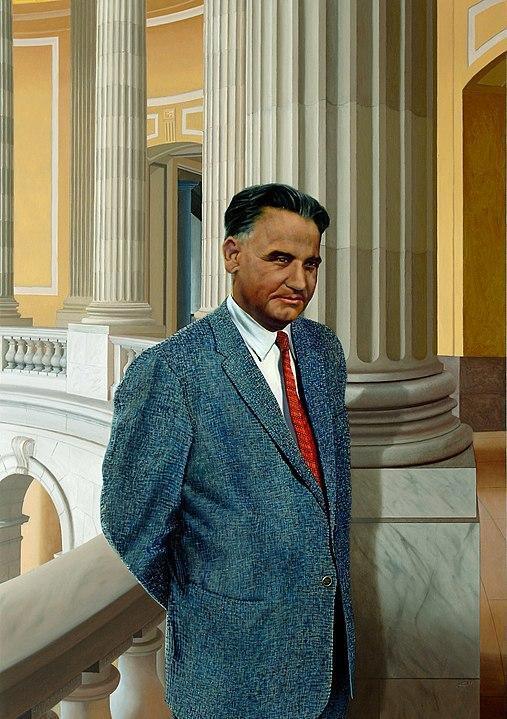
Dalip Singh Saund was one of the first to benefit from this law, naturalizing and later making history as the first Asian American elected to the U.S. Congress in 1956.

Once elected, Saund worked to fight the kind of discrimination he had faced firsthand. His time in Congress was marked by his dedication to civil rights and the immigrant cause, proving that once given the chance, immigrants could contribute not just economically but politically and culturally.

His legacy is a testament to the power of perseverance and the ability to challenge unjust systems.

Yet, today, millions of immigrants, particularly from India, find themselves in a similar situation: stuck in a system that prevents them from fully integrating into American society.

Though they are eligible for green cards and have lived here for years, they face decades-long waits due to an outdated immigration system.

The Green Card Backlog: A Crisis in Need of a Hero

America’s employment-based immigration system is broken, particularly for skilled workers from India. The green card backlog for Indian nationals has swelled to over a million people.

These individuals work in essential sectors like technology, medicine, and engineering, but their contributions are not enough to overcome the bureaucratic bottleneck they face.

Due to the outdated per-country cap system, which limits the number of green cards issued to any one country to 7% of the total, Indians in particular suffer.

Despite their large numbers and essential contributions to the U.S. economy, they face disproportionately long wait times, sometimes spanning decades.

Many live in limbo, unable to fully commit to their futures in the U.S., despite having spent years, even decades, working here.

Why Dalip Singh Saund’s Spirit Is Needed

1. A Leader Who Understands the Pain of Immigration Struggles

Dalip Singh Saund knew the struggles of being an immigrant excluded from the system, just as those in the green card backlog know the pain of living in limbo.

He personally experienced the harsh realities of discriminatory policies that kept Indian immigrants from becoming citizens. Similarly, the United States needs someone who has firsthand experience with the green card backlog—someone who has endured the seemingly endless wait, who has felt the anxiety of uncertain status, and who has triumphed over it to become a citizen.

It’s not just about securing citizenship, though. This leader needs to channel their personal struggles into political action, following in Saund’s footsteps.

Saund fought for the very rights he was once denied, and America now needs someone who has navigated the green card system, experienced its pitfalls, and emerged determined to fix it for future generations.

Unfortunately, many individuals, once they obtain their green cards and citizenship, lose sight of the struggles they endured.

They get caught up in their careers and daily lives, and the fight for reform fades into the background. But what the system needs is someone who, after achieving citizenship, steps into a political role and strategically fights for those still stuck in the backlog.

The pain of the green card backlog should not be forgotten but used as fuel to drive meaningful change.

2. A Voice for the Voiceless

Like Saund, who spoke out for immigrants when they were a marginalized group in the political landscape, we need a leader who can raise their voice for the Indian nationals trapped in the green card backlog.

Saund’s election to Congress was groundbreaking not just because of his identity, but because he was a tireless advocate for immigrant rights.

The people stuck in the green card backlog need a leader who can articulate their struggles to lawmakers, media, and the public at large—someone who will keep their issues at the forefront of political conversations.

3. A Courageous Reformer

Saund was a man who didn’t shy away from difficult battles. He fought against racial prejudice and discriminatory laws, despite knowing how deeply embedded those biases were in the system.

America needs someone with that same courage today—someone willing to challenge the outdated immigration laws that create backlogs and keep talented, hardworking people from fully participating in American life.

Whether it’s eliminating the per-country caps, increasing the number of employment-based green cards, or clearing the existing backlog, this leader must push for reforms even when the political climate is resistant to change.

4. A Bridge Builder

In a highly polarized political landscape, change cannot happen without building coalitions. Saund understood the value of collaboration, working across party lines to achieve meaningful reform.

Today’s immigration system needs a leader who can do the same. Someone who can rally not just the immigrant community, but lawmakers, businesses, and the public to recognize the necessity of immigration reform. Immigration should not be viewed as a divisive issue but as one that strengthens the country.

5. A Humanitarian Focus

Above all, Dalip Singh Saund never lost sight of the human beings behind the policies he was fighting for. He knew that immigration reform wasn’t just about laws and quotas; it was about real people and their families.

The green card backlog isn’t just a bureaucratic issue—it’s a human crisis. Thousands of families live in a constant state of uncertainty, and many children of green card applicants age out of their parents’ applications, leaving them in legal limbo.

A leader like Saund would remind us of the moral and humanitarian urgency of fixing the system.

Conclusion: A New Dalip Singh Saund for Today

America’s immigration system, particularly for Indian nationals, is in desperate need of reform. With wait times for green cards stretching into decades, the dream of citizenship is slipping further and further away for many.

The U.S. must do better, not just for the economy, but for the people whose lives are trapped in uncertainty.

Dalip Singh Saund’s legacy shows us that change is possible, but it requires bold leadership. We need someone who has lived the experience of navigating the green card backlog, who understands the pain and frustration of being stuck in the system, and who is willing to fight for those who are still struggling.

Like Saund, this leader must take that personal struggle and turn it into political action—becoming a voice for the voiceless, a bridge builder, and a courageous reformer.

America needs another Dalip Singh Saund, someone who will not forget the fight, but instead use it as a driving force to push for the reforms that are long overdue.

The green card backlog is not just a policy issue—it’s a human issue, and we need leaders who will fight for the rights and dignity of those still waiting for their chance to fully realize the American Dream. The time for action is now, and we need bold leadership to make it happen.

Dalip Singh Saund: The First Indian-American Congressman Who Defied the Odds

Imagine this: Forget about green card backlogs and immigration delays. Imagine you’re a legal immigrant in America, working hard, building a life, but there’s one catch—you’re not even allowed to become a U.S. citizen. No matter how long you’ve lived in the country, how much you’ve contributed, the law simply says, “No.” This was the reality faced by countless immigrants like Dalip Singh Saund in the early 20th century, a time when racial barriers stood tall.

Now picture Saund—an Indian immigrant, determined and undeterred—taking on this challenge and going beyond just becoming a citizen. He would rise to break barriers and make history as the first Indian-American Congressman.

Dalip Singh Saund’s story is one that defies the ordinary. Born in a small village in Punjab, India, in 1899, his journey from a rural farming background to becoming the first Indian-American elected to the U.S. Congress is nothing short of extraordinary. Saund’s life is a vivid testament to perseverance, hope, and the belief that even in the face of insurmountable challenges, one person can truly make a difference.

A Humble Beginning in Punjab

Growing up in British India, Saund was raised in a Sikh family rooted in the values of hard work, community, and education. His early years in the village of Chhajjal Wadi, Punjab, were steeped in the agricultural traditions of his ancestors. But Saund was destined for more.

His family, despite their humble means, prioritized education, sending him to schools where he developed a passion for learning. His intellectual spark led him to the University of Punjab, where he studied mathematics and agriculture.

It was during his youth in Punjab that Saund was first drawn to the fight for justice. He actively participated in India’s growing independence movement, inspired by leaders like Mahatma Gandhi. However, he was also inspired by the opportunities that awaited in the West. In 1920, with a spirit of adventure and the determination to seize new opportunities, Saund made the life-altering decision to move to the United States.

Navigating the American Dream

Landing in California, Saund enrolled at the prestigious University of California, Berkeley, where he pursued a Ph.D. in mathematics. But academic achievements were not enough to shield him from the harsh realities of life as an immigrant in the early 20th century.

The racial barriers in America were high, especially for Asians. At the time, U.S. laws like the Immigration Act of 1917 explicitly barred Asian immigrants from becoming citizens. Despite these barriers, Saund made a life for himself, finding work in the agricultural heartlands of California.

He settled in the Imperial Valley, where he worked as a farmer. It was a challenging time. The Great Depression hit rural communities hard, and Saund witnessed firsthand the struggles of fellow farmers and laborers, many of whom were also immigrants. These experiences not only solidified his belief in the values of fairness and equality but also spurred him toward activism. Saund’s determination wasn’t just for his own success; it was for the countless others who were similarly marginalized by systemic racial and social discrimination​.

Overcoming Immigrant Barriers

Saund’s political awakening came as he realized that laws needed to change for immigrants to thrive in America. For years, Indian immigrants were unable to become U.S. citizens due to discriminatory laws.

Saund, along with others in the Indian community, actively campaigned for change. His involvement with the Indian Association of America was instrumental in pushing for the passage of the Luce-Celler Act of 1946, which finally granted citizenship rights to Indian immigrants.

In 1949, after nearly three decades in the U.S., Saund became a U.S. citizen. This was a defining moment not just for him, but for all Indian-Americans in the country. Saund wasted no time in putting his newfound citizenship to use. He quickly dove into local politics, becoming a key figure in the Democratic Party in California’s Imperial Valley.

The Road to Congress

Saund’s entry into politics wasn’t smooth, but his resilience saw him through. In 1952, he ran for and won a position as a judge in California, despite racial attacks from opponents who questioned his background and religion. His calm, witty responses to such prejudice endeared him to many, setting the stage for a much larger political leap.

In 1956, Saund achieved the unimaginable: he ran for Congress in California’s 29th District. The race was fierce, not just because of his political inexperience but also because of entrenched racial biases. His Republican opponent, famed aviator Jacqueline Cochran, played heavily on his ethnicity, but Saund remained undeterred.

He mounted a grassroots campaign that focused on engaging small farmers and business owners, many of whom had come to know and respect him through his years of local service. His relentless efforts paid off, and he became the first Indian-American and the first Asian-American ever elected to the U.S. Congress​ (Source: The HISTORY Channel).

A Champion for Civil Rights and Farmers

Saund’s time in Congress was marked by his tireless advocacy for the causes closest to his heart: civil rights, immigration reform, and support for farmers. He was a passionate supporter of civil rights legislation and played a pivotal role in advocating for immigration policies that would offer more inclusive pathways to citizenship for immigrants, particularly those from Asia. His experiences as an immigrant gave him a unique perspective in Congress, and he consistently fought for the rights of those who had been marginalized.

Saund also worked to foster stronger U.S.-India relations, understanding that diplomacy was key to building a peaceful world. His contributions to international diplomacy laid the foundation for the strong U.S.-India ties we see today​ (Source: Encyclopedia Britannica  and Eric Saund).

Lasting Legacy

Saund’s political career was tragically cut short when he suffered a stroke in 1962, just before he could run for a fourth term. He passed away in 1973, but his legacy endures. Dalip Singh Saund’s life remains a beacon of hope and inspiration, particularly for immigrants and minorities in the U.S. His story demonstrates the power of resilience, the importance of representation, and the belief that one person’s courage can change the course of history.

In the decades since his time in office, Saund’s influence has continued to grow. His groundbreaking achievements have inspired generations of Indian-Americans to enter public service. Figures like Bobby Jindal and Kamala Harris owe part of their political journeys to the path that Saund blazed. His legacy also serves as a reminder of the importance of diversity and inclusion in American politics—a fight that continues to this day.

Conclusion: A Legacy of Courage and Determination

Dalip Singh Saund’s life is more than a historical footnote. It is a vibrant example of how one man’s courage, intelligence, and relentless drive for equality reshaped American politics. His legacy as the first Indian-American Congressman is a powerful reminder of the impact immigrants can have in shaping the future of a nation.

Saund’s story, from a small Punjabi village to the halls of the U.S. Capitol, continues to inspire those who seek justice, fairness, and equality in all walks of life. 

7 Reasons: Why Indian Diaspora in the U.S. Remitted Billions to India

The Indian diaspora in the U.S. is among the most active communities globally when it comes to remittances. The flow of money from the USA to India has been a significant economic force driven by various factors. This article delves into the reasons behind this trend, supported by relevant data, charts, and personal statements.

According to the World Bank, in 2023, the Indian diaspora in the U.S. sent approximately   $89 billion out of a total of $125 billion to India, making India the largest recipient of remittances globally.

Media companies have widely reported on this staggering figure, highlighting the economic impact of the Desi-Indian diaspora. But do you know why they are sending this money? This article explores the diverse reasons behind these substantial remittances.

7 Key Reasons for Remittances: Why Indians in the U.S. Are Sending Billions to India-

1. Family Support and Social Obligations

Many in the Indian diaspora have close family ties in India, including parents, siblings, and extended relatives who may depend on financial support. Cultural values emphasize the importance of taking care of one’s family, which includes providing monetary assistance for daily living expenses, healthcare, and education.

Anu, a software engineer in California, shares,

“I send $500 every month to my elderly parents in India to cover their living expenses and medical bills. It’s my way of ensuring they are comfortable and well taken care of.”

2. Investment in Real Estate and Businesses

Members of the Indian diaspora often invest in real estate and businesses in India. With property prices and the entrepreneurial ecosystem growing, many see this as a lucrative opportunity. Investing in their homeland provides a sense of connection and future security.

Sanjay, an entrepreneur in New York, explains,

“I send $1,000 monthly to pay off the mortgage on my apartment in Mumbai. Investing in property back home not only gives me financial security but also a place to return to.”

3. Savings and Retirement Planning

The cost of living in India is generally lower than in the USA, making it an attractive option for savings and retirement planning. Many members of the Indian diaspora send money back home to save or invest in pension plans, insurance, and other financial instruments that offer better returns or benefits in India.

4. Charity and Philanthropy

The Indian diaspora is also known for its philanthropic efforts, which have contributed significantly to charitable organizations, social causes, and disaster relief efforts in India. This form of giving back to society is rooted in cultural and moral values.

Meena, a doctor in Texas, says,

“I donate $200 monthly to a non-profit organization in India that provides education to underprivileged children. Supporting these children’s education is my way of giving back to the community.”

5. Immigration Uncertainty, Green Card Backlogs, and Job Security

The long wait times and uncertainties surrounding green card applications motivate many in the Indian diaspora to maintain financial stability in India. This includes paying off homes, saving for education fees, and securing investments, ensuring a stable life if they need to return to India due to layoffs or visa issues.

Fear of job loss, especially while on H1B or L1 visas, adds to this need for financial security in their home country.

Raj, a tech professional in Seattle, mentions,

“With the green card backlog and potential layoffs, I make sure to have a paid-off house and savings in India. It’s a safety net in case I have to move back.”

6. Gifts and Special Occasions

It is common to send money to cousins, close friends, and family for special occasions like birthdays, anniversaries, weddings, and festivals. This helps maintain strong family bonds despite the distance.

Priya, a marketing manager in Chicago, adds,

“I often send money to my cousins and close friends in India for their birthdays and other special occasions. It keeps our connection strong and shows them I care.”

7. Paying Off Student Loans

Many Indian students come to the U.S. for higher education, often taking out loans to fund their studies. After graduation, they send money back to India to pay off these education loans.

Ravi, a recent graduate working in San Francisco, says,

“I took a loan for my master’s degree in the U.S. Now, I send a significant portion of my salary back home to pay off the loan. It’s important for me to clear this debt as soon as possible.”

Data and Figures

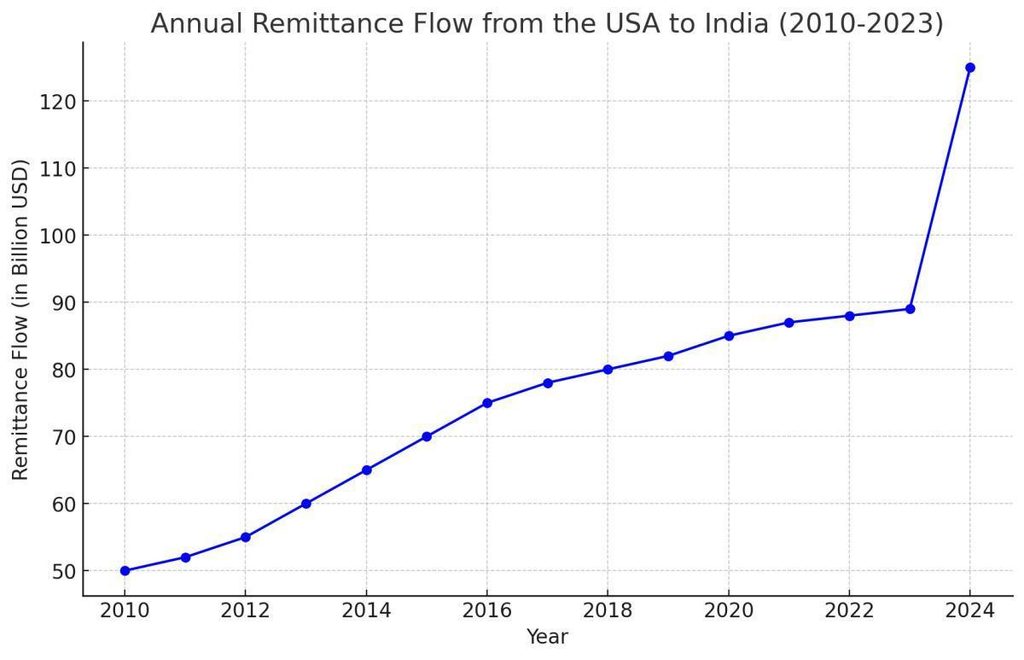
According to the World Bank, India received approximately $125 billion in remittances in 2023, making it the largest recipient of remittances globally. A significant portion of this comes from the Indian diaspora in the U.S. Here are some key data points and trends:

  • Remittance Volume Growth: The remittance volume from the USA to India has been steadily increasing over the past decade. In 2023, remittances from the USA constituted about 25% of the total remittances to India.
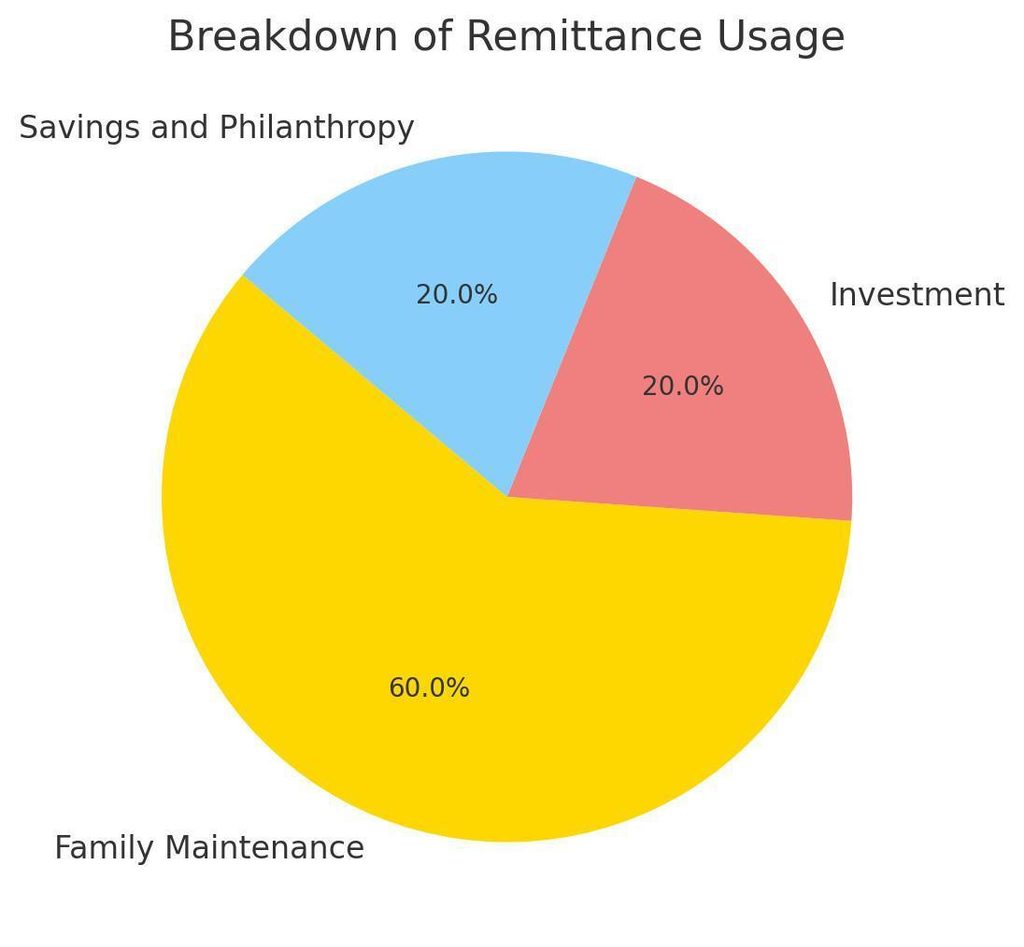
  • Purpose of Remittances: According to a survey by the Reserve Bank of India (RBI), around 60% of remittances are used for family maintenance, 20% for investment purposes, and the remaining for savings and philanthropy.

Visual Data Representation

Below are some charts and graphs to illustrate these trends:

Annual Remittance Flow from the USA to India (2010-2023)

Breakdown of Remittance Usage

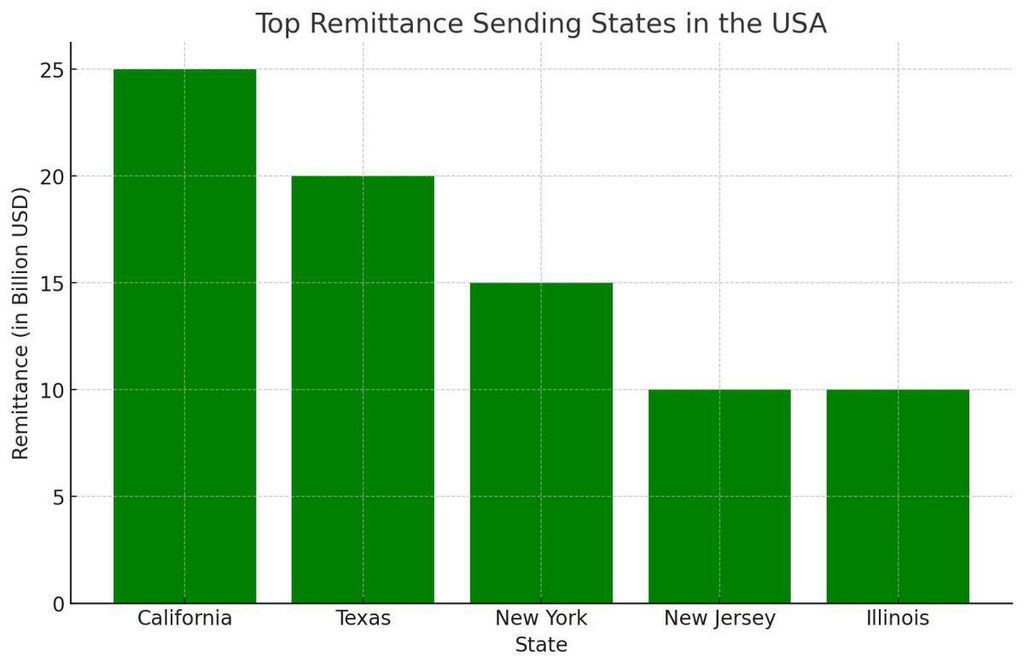
Top Remittance Sending States in the USA

Bar chart showing California, Texas, New York, New Jersey, Illinois remittance amounts.

The flow of money from the Indian diaspora in the U.S. to India is driven by a blend of cultural, economic, and personal factors. Whether it’s supporting family, investing in property, planning for retirement, or contributing to charitable causes, these remittances play a crucial role in the lives of both the senders and recipients. Understanding these trends is essential for grasping the broader economic and social dynamics at play. Jai Ho India!!

Top 10 Places to Buy Gold if You Missed Costco’s Gold Bars

Image Credits: Photo by Michael Steinberg

Every time Vijay’s phone buzzed with a message from a friend, it was always the same — “Gold is back on Costco!” But by the time Vijay would scramble to the website, the gold bars were already gone.

It felt like a race against time, reminding him of his college days in India when booking a train ticket on IRCTC felt like trying to win a lottery.

If you’ve experienced similar frustration with Costco’s elusive gold bars, don’t worry — there are plenty of other reputable places to buy gold without needing lightning-fast reflexes.

Gold has always been a favored investment option due to its stability and value retention, especially during times of economic uncertainty.

According to the World Gold Council, global demand for gold in 2023 increased by 12% compared to the previous year, with North America seeing a significant spike.

While Costco’s limited gold supply may have grabbed headlines, there are numerous other trusted sources where you can secure gold bars, coins, or jewelry.

Here are the top 10 places to consider if you missed out on Costco’s gold bars:


1. Apmex

Why Apmex?
Apmex, short for American Precious Metals Exchange, is one of the largest and most reputable online dealers for precious metals globally. With a well-established reputation and over two decades in the business, Apmex offers customers a wide selection of gold products, making it a go-to option for both novice and seasoned investors.

Product Variety:
Their catalog features a comprehensive array of gold products, including gold bars and coins from well-known mints like PAMP Suisse, Perth Mint, and the U.S. Mint. You can choose from fractional bars for smaller investments to larger 1-kilo bars for bigger portfolio allocations.

Special Features:
Apmex stands out with its user-friendly online platform and mobile app, allowing you to shop and manage your orders conveniently. They also provide transparent pricing and secure shipping, ensuring that you receive your purchases safely.

Official Website: www.apmex.com


2. JM Bullion

Why JM Bullion?
Founded in 2011, JM Bullion has quickly become a trusted name in the industry due to its commitment to customer service and transparent pricing. Whether you’re looking to buy gold for an IRA or just adding to your personal collection, JM Bullion offers a seamless buying experience.

Product Variety:
JM Bullion provides a diverse range of gold products, including bars and coins from prestigious mints like the Royal Canadian Mint and the Austrian Mint. You’ll find both standard investment-grade gold as well as unique, collectible items.

Special Features:
In addition to their competitive prices, JM Bullion offers free shipping on orders over $199, making it a cost-effective choice for investors. They also feature a secure online platform with up-to-date market data, so you can make informed decisions.

Official Website: www.jmbullion.com


3. GoldSilver

Why GoldSilver?
GoldSilver, established by renowned precious metals investor Mike Maloney, is a platform that not only sells gold but also offers an educational perspective on precious metal investments. It’s ideal for those who want to learn more about why investing in gold makes sense, thanks to their in-depth articles and videos.

Product Variety:
They offer a range of products, including American Eagles, Canadian Maple Leafs, and a selection of gold bars from internationally recognized mints. Whether you want a small piece of gold or a more significant investment, GoldSilver has you covered.

Special Features:
The educational resources on GoldSilver set it apart from other platforms. With a library of informative videos, newsletters, and market insights, they help investors understand the broader context of precious metals investing.

Official Website: www.goldsilver.com


4. SD Bullion

Why SD Bullion?
SD Bullion is well-known for offering some of the most competitive prices in the precious metals market. Founded by two doctors with a passion for precious metals, SD Bullion provides a simple and straightforward buying experience with an emphasis on transparency and low premiums.

Product Variety:
From small, fractional-sized gold bars to 1-kilo gold bars, SD Bullion caters to a range of investment needs. They also stock a variety of gold coins, such as American Eagles and South African Krugerrands, ensuring that buyers have ample options.

Special Features:
SD Bullion provides additional savings for those paying via wire transfer and for bulk purchases. Their commitment to maintaining low premiums and offering discounts makes them an attractive option for budget-conscious investors.

Official Website: www.sdbullion.com


5. Money Metals Exchange

Why Money Metals Exchange?
Money Metals Exchange is a trusted platform for gold buyers looking for a seamless, no-hassle experience. Founded by Stefan Gleason in 2010, the company has received several accolades for its customer service and transparency.

Product Variety:
They offer a broad selection of gold bars and coins, including IRA-approved options. You can find everything from American Eagles to British Britannias, catering to various investment goals and preferences.

Special Features:
What sets Money Metals apart is their monthly savings plan, which allows customers to automate their gold purchases. This feature is excellent for those who want to build their gold portfolio gradually. They also have a strong educational platform to guide new buyers.

Official Website: www.moneymetals.com


6. BullionVault

Why BullionVault?
BullionVault is the largest online investment platform for physical gold, giving you the option to buy and store gold in high-security vaults across different countries. It’s a fantastic choice for those who want flexibility and security in their investments.

Product Variety:
You can choose to buy gold in various forms, from small quantities to larger investments. BullionVault allows you to store your gold in secure vaults located in Zurich, London, New York, and other key financial hubs.

Special Features:
Their low storage fees and real-time trading platform set them apart. You can buy and sell your gold instantly, making it feel more like stock trading. This feature is particularly beneficial for active investors who want the option to move quickly based on market trends.

Official Website: www.bullionvault.com


7. Kitco

Why Kitco?
With over 40 years in the precious metals industry, Kitco is a well-established player known for its reliability and broad range of services. They have been trusted by institutional and individual investors alike, making them a top choice for gold purchases.

Product Variety:
Kitco’s catalog includes everything from their own branded gold products to popular coins and bars from international mints. Whether you’re looking for investment-grade gold or collectible items, Kitco has a broad inventory.

Special Features:
Kitco offers a range of unique services, such as live market data, price alerts, and secure storage options. Their comprehensive market insights make them a preferred choice for those who want to stay informed about precious metals trends.

Official Website: www.kitco.com


8. Local Coin Shops

Why Local Coin Shops?
Sometimes, supporting your local coin shop can be a great way to buy gold without the hassle of shipping or waiting times. Local coin shops offer the advantage of immediate physical ownership and often provide personalized service.

Product Variety:
While selection may vary depending on the shop, most local coin dealers carry a mix of modern bullion and historical gold coins. You can walk out of the shop with your purchase in hand and often get expert advice from shop owners.

Special Features:
The opportunity to see and hold the gold before purchasing can provide peace of mind. Many local coin shops also buy back gold, making them a convenient option for both buying and selling.

Official Website: Dependent on your local shop listings.


9. U.S. Mint

Why U.S. Mint?
If you’re looking for gold coins that are backed by the U.S. government, the U.S. Mint is the most direct source. They offer some of the highest-quality coins with a guarantee of weight and purity.

Product Variety:
The U.S. Mint sells a range of gold coins, including the iconic American Gold Eagle and the American Buffalo. These coins are known for their purity and are widely accepted and trusted by investors.

Special Features:
Buying directly from the U.S. Mint ensures authenticity, and you don’t have to worry about counterfeit products. The government-backed guarantee makes these coins a secure investment.

Official Website: www.usmint.gov


10. eBay

Why eBay?
Although not a traditional gold retailer, eBay can be a good source for finding deals on gold products. However, it’s crucial to ensure you’re buying from reputable sellers with strong feedback ratings.

Product Variety:
You’ll find a wide range of gold items on eBay, from small coins and bars to rare collectibles. It’s a versatile platform for those who want to explore different types of gold investments.

Special Features:
The bidding process on eBay allows you to potentially purchase gold at a lower price. However, it’s essential to do thorough research and only buy from highly rated sellers to avoid any issues.

Official Website: www.ebay.com

Final Thoughts

With the rising demand for gold as an investment and a hedge against market volatility, it’s crucial to know where to buy this precious metal from reliable sources. While Costco’s gold bars were a sensation, numerous other options can provide just as much value, if not more.

Whether you’re looking for small gold bars, collectible coins, or larger investments, the top 10 sources listed above cater to a wide range of needs and preferences. Remember to always verify the authenticity of the seller, check customer reviews, and compare prices before making a purchase.

Investing in gold is not just about securing a tangible asset; it’s about building a future of financial security. So, take your time to explore these options, understand what fits your investment strategy, and make informed decisions that will benefit you in the long run.

The H4 Visa: A Modern-Day Sati Pratha?

The H4 visa, often called the “dependent” visa, might sound like a pathway to a promising new life in the United States, but for thousands of women, it’s become a trap—one that shackles them to a life of dependency, stifling their aspirations and potential. What was meant to unite families has turned into a slow, silent burn that echoes the haunting remnants of an age-old tradition: Sati.

An Unexpected Parallel: From Ancient Sati to Modern H4 Visa

Sati (or Suttee) was a brutal practice in ancient India where widows were expected—or sometimes forced—to self-immolate (burn) on their husband’s funeral pyre. It was seen as the ultimate act of devotion, but it was much more than that. It was a grim way to ensure that a woman’s life ended with her husband’s, leaving no room for her to remarry or claim his property.

In many ways, it was a cruel method of ensuring that women had no future without the men they had lost, reinforcing their dependence and erasing their identities.

The Harrowing Reality of Sati

  • Sati was often seen as a way to maintain the purity of lineage and reinforce male dominance by eliminating a widow’s independence. Widows who resisted Sati were often ostracized, stripped of their social standing, and condemned to a life of misery and isolation.
  • Reformers like Raja Ram Mohan Roy campaigned vigorously against this practice, ultimately leading to the British abolition of it in 1829. However, isolated incidents of Sati persisted well into the 20th century, revealing the depth of these beliefs in some communities.
  • It was about control, subjugation, and, most importantly, erasing women’s agency. While the physical practice of Sati has been abolished, its essence—placing women’s worth solely in relation to their husbands—seems to have found a subtle, modern reflection in the H4 visa.

A Modern Echo: H4 Visa as a 21st-Century Sati

Unlike the practice of Sati, the H4 visa doesn’t physically harm women, but it isolates and suppresses them, forcing many to remain in the shadow of their spouse’s career.

These highly educated, ambitious women are often barred from working and pursuing their own careers, making them economically dependent on their spouses. It’s a silent, unseen sacrifice—a metaphorical 21st-century Sati—where women’s ambitions are metaphorically burned in the flames of restrictive immigration policies.

The H4 Visa’s Impact: Loss of Identity and Self-Worth

Take Aarti, for instance. A young architect from Mumbai, she moved to the U.S. with her husband on an H4 visa, brimming with excitement about new possibilities. But that excitement quickly dimmed as she realized she couldn’t practice her profession, get a job, or even engage in meaningful hobbies and receive some money without work authorization.

Days turned into months, and months into years. Her career, which she had worked so hard to build, slowly faded away.

“I chose my husband, but not this life,” she would often say to herself. “What’s left of me now?”

Without her career, she felt like a shadow of her former self, aimlessly drifting in a foreign land. Her story is not unique—countless women on H4 visas are in similar predicaments, left to wonder what their worth is when their talents and skills are kept under lock and key.

The restrictions stripped Aarti of her professional identity, and as time passed, she started to question her value and place in the world. Aarti’s situation, like that of countless others, mirrors the plight of those women who, during the Sati era, were told that their lives held no meaning without their husbands.

Although today’s women on H4 visas are not expected to sacrifice themselves physically, they often sacrifice their personal and professional growth, leading to similar psychological trauma.

Invisible Scars: The Hidden Toll on Mental Health and Relationships

Beyond the obvious financial dependency, the impact of the H4 visa is deeper and more insidious. These women often find themselves trapped in an invisible cage, with walls built by cultural expectations, lack of social support, and a visa status that leaves them vulnerable.

For some, the inability to work or seek financial independence exacerbates the risk of staying in abusive or unhealthy relationships because they feel they have no way out. Without a work permit, they can’t legally support themselves. Without legal support, they can’t seek protection.

In essence, these women are “immigrants within immigrants”—stuck in a place where their voices go unheard, and their potential remains unseen. This enforced dependency creates a power imbalance that is all too easy to exploit.

Like the Sati practice, which sought to control women’s bodies and choices, the H4 visa controls their opportunities and options. Moreover, even when H4 visa holders finally receive EAD approval, many find that re-entering the workforce after years of forced unemployment is challenging, if not impossible. The professional and personal cost of this lost time is immense.

A Wasted Resource: The Cost to Individuals and Society

Let’s not forget the impact on the U.S. economy. These women are not just “dependents”; they are engineers, doctors, scientists, architects—highly qualified professionals who have been sidelined. Imagine having a room full of talented individuals but locking the door and throwing away the key.

That’s what the H4 visa does. There are over 100,000 H4 visa holders with advanced degrees who are either unemployed or underemployed due to visa restrictions. It’s a colossal waste of talent and potential.

A report by the Migration Policy Institute found that if H4 visa holders were allowed to work, they could fill critical skill gaps in STEM and healthcare, contributing billions of dollars to the U.S. economy. Yet, while American companies scramble to find skilled workers, these qualified individuals are confined to domestic roles that don’t use even a fraction of their capabilities.

The Struggle for Change: Legal Battles and Bureaucratic Nightmares

There was a glimmer of hope in 2015, when the Employment Authorization Document (EAD) was introduced, allowing some H4 visa holders to apply for work permits. However, this program has been fraught with legal challenges and bureaucratic backlogs, with many H4 holders waiting for months, even years, to get approval.

And when they do finally get it, they often find re-entering the workforce difficult after such a long hiatus. Skills go stale, confidence wanes, and the sense of being “left behind” becomes a daily reality.

Consider Meera’s story. A 32-year-old marketing professional from Chennai, Meera’s career was soaring until she moved to the U.S. with her husband. Eager to build a new life, she applied for an EAD. But what followed was years of uncertainty and waiting. By the time she finally got approval, the marketing world had moved on without her. Job offers were few and far between.

“I went from being a decision-maker in the boardroom to asking for an allowance to buy groceries,” she shared in a hushed tone, revealing the crushing weight of dependency.

A Call to Action: Breaking the Shackles

Much like the abolition of Sati required a movement and collective outcry against an inhumane practice, the plight of H4 visa holders demands a similar response. It’s time to recognize that these women are more than “dependents”—they are individuals with dreams, ambitions, and the potential to make significant contributions to society.

To truly empower H4 visa holders, the following reforms are essential:

  • Grant Automatic Work Authorization: Ensure that all H4 visa holders have access to an Employment Authorization Document (EAD) without lengthy approval processes.
  • Simplify the Bureaucratic Process: Streamline the application and approval processes for work permits, eliminating the uncertainty that keeps families in limbo.
  • Support Mental Health and Skill Development: Create mental health services and skill development programs tailored to H4 visa holders, allowing them to maintain and update their skills while navigating the uncertainties of their visa status.

Statistics: Numbers and Visuals:

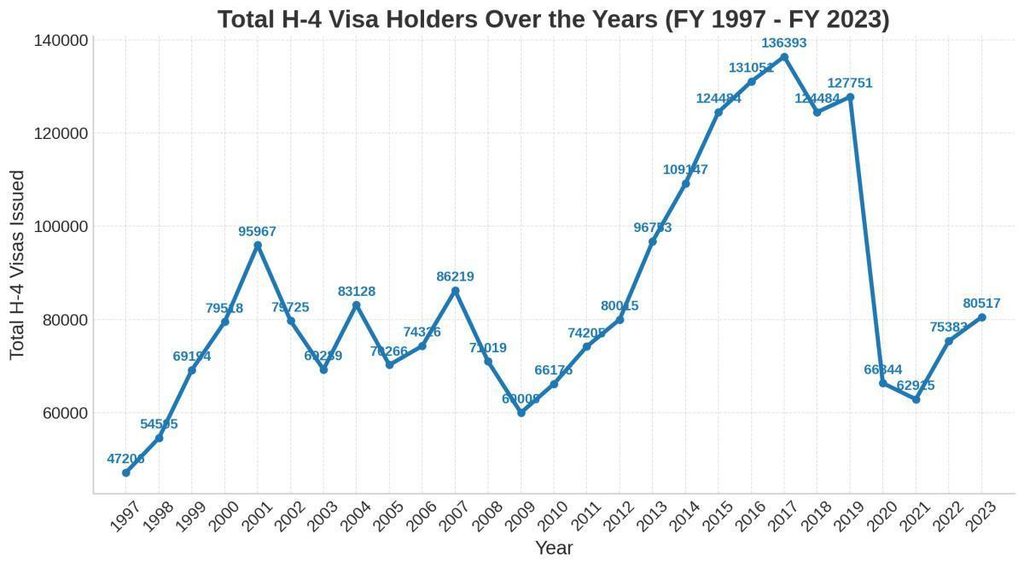
Total H-4 Visa Holders Over the Years (FY 1997 – FY 2023)
Here is the visualization for Total H-4 Visa Holders Over the Years (FY 1997 – FY 2023); these numbers are sourced directly from the official Visa Statistics page of the U.S. Department of State.

Image Credit: Asia91.com

Characteristics of H-4 Visa Recipients
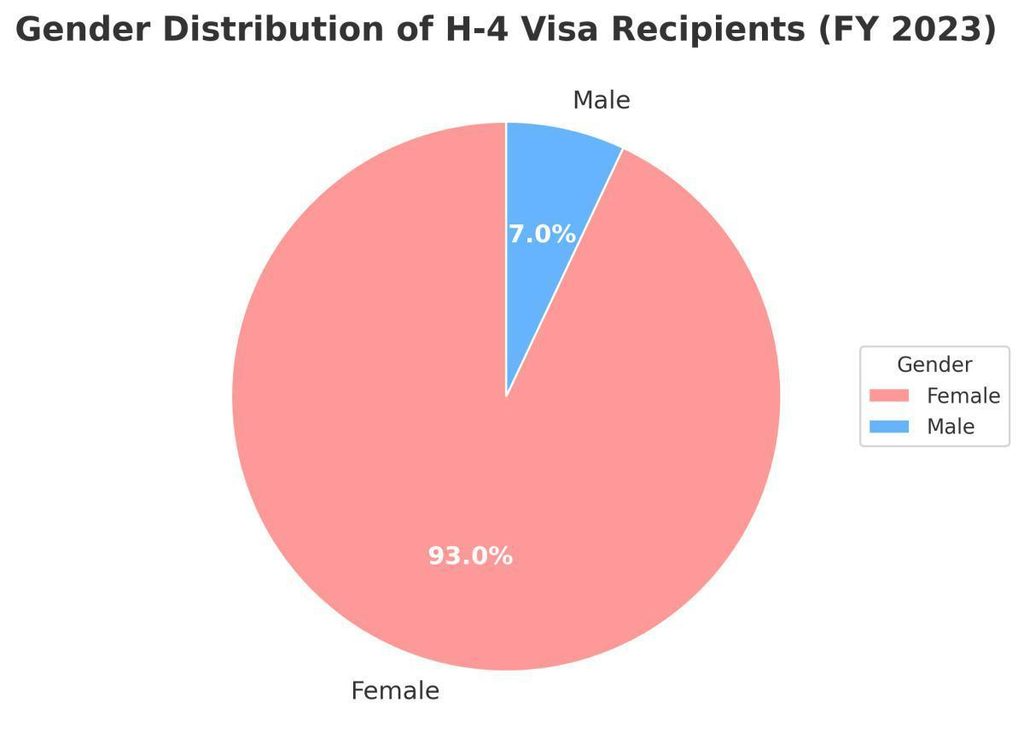
The majority of H-4 visa holders are dependents of H-1B workers. Most H-4 recipients are women, as the visa category is primarily used by spouses. Data indicates that around 93% of H-4 visa holders are female, reflecting the dependent nature of the visa, whereas the primary H-1B visa holders tend to be male (Source: USCIS, 2023).

Image Credit: Asia91.com

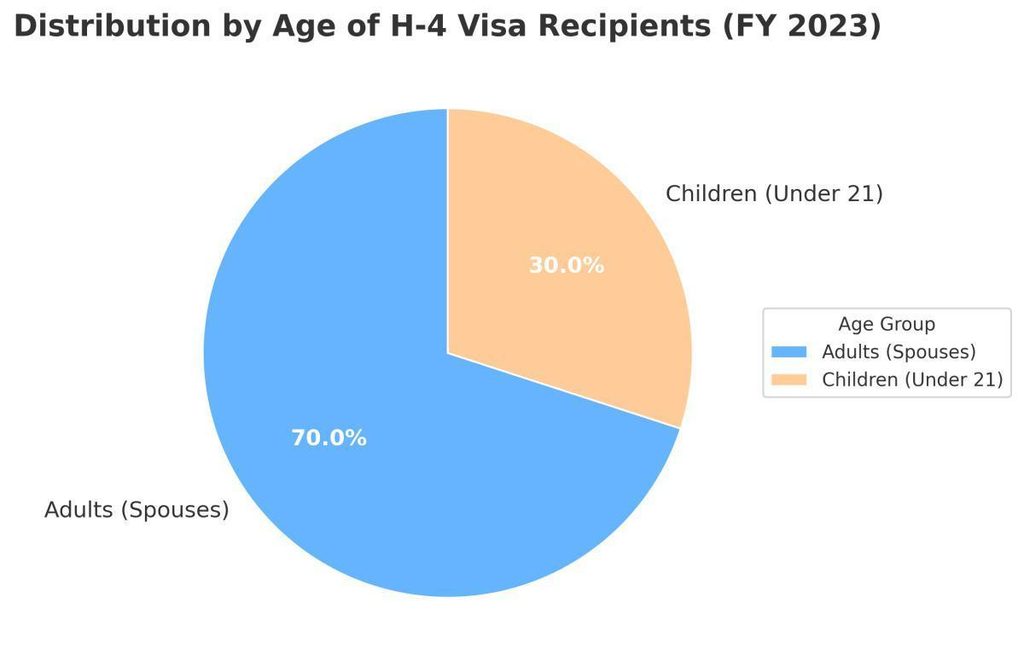
Distribution by Age
While specific age group data wasn’t detailed, the visa generally applies to spouses and children under the age of 21. This indicates that a significant portion of H-4 holders are likely adults (spouses), with a smaller percentage being children under 21 accompanying the primary visa holder.

Educational Background of H-4 Visa Holders
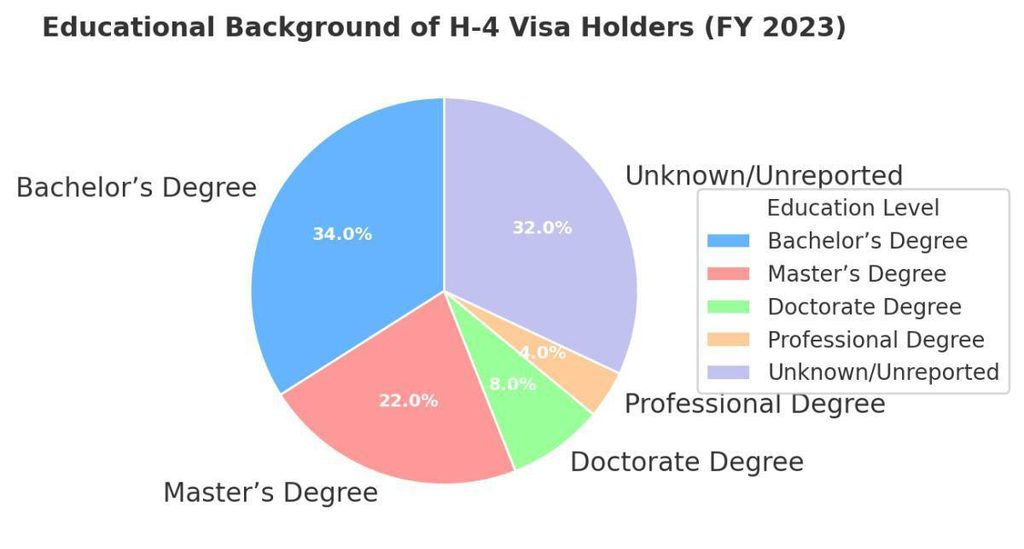
The educational background of H-4 visa holders reveals that the majority (68%) have at least a bachelor’s degree or higher, reflecting a highly educated group. Specifically, 34% hold a bachelor’s degree, 22% have a master’s degree, 8% possess a doctorate degree, and 4% hold a professional degree. However, 32% fall into the “Unknown/Unreported” category due to incomplete data. Compared to the general U.S. working population, where only about 35% hold a bachelor’s degree or higher, H-4 visa holders represent a significantly more educated demographic. This level of educational attainment highlights the potential of H-4 visa holders to contribute meaningfully to specialized fields within the U.S. workforce.

Pie chart showing education levels of H-4 visa holders in 2023.

Economic Contributions
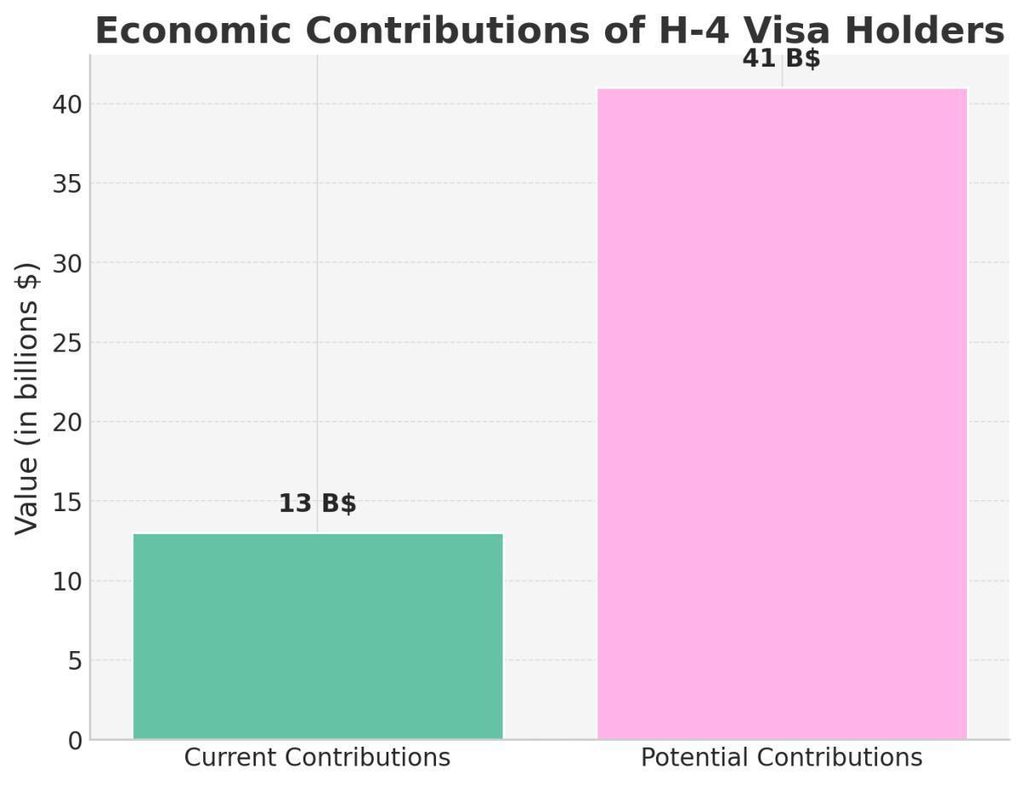
H-4 visa holders contribute nearly $13 billion to the U.S. economy each year. If every eligible H-4 visa holder were granted work authorization, this number could rise to approximately $41 billion annually​ (AAF). This data highlights the significant economic impact that H-4 visa holders could make if given the opportunity to work.

Bar chart showing economic contributions of H-4 visa holders in billions of dollars.

Employment Distribution
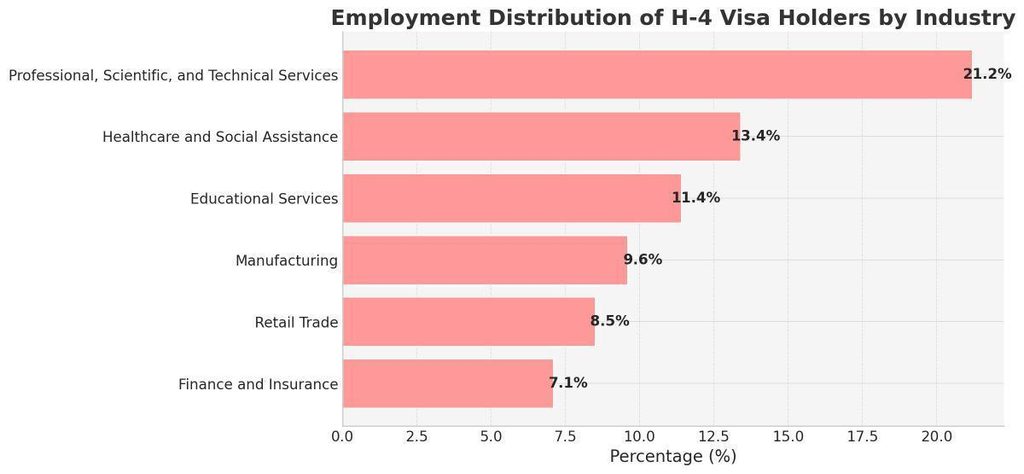
The majority of H-4 visa holders are employed in high-demand fields such as professional, scientific, and technical services (21.2%), healthcare and social assistance (13.4%), and educational services (11.4%)​ (AAF). This demonstrates their potential to fill critical skill gaps in these industries.

Number of H-4 Visa Holders
In FY 2017, a total of 136,393 H-4 visas were issued, with 86% going to family members of workers from India. The number of H-4 visa holders has been steadily increasing, reflecting the growing demand for skilled workers in the U.S.​  as per the American Immigration Council report.

Immigrants’ Economic Role
Immigrant households, including H-4 visa holders, paid over $524.7 billion in taxes in 2021 and held $1.4 trillion in spending power. They also made up 20% of all U.S. entrepreneurs in 2021, showing their significant contributions as both workers and business owners​ .

Conclusion: From Silent Suffering to Empowered Voices

The H4 visa may not subject women to a literal pyre like Sati, but it certainly consigns them to a cycle of invisible suffering—slowly burning away their dreams and ambitions.

Reforming this visa category to include better work authorization policies can help end this modern-day constraint on women’s freedom, enabling them to thrive while contributing positively to society and the economy.

As we look ahead, we must learn from history. Just as Sati was abolished and recognized as an inhumane practice, let us acknowledge that the constraints of the H4 visa are a modern echo of that same oppressive legacy.

By making these changes, we can transform the H4 visa from a symbol of silent suffering into one of opportunity and empowerment for thousands of women, allowing them to reclaim their voices and destinies.