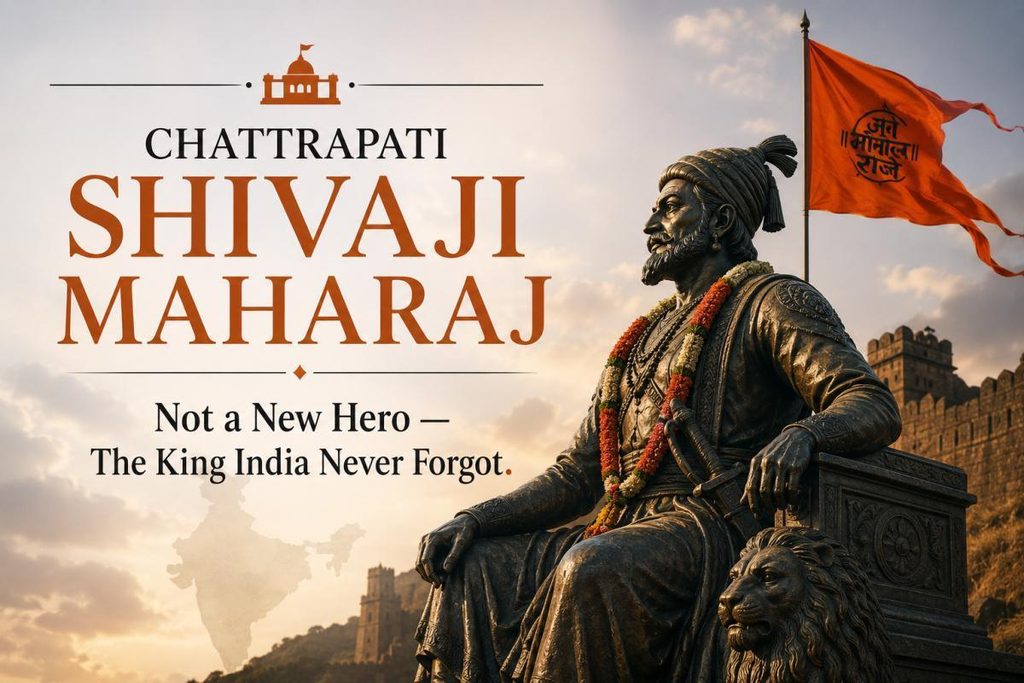
Not a New Hero — The King India Never Forgot.

Statue of Shivaji Maharaj with flag at Chhatrapati Shivaji U.

The New York Times article is under scrutiny for reducing Chhatrapati Shivaji Maharaj’s legacy to contemporary politics.

If someone told an Indian that Chhatrapati Shivaji Maharaj is India’s “new hero,” the reaction would probably not begin with agreement — it would begin with confusion.

That is exactly why a recent New York Times article sparked such intense discussion online.

Titled around the idea that India’s right wing has embraced a 17th-century king as a modern symbol, the article explored how Chhatrapati Shivaji Maharaj’s public visibility has expanded in recent years and argued that his image is increasingly being linked with Hindu nationalism and contemporary politics.

But the controversy that followed was not simply about politics. It was about something deeper: who gets to define historical memory, and whether global media sometimes oversimplifies how India remembers its own icons.

What the New York Times article argues

The central argument of the New York Times article is not that Shivaji Maharaj suddenly became important. Rather, it suggests that in recent years his image has been elevated nationally and increasingly connected with modern political identity — especially under the current political environment.

The article points to visible examples:

– more public statues and memorials,

– stronger national references to Shivaji beyond Maharashtra,

– political speeches invoking his legacy,

– and the broader use of historical figures in shaping public identity.

The article appears to frame this growth as part of a larger political and cultural movement in India — particularly linked to Hindu nationalism and the rise of the BJP over the last decade.

The underlying implication is that historical figures are being reintroduced into national consciousness through contemporary politics.

That argument is not entirely unusual. Governments around the world often draw inspiration from historical personalities to create national narratives. But where the article became controversial was in how many readers interpreted its framing.

The political usage of Shivaji in contemporary India

There is little debate that Chhatrapati Shivaji Maharaj occupies an increasingly visible place in national political language today.

Prime Minister Narendra Modi has repeatedly referenced Shivaji Maharaj in speeches and public events, often presenting him as a symbol of courage, governance, strategic thinking and civilizational confidence.

Large memorial projects and public commemorations have also gained visibility in recent years.

At the same time, Shivaji’s national reach today is wider than before. Historically associated most strongly with Maharashtra and Maratha identity, his symbolism now appears more prominently across different parts of India.

Supporters of this trend argue that this is not political manufacturing but broader recognition of a historical figure whose influence deserved greater national attention.

Many also point to the fact that Shivaji’s memory was never restricted only to one region.

His name has existed for decades in public life — across roads, institutions, airports, textbooks, public celebrations and popular culture.

Supporters of broader recognition also argue that institutions have drawn lessons from his military and administrative thinking.

For example, Shivaji’s emphasis on naval strength is often referenced in discussions around India’s maritime traditions, and his strategic use of terrain and fort systems is frequently discussed in military history and leadership contexts.

However, whether such references amount to historical appreciation or political symbolism depends largely on perspective.

The backlash: “Shivaji was never a new hero”

One of the strongest criticisms of the article came from social media users who argued that the headline itself created a misleading impression.

Among the widely circulated responses was a thread by commentator Indu Viswanathan.

Her central criticism was straightforward:

Shivaji Maharaj was never a forgotten figure waiting to be rediscovered.

She argued that presenting him as a “new hero” creates a false impression for international readers — as if modern politics created his relevance.

Her comparison was striking: describing Shivaji as a new hero, she argued, would be similar to calling George Washington a new hero for Americans.

She also criticized the article’s language choices.

One example she highlighted was describing Shivaji statues as “rising across India.”

Her argument was that such wording subtly changes perception.

Instead of describing public commemoration, she argued, language like “rise” can create associations of political movements, social threat, or ideological expansion.

Her larger point was not that political usage does not exist.

Her argument was that political usage and historical significance are not the same thing.

According to this view, political parties may amplify Shivaji’s visibility, but they did not create his importance.

My view: where the New York Times article feels incomplete

The strongest limitation of the article is not that it discusses politics.

Political usage of historical figures is a valid topic and governments across the world do it. But the article, in my view, underestimates how deeply embedded Chhatrapati Shivaji Maharaj already was in Indian public memory long before the current political environment.

Shivaji’s popularity is not recent.

His symbolic importance did not emerge in the last 10–12 years, nor can it be understood mainly through the rise of one political party.

For generations, Shivaji Maharaj has occupied a major place in Indian public consciousness through education, literature, public institutions, regional identity, cultural memory and political discourse.

His influence has also existed in Indian politics for decades across different periods and movements. References to Shivaji appeared during parts of the Independence movement as a symbol of resistance and self-rule, and later his legacy became strongly associated with regional political mobilisation in Maharashtra, including through parties such as Shiv Sena long before the current government came to power.

This is why reducing his present visibility mainly to recent political promotion feels incomplete.

The article appears to move too quickly from observing increased public celebration of Shivaji to suggesting that his prominence is primarily a result of BJP-era political messaging.

That connection, in my view, overlooks an important distinction:

Political amplification is not the same as political creation.

A government or political movement can elevate, nationalise, or emphasise a historical figure — but that does not necessarily mean it created that figure’s relevance.

This is where I think the article lacks deeper engagement with the historical and emotional impact Shivaji Maharaj has had on Indian society over centuries.

To many Indians, Shivaji is not viewed as a newly constructed political symbol but as a historical personality whose relevance already existed and continues to evolve.

Similarly, the article’s framing risks presenting Shivaji’s growing visibility mainly as evidence of Hindu nationalism or minority marginalisation.

That framing may resonate with a familiar international narrative, but it can also simplify a far more layered reality.

Understanding Shivaji primarily through the lens of contemporary political gain may miss why his image continues to resonate so strongly across generations and regions in the first place.

Conclusion

The New York Times article raises an important discussion about how historical figures continue to shape modern politics. But in doing so, it appears to miss a much deeper reality — Chhatrapati Shivaji Maharaj is not a newly elevated political symbol, but a figure who has occupied a powerful place in India’s historical and political consciousness for generations.

His influence did not begin with the current government, nor can it be explained only through contemporary political narratives. While political parties may amplify his legacy, they did not create it.

The article’s framing may fit a narrative that is easier for Western audiences to understand — one centred on Hindu nationalism and political symbolism — but in doing so, it risks overlooking the historical depth, emotional connection, and long-standing public memory associated with Shivaji Maharaj in India.

Shivaji was never waiting to be rediscovered. And regardless of political cycles, his impact on Indian society and public imagination is likely to continue for generations to come.

The Young Champion serving “Chai” with “Change”

Young boy brewing masala chai for Cancer Council fundraiser at Asia91 event.
Child preparing masala chai for Cancer Council fundraiser at Asia91, promoting awareness and community support.

With the right mindset into reality you can turn one vision by developing a pioneering business idea. This line demonstrates the power of empathy and humanity, this exemplifies the story of a young chai champion of Australia, Prahar. The young boy Who raised dollar 5163 for the cancer council not just by breathing homemade masala Chai but more than that providing an supporting a living structure tailored for individuals battling cancer paragraph change

The generation has become added that to their phones and it is not just about Gen Z but also people from older generation. This is one of those problems that is not half solved by simply identifying it. Amid the difficult to break cycle comes a story which is a beacon of hope. The initiative started with the idea that a simple cup of Chai could tie people together and that child would ultimately support people who have lost their smile facing this life deadly disease.

The story began put the heart at the age of 5 when he watched Harry to meta his mother host cancer council biggest morning tea event and that was struck his mind and he understood then even he could support Cancer Research and patient services.

 With determination in his heart he registered for Australia’s biggest morning tea event he reached out to the family and friends and ask them to encourage him to support his cause he also prepared a heartfelt speech that he gave at his father’s office explaining why he wanted to raise funds for cancer patients will stop the highlight of the campaign came when guests gathered on May 24 add 4th Kingsgrove Scout Hall  to savour the authentic masala Chai wild country grouping for Prahar ‘s  shared vision not be hard .

Prahar  said he simply loved making tea for people and every compliment that came from it made him feel like a superstar. One of the most memorable movements of the event came when a single cup of his masala Chai was auctioned for an impressive 101 Australian dollars.

 The now replaced lemonade stand tradition

Children in Western countries for generation have been encouraged to develop a sense of independence. One of the most iconic  symbols of this culture is lemonade stand which might appear as a simple roadside stall but it was a child’s first lesson in entrepreneurship. Children have children used to set up small tables design poster calculate cost manage profits and they learned to talk with strangers over time.

The stands became more than a summer pastime but a base for young minds to learn business fundamentals “I want to be the boss t” these were  the words of an 8 year old Flannery Partain who confidently declared while preparing to learn her lemonade stand during the American entrepreneurship initiative lemonade day.

The same spirit can be seen in the story of young  desi entrepreneurs stop the now thriving chai  stalls is India’s version of classic lemonade stand the spirit demonstrates and entrepreneurship is not restricted to geography and culture the story is a reminder that people grow and achieve incredible things when given the right support an age does not matter for that using that success to help others change their lives is even more interesting this story equals powerful message from the best selling book by William Kakamwaba” The Boy Who Harnessed the Wind” . In the book, Kakamwaba recounts how, as a teenager in rural Malawi, he taught himself engineering from library books and built a windmill from scrap materials to bring electricity and hope to his village during a devastating famine. His story became an international symbol of youthful ingenuity, resilience, and problem-solving.

In a world full of stories heard , written , spoken this story of a young boy felt deeper. This story is not about the lemonade , not the chai not the charity itself but because of the lessons it holds the conviction and willingness to create a change that is small yet meaningful.

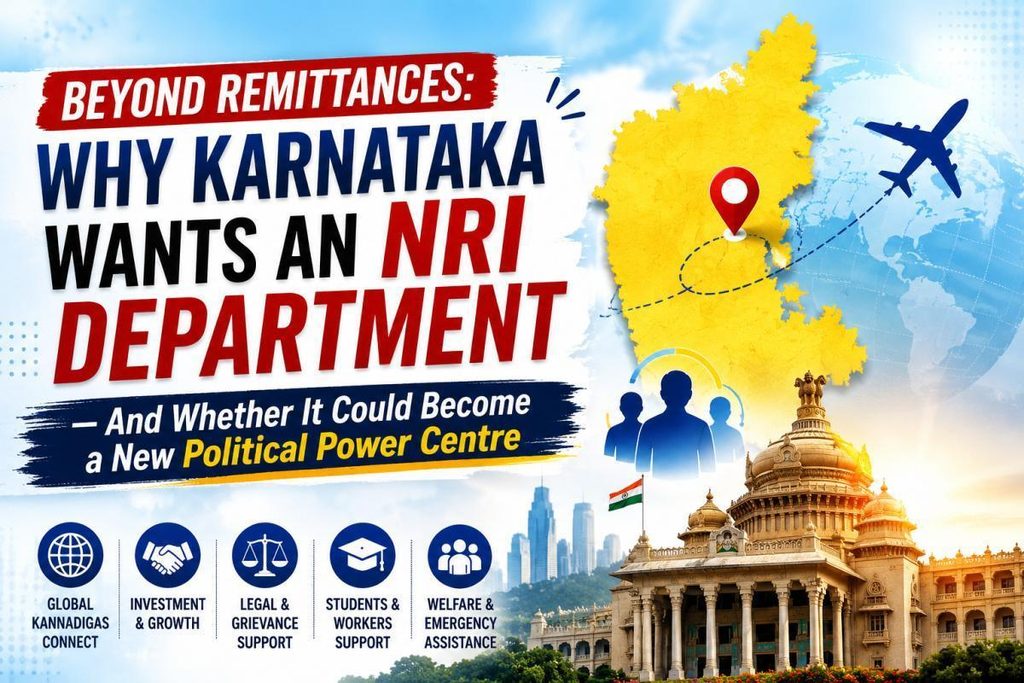
Beyond Remittances: Why Karnataka Wants an NRI Department — And Whether It Could Become a New Political Power Centre

Map of Karnataka with NRI route and airplane icon for connectivity.

The Karnataka government’s proposal to create a dedicated mechanism for Non-Resident Indians (NRIs) has sparked a wider debate about how Indian states engage with their overseas communities.

In recent weeks, overseas Kannadigas organisations have intensified their demand for a dedicated institution to handle the concerns of the state’s global diaspora. A delegation led by entrepreneur and philanthropist Dr. Ronald Colaco met Karnataka leaders and called for a separate ministry, secretariat and directorate to address issues ranging from welfare and legal assistance to investment facilitation and student support.

The discussion gained momentum after Karnataka Deputy Chief Minister D. K. Shivakumar announced plans to establish a dedicated NRI-focused government department aimed at strengthening engagement with overseas Kannadigas and attracting investment into the state. However, subsequent reports indicate that the government is still evaluating the proposal and examining whether a new department would overlap with existing agencies involved in investment promotion and administration. As a result, it remains unclear whether the final structure will be a full-fledged ministry, a department, a secretariat or another institutional arrangement.

The debate reflects a broader trend across India: states increasingly see their overseas populations not merely as emigrants sending remittances home, but as investors, skilled professionals, entrepreneurs and influential global networks.

What Karnataka Is Proposing

According to government announcements and diaspora representatives, the proposed NRI mechanism would focus on:

  •  Grievance redressal for overseas Kannadigas.
  •  Assistance in legal and property-related matters.
  • Support for overseas students and workers.
  • Emergency coordination during crises abroad.
  • Investment facilitation through a single-window system.
  • Stronger links between the state government and the global Kannadigas community.

Supporters argue that Karnataka, despite having one of India’s largest overseas professional communities, lacks a dedicated institutional framework comparable to those operating in several other states.

At the same time, the proposal appears to be evolving. While diaspora groups have demanded a separate ministry, government discussions have increasingly focused on the practical structure and whether existing departments can already perform some of these functions.

Other States Have Already Built Similar Institutions

Karnataka would not be the first state to create a dedicated diaspora-focused institution.

Kerala: India’s Most Developed NRI Model

The benchmark remains Kerala’s Non-Resident Keralites Affairs Department (NORKA), established in 1996 as the first state-level NRI department in India.

Over the years, NORKA has developed into a comprehensive system that includes:

  • Grievance redressal services.
  • Welfare programmes.
  • Insurance schemes.
  • Overseas recruitment support.
  • Assistance during emergencies.
  • Rehabilitation and entrepreneurship support for returning migrants.
  • Dedicated coordination with Indian missions and central government agencies.
  • Kerala has continued expanding these efforts. In recent years, it launched additional welfare and insurance initiatives for expatriate Malayalis and strengthened support systems for overseas workers and returnees.

Because of its institutional depth and longevity, NORKA is often cited as the model that other states seek to emulate.

Punjab maintains a dedicated Department of NRI Affairs along with a State Commission for NRIs.

The department has historically concentrated on:

  • Property disputes involving overseas Punjabis.
  • Legal assistance.
  • Complaint redressal.
  • Coordination with police and district administrations.

Punjab’s model emerged largely because of the large Punjabi diaspora in countries such as Canada, the United Kingdom, the United States and Australia.

Rajasthan: The Newest Entrant

Rajasthan recently established the Department of Domestic and Overseas Rajasthani Affairs (DORA).

The department focuses on:

  • Engagement with overseas Rajasthanis.
  • Investment promotion.
  • Diaspora outreach.
  • Grievance handling.

Because the initiative is relatively new, it is still too early to assess its long-term effectiveness.

Other States

Several other states have diaspora-focused bodies, though not always full ministries or departments.

These include:

  • Gujarat’s Non-Resident Gujarati initiatives.
  • Andhra Pradesh’s overseas Telugu engagement programmes.
  • Telangana’s NRI cell and migrant welfare efforts.
  • Tamil Nadu’s Overseas Tamils Welfare mechanisms.
  • Uttar Pradesh’s Pravasi engagement programmes.

The structures differ significantly, but the common goal is to maintain stronger links with overseas communities.

Why Governments Want Dedicated NRI Institutions

Supporters of dedicated NRI departments argue that they serve practical administrative needs rather than purely political objectives.

Millions of Indians live and work abroad. Many encounter challenges involving:

  • Labour disputes.
  • Immigration issues.
  • Property conflicts.
  • Documentation problems.
  • Fraud and recruitment scams.
  • Emergency evacuations.
  • Repatriation after deaths or crises.

Because responsibility for these issues is often spread across multiple agencies, a dedicated department can act as a single point of contact.

Investment and Economic Benefits

States also view their diasporas as valuable economic partners.

NRIs frequently invest in:

  • Real estate.
  • Healthcare.
  • Education.
  • Startups.
  • Infrastructure projects.

A specialised institution can reduce bureaucratic hurdles and provide a single-window mechanism for investors.

For Karnataka in particular, this argument carries weight because many overseas Kannadigas work in technology, engineering, medicine and business sectors that align closely with the state’s economic priorities.

Emergency Response

Events such as the COVID-19 pandemic, conflicts in West Asia and sudden labour crises have demonstrated the importance of organised communication channels between governments and overseas citizens.

Departments like NORKA have often played an important role during such emergencies by coordinating with Indian embassies and helping affected expatriates.

The Limits of State-Level NRI Departments

Despite their benefits, such institutions face significant limitations.

Foreign affairs remain the exclusive responsibility of the Union government.

State governments cannot:

  • Issue visas.
  • Conduct diplomacy.
  • Negotiate with foreign governments.
  • Directly intervene in immigration policies.

As a result, state NRI departments largely function as coordination and facilitation bodies.

Another challenge is administrative overlap. Many of the functions proposed for NRI departments are already handled by investment agencies, labour departments, revenue authorities, police departments or the Ministry of External Affairs.

This concern appears to be one reason Karnataka is reviewing its proposal before making a final decision.

Are NRIs Becoming a Political Constituency?

The Karnataka debate also raises a broader political question.

Traditionally, NRIs were viewed primarily through the lens of remittances and economic contributions. Today, they are increasingly recognised as influential global communities with financial resources, professional networks and significant social influence.

Although most overseas Indians cannot easily participate in elections without travelling to India, diaspora groups often influence public opinion through:

  • Community organisations.
  • Social media networks.
  • Business associations.
  • Philanthropic initiatives.
  • Political advocacy campaigns.

This has led some critics to question whether governments are creating NRI institutions primarily for welfare purposes or partly to cultivate influential support networks abroad.

Critics argue that if such departments are not carefully structured, they could evolve into:

  • Patronage networks.
  • Donation channels.
  • Elite lobbying platforms.
  • Preferential access systems for wealthy expatriates.

Supporters counter that these concerns should not overshadow the genuine administrative needs of millions of overseas Indians. They argue that transparency, independent oversight and clear accountability mechanisms can prevent misuse.

What Has the Central Government Done for NRIs?

The Union government has significantly expanded diaspora engagement over the past few years.

Key initiatives include:

  • Expansion of digital consular services.
  • Continued reforms under the e-Migrate system to protect overseas workers.
  • Pravasi Bharatiya Divas outreach programmes.
  • Increased focus on Overseas Citizen of India (OCI) services.
  • Measures to simplify investment and financial transactions for NRIs and OCIs.
  • Consular assistance and evacuation support during international crises.

The central government’s approach has generally focused on economic engagement, worker protection, cultural ties and strategic outreach rather than creating a separate political constituency.

A Test Case for the Future

Karnataka’s proposal comes at a time when states are increasingly competing for global capital, skilled professionals and diaspora engagement.

Whether the state eventually creates a ministry, department, secretariat or another institutional mechanism, the debate highlights a larger transformation in Indian governance.

Overseas Indians are no longer seen solely as remittance senders. They are increasingly viewed as investors, innovators, knowledge partners and global ambassadors for their home states.

The success of any future Karnataka NRI institution will ultimately depend on whether it delivers practical benefits—faster grievance redressal, better investment facilitation and stronger welfare support—or whether it becomes another layer of bureaucracy.

The larger question remains unresolved: are Indian states building these institutions because NRIs genuinely need them, or because overseas communities are becoming an increasingly valuable source of influence, funding and political capital?

Dowry: India’s Most Successful Illegal Marketplace

Traditional Asian marriage ceremony with couple, wedding decor, and symbolic items.

The law banned it. Society simply found better ways to continue it.

Dowry may be one of India’s most successful illegal marketplaces.

It survives court judgments, police complaints, awareness campaigns, social media outrage, and generations of promises to change. Publicly, it is condemned. Privately, it continues to flourish. It is disguised as affection, justified as tradition, and defended as a social norm.

Every wedding album captures smiling faces, decorated mandaps, and celebrations of a new beginning. What it rarely captures are the negotiations that happened before the photographs were taken. The conversations hidden behind courtesy. The expectations disguised as gifts. The transactions wrapped in the language of culture.

The Dowry Prohibition Act stands tall in law books, yet dowry remains an uncomfortable reality in countless homes. What society calls a timeless tradition often shines like gold on the surface but leaves behind corrosion that destroys lives.

Society speaks the language of change. It posts about equality, condemns dowry, and celebrates progress. Yet behind the façade of what is often described as a timeless tradition exists a force that appears as lustrous as gold but ultimately leaves behind rust. What shines in public often destroys lives in private.

Dowry: A Market, Not a Tradition

Society talks about change, posts about equality, and frames dowry as wrong. Yet behind this façade exists a system that continues to operate with remarkable resilience.

The wedding album captures smiling faces of the bride and groom. The wedding bells signal a new journey. Families gather to celebrate a union. What the camera rarely captures, however, are the negotiations, expectations, and silent agreements that precede those celebrations.

The modern dowry conversation rarely begins with demands. It begins with statements such as: “Aapne hume apni beti de di, yahi toh sabse bada tohfa hai.” Yet somewhere between engagement and marriage, gratitude quietly transforms into expectation. “Ek gaadi mil jaati toh dono ke liye achha hota.”

A gesture becomes an obligation. A gift becomes an expectation. A suggestion becomes a demand.

This is where the insights of historian Veena Talwar become particularly relevant. In her book Dowry Murder, she argues that changes in status and property relations transformed what was once considered a daughter’s entitlement into a continuing burden imposed upon her family by the groom’s side.

The objects may have changed. The transaction has not.

When Saving a Marriage Becomes More Important Than Saving a Life

The cases of Deepika Nagar and Twisha Mehta do not appear isolated from this larger narrative. Their stories mirror one another with disturbing familiarity.

When a 24-year-old woman dies after falling from the third floor of the very home where she once dreamed of building her future, questions inevitably follow. Deepika Nagar’s family later alleged that she had faced harassment linked to dowry demands.

Perhaps the most troubling aspect of the case was not merely the allegation itself, but the reconciliation efforts that reportedly took place before her death. These attempts were presented as solutions intended to preserve a sacred marriage.

Beneath the language of reconciliation often lies an uncomfortable reality: adjustment becomes the responsibility of the woman’s family. Preserving the marriage becomes more important than examining the conditions under which that marriage survives.

The institution is protected. The individual bears the cost.

Twisha Mehta, a former Miss Pune who was found dead at her marital home on May 12, raises the concern reflected in Solicitor General Tushar Mehta’s statement: “A divorced daughter is better than a dead one.”

Voice Notes Buried Under ‘Log Kya Kahenge?’

“Mera jeevan narak ho gaya hai.”

A message reportedly sent by Twisha Mehta to her mother shortly before her death.

Why were her voice notes not heard? Why do families continue to believe things will improve? Why does society often treat divorce as a greater failure than suffering? Why do daughters continue to carry the burden of preserving marriages that are already breaking them?

The answers may change. The question remains the same: Why?

The Answer Beneath the Numbers

According to the National Crime Records Bureau, dowry-related crimes witnessed a 14 percent increase in 2023, with more than 15,000 registered cases nationwide and over 6,100 reported deaths in a single year.

Earlier studies paint an equally disturbing picture. Between 1999 and 2016, dowry deaths accounted for nearly 40 to 50 percent of all recorded female homicides annually in India.

As early as 1996, reports from the Indian Police Service documented more than 2,500 cases of bride-burning every year.

The methods evolve. The pattern remains. The faces change. The tragedy does not.

Premchand Saw the Problem Long Before We Did

Munshi Premchand was remarkably ahead of his time when he wrote Nirmala.

The novel explores a young woman who is married to a much older man because her family could not afford the expected dowry following her father’s death.

Dowry redistributes power. It determines who negotiates, who compromises, who carries fear, and who loses control over their future.

More than a century later, the questions raised by Nirmala remain painfully relevant.

Education Changed the Language of Dowry, Not the Practice

When Mary Wollstonecraft, in A Vindication of the Rights of Woman, advocated education as a means of empowering women and helping them build an identity of their own, she was arguing for agency.

Yet education and financial independence alone do not automatically liberate women from the expectations imposed by society, family, and marriage itself.

The cases of Deepika Nagar and Twisha Mehta challenge the assumption that modern education automatically dismantles patriarchal structures. They reveal that dowry has not disappeared in the face of modernity—it has adapted.

Dowry no longer speaks only the language of tradition. Increasingly, it speaks the language of status, prestige, family reputation, and social mobility.

“I do not wish women to have power over men; but over themselves.”

The tragedy of the dowry system persists because many women are educated enough to succeed in public life, yet are denied full control over their choices, fears, and futures within marriage.

Perhaps the greatest tragedy is that women are repeatedly asked to protect institutions that too often fail to protect them.

Conclusion

The real question is no longer whether dowry exists. The real question is why society continues to protect it.

The law may have outlawed dowry decades ago, but social acceptance continues to provide it shelter. It survives because it adapts.

Dowry was never merely a tradition. It was always a transaction—one disguised as culture, protected by silence, and sustained by social acceptance.

Until society becomes more concerned about protecting daughters than protecting appearances, the marketplace will remain open.

The law banned dowry decades ago. Society is still negotiating its price.

One Cognizant Call — Now a $380 Million Bill

You’d think a company known for disinfecting just about everything would be better at cleaning up cyber messes.  But in August 2023, Clorox found itself knee-deep in a digital disaster that had nothing to do with bleach and everything to do with a hacker group called Scattered Spider.  And now, two years later, that little … Read more