 Skip to content
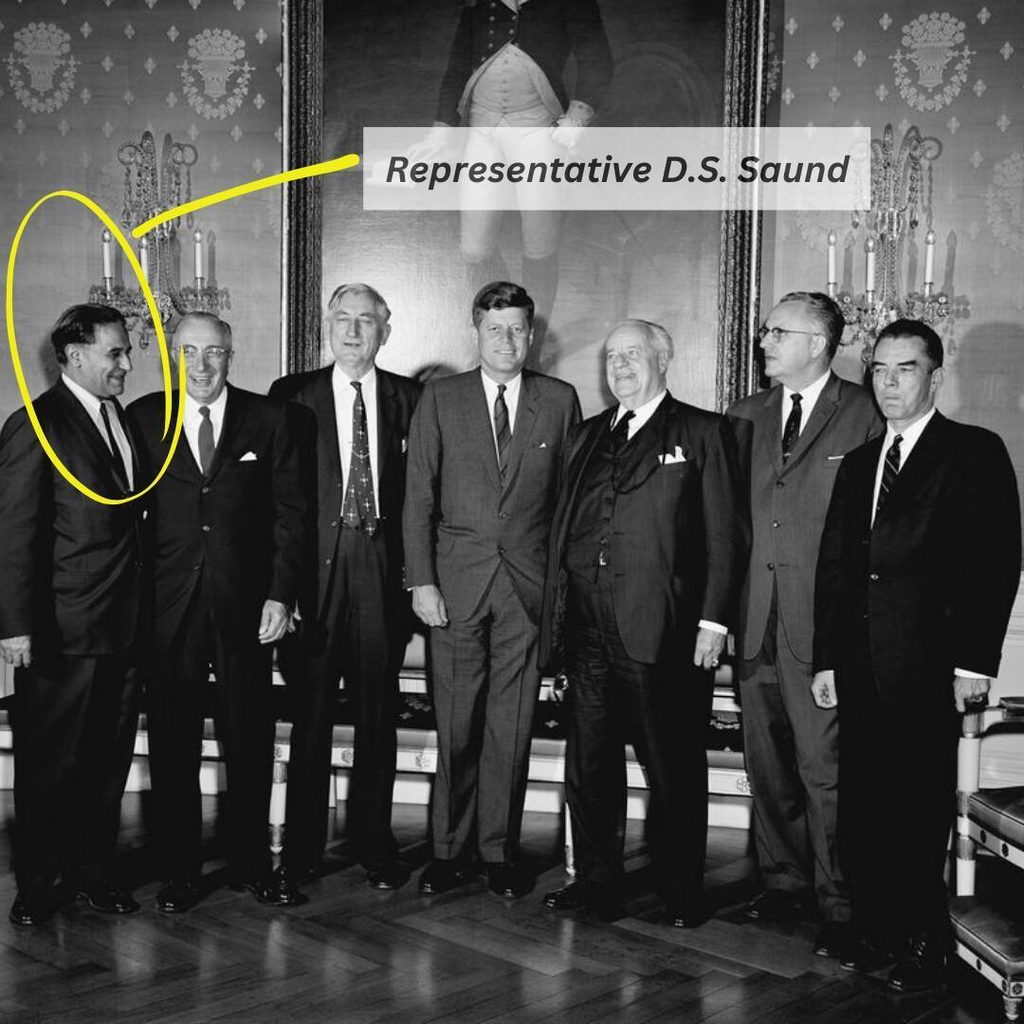
Imagine this: Forget about green card backlogs and immigration delays. Imagine you’re a legal immigrant in America, working hard, building a life, but there’s one catch—you’re not even allowed to become a U.S. citizen. No matter how long you’ve lived in the country, how much you’ve contributed, the law simply says, “No.” This was the reality faced by countless immigrants like Dalip Singh Saund in the early 20th century, a time when racial barriers stood tall.
Now picture Saund—an Indian immigrant, determined and undeterred—taking on this challenge and going beyond just becoming a citizen. He would rise to break barriers and make history as the first Indian-American Congressman.
Dalip Singh Saund’s story is one that defies the ordinary. Born in a small village in Punjab, India, in 1899, his journey from a rural farming background to becoming the first Indian-American elected to the U.S. Congress is nothing short of extraordinary. Saund’s life is a vivid testament to perseverance, hope, and the belief that even in the face of insurmountable challenges, one person can truly make a difference.
A Humble Beginning in Punjab
Growing up in British India, Saund was raised in a Sikh family rooted in the values of hard work, community, and education. His early years in the village of Chhajjal Wadi, Punjab, were steeped in the agricultural traditions of his ancestors. But Saund was destined for more.
His family, despite their humble means, prioritized education, sending him to schools where he developed a passion for learning. His intellectual spark led him to the University of Punjab, where he studied mathematics and agriculture.


It was during his youth in Punjab that Saund was first drawn to the fight for justice. He actively participated in India’s growing independence movement, inspired by leaders like Mahatma Gandhi. However, he was also inspired by the opportunities that awaited in the West. In 1920, with a spirit of adventure and the determination to seize new opportunities, Saund made the life-altering decision to move to the United States.
Navigating the American Dream
Landing in California, Saund enrolled at the prestigious University of California, Berkeley, where he pursued a Ph.D. in mathematics. But academic achievements were not enough to shield him from the harsh realities of life as an immigrant in the early 20th century.
The racial barriers in America were high, especially for Asians. At the time, U.S. laws like the Immigration Act of 1917 explicitly barred Asian immigrants from becoming citizens. Despite these barriers, Saund made a life for himself, finding work in the agricultural heartlands of California.
He settled in the Imperial Valley, where he worked as a farmer. It was a challenging time. The Great Depression hit rural communities hard, and Saund witnessed firsthand the struggles of fellow farmers and laborers, many of whom were also immigrants. These experiences not only solidified his belief in the values of fairness and equality but also spurred him toward activism. Saund’s determination wasn’t just for his own success; it was for the countless others who were similarly marginalized by systemic racial and social discrimination.
Overcoming Immigrant Barriers
Saund’s political awakening came as he realized that laws needed to change for immigrants to thrive in America. For years, Indian immigrants were unable to become U.S. citizens due to discriminatory laws.
Saund, along with others in the Indian community, actively campaigned for change. His involvement with the Indian Association of America was instrumental in pushing for the passage of the Luce-Celler Act of 1946, which finally granted citizenship rights to Indian immigrants.
In 1949, after nearly three decades in the U.S., Saund became a U.S. citizen. This was a defining moment not just for him, but for all Indian-Americans in the country. Saund wasted no time in putting his newfound citizenship to use. He quickly dove into local politics, becoming a key figure in the Democratic Party in California’s Imperial Valley.
The Road to Congress
Saund’s entry into politics wasn’t smooth, but his resilience saw him through. In 1952, he ran for and won a position as a judge in California, despite racial attacks from opponents who questioned his background and religion. His calm, witty responses to such prejudice endeared him to many, setting the stage for a much larger political leap.
In 1956, Saund achieved the unimaginable: he ran for Congress in California’s 29th District. The race was fierce, not just because of his political inexperience but also because of entrenched racial biases. His Republican opponent, famed aviator Jacqueline Cochran, played heavily on his ethnicity, but Saund remained undeterred.
He mounted a grassroots campaign that focused on engaging small farmers and business owners, many of whom had come to know and respect him through his years of local service. His relentless efforts paid off, and he became the first Indian-American and the first Asian-American ever elected to the U.S. Congress (Source: The HISTORY Channel).
A Champion for Civil Rights and Farmers
Saund’s time in Congress was marked by his tireless advocacy for the causes closest to his heart: civil rights, immigration reform, and support for farmers. He was a passionate supporter of civil rights legislation and played a pivotal role in advocating for immigration policies that would offer more inclusive pathways to citizenship for immigrants, particularly those from Asia. His experiences as an immigrant gave him a unique perspective in Congress, and he consistently fought for the rights of those who had been marginalized.
Saund also worked to foster stronger U.S.-India relations, understanding that diplomacy was key to building a peaceful world. His contributions to international diplomacy laid the foundation for the strong U.S.-India ties we see today (Source: Encyclopedia Britannica and Eric Saund).
Lasting Legacy
Saund’s political career was tragically cut short when he suffered a stroke in 1962, just before he could run for a fourth term. He passed away in 1973, but his legacy endures. Dalip Singh Saund’s life remains a beacon of hope and inspiration, particularly for immigrants and minorities in the U.S. His story demonstrates the power of resilience, the importance of representation, and the belief that one person’s courage can change the course of history.
In the decades since his time in office, Saund’s influence has continued to grow. His groundbreaking achievements have inspired generations of Indian-Americans to enter public service. Figures like Bobby Jindal and Kamala Harris owe part of their political journeys to the path that Saund blazed. His legacy also serves as a reminder of the importance of diversity and inclusion in American politics—a fight that continues to this day.
Conclusion: A Legacy of Courage and Determination
Dalip Singh Saund’s life is more than a historical footnote. It is a vibrant example of how one man’s courage, intelligence, and relentless drive for equality reshaped American politics. His legacy as the first Indian-American Congressman is a powerful reminder of the impact immigrants can have in shaping the future of a nation.
Saund’s story, from a small Punjabi village to the halls of the U.S. Capitol, continues to inspire those who seek justice, fairness, and equality in all walks of life.

Mandavi holds a master’s degree in English literature and is passionate about exploring the intersections of politics, culture, art, and literature. With a curious and analytical mind, she is drawn to storytelling and crafting narratives that capture the complexity of the human experience.