 Skip to content
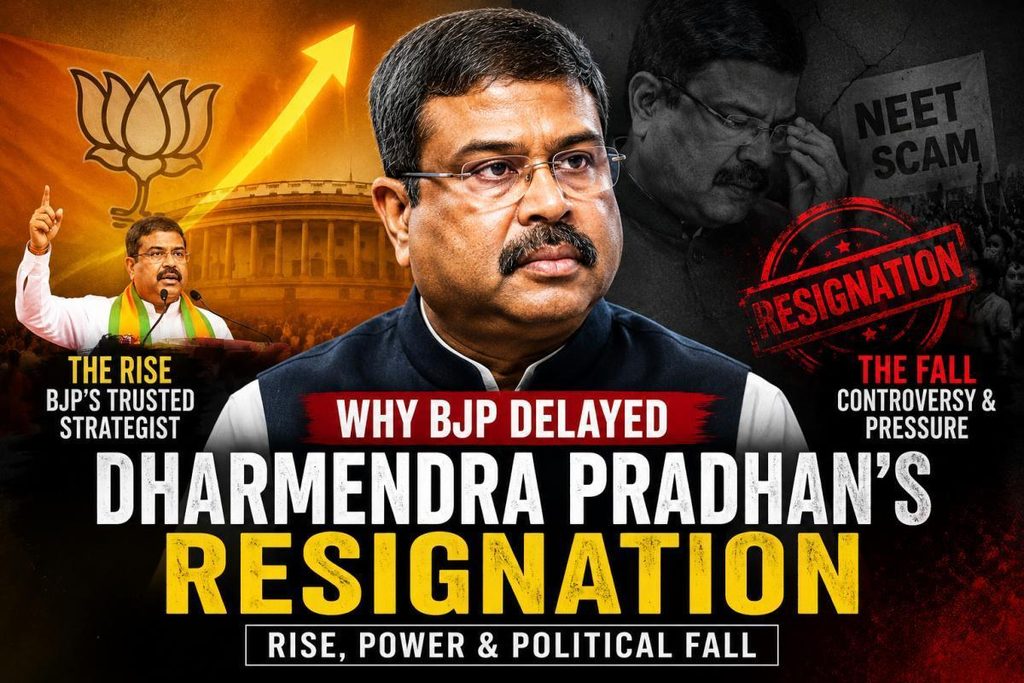
Why the Modi government took so long to let him go!
On 25th July, an unprecedented event happened! A minister from the Modi government resigned. A government known for its habit of not kneeling down, known for taking strong and controversial decisions, succumbed in front of the public outrage and made its Education Minister, i.e., Dharmendra Pradhan, resign.
The foundation of this monumental event was laid much before, on May 3rd, when the catastrophe of the NEET paper leak happened.
Now, as I am writing this article on 26th July, almost everybody knows what transpired during these two months. A popular online movement by the name of “Cockroach Janta Party,” led by a student, Abhijit Dipke, started gaining momentum. A movement which initially started out as a satirical response to the rather insensitive comments made by the CJI got a lot of traction and support when it started raising the issue of the NEET paper leak and demanding the resignation of the sitting Education Minister.
The movement initially didn’t get any attention from the ruling party and was brushed off as a mere online trend. But little did they know that, in just a matter of a few weeks, this would turn into a full-blown mass agitation, with thousands of Gen Z marching together and demanding accountability and the resignation of the incumbent minister—Dharmendra Pradhan.


The above was the complete overview of the situation, or at least I tried to condense it into a few paragraphs. This article, though, will not be about pointing out the criticisms of the Education Minister—or, I must say, the former Education Minister—as you will be hearing them all over the media across various platforms. Rather, I will focus on why it was so difficult for the BJP to let go of this particular minister that they almost turned the whole nation against themselves.
The significance of Dharmendra Pradhan can be noted from the fact that he continuously served as a Cabinet Minister since 2014, the same year the BJP came to power, making him part of the league of stalwart ministers in the Modi government, such as Rajnath Singh, Amit Shah, Nitin Gadkari, Nirmala Sitharaman, and Piyush Goyal. This fact clearly shows how significant he was to this establishment.
Four major reasons why it was so difficult for the Modi government to let Dharmendra Pradhan go.
- Dharmendra Pradhan’s long ministerial career (2014–2026), the key portfolios he handled, and the major policies associated with his tenure.
- His role in the BJP’s rise and victory in Odisha.
- His political background and influence within the BJP.
- The BJP/RSS organisational culture of resisting immediate political pressure.
Now, let’s discuss the above reasons in detail.
1
Pradhan has continuously served as a minister in the cabinet from 6 May 2014, when the Modi government first assumed office, until his resignation on 25 July 2026. Over this period of more than twelve years, he handled some of the government’s most consequential portfolios—including Petroleum and Natural Gas, Skill Development and Entrepreneurship, Steel, and Education.
With the uninterrupted serving period of 12 years, Pradhan was also associated with some of the most crucial policies and initiatives rolled out by the Modi government and the ministries he headed.
Under his leadership as the petroleum minister, the Pradhan Mantri Ujjwala Yojana (PMUY) was launched in 2016.
The scheme aimed to provide free LPG connections to women from poor households. Under his tenure, the government achieved the groundbreaking target of 8 crore LPG connections by September 2019, almost two years ahead of the original deadline.
The transformation was not limited to one welfare scheme alone. When the Modi government assumed office in 2014, India’s LPG coverage stood at 55.9%, over the next decade, that figure rose to near-universal coverage, with active domestic LPG consumers increasing from 14.5 crore in 2014 to over 33.3 crore.
Pradhan’s responsibility, though, was not just restricted to the petroleum ministry as he was later entrusted with the Ministry of Skill Development and Entrepreneurship.
He oversaw the expansion of the Skill India Mission and the Pradhan Mantri Kaushal Vikas Yojana (PMKVY). The ministry increasingly focused on industry-oriented skill development, vocational education and apprenticeship programmes aimed at improving employability among India’s youth.
With also briefly serving as union steel minister, he was handed the most crucial and what proved to be his last assignment as the minister in this series- the education ministry.
As Education Minister, he was entrusted with implementing the National Education Policy (NEP) 2020, arguably one of the most ambitious education reforms undertaken in independent India. His ministry oversaw the rollout of reforms such as the Academic Bank of Credits, the National Curriculum Framework, greater emphasis on multidisciplinary education, and the expansion of digital learning platforms like DIKSHA, SWAYAM and PM eVIDYA as part of the NEP implementation process.
With the sheer longevity and plethora of ministries he headed, it surely was one of the reason, that it was so difficult for the modi government to relieve him from his duties.
2
The second reason lies outside New Delhi.
To understand Dharmendra Pradhan’s importance within the BJP, one has to travel to Odisha.
For years, Odisha remained like the walls of Troy, where the BJP struggled to establish itself and conquer it. The Biju Janata Dal, under Naveen Patnaik, had dominated the state’s politics for nearly twenty-four years. Breaking that dominance required far more than election speeches; it required years of organisational work.
This is where Dharmendra Pradhan’s role becomes significant.
Political observers have often described him as an organisation man. Long before becoming one of the BJP’s senior ministers, he spent years strengthening the party’s grassroots network in Odisha. He worked on cadre building, organisational expansion, and acted as one of the principal links between the BJP’s central leadership and its state unit.
By the time the 2024 Assembly elections arrived, the BJP had transformed from being a peripheral player into the principal challenger to the BJD. The party eventually formed the government in Odisha for the first time, bringing an end to the BJD’s uninterrupted twenty-four-year rule.Across political commentary and reporting, he has consistently been recognised as one of the architects of the BJP’s organisational rise in Odisha.
For any political party, leaders capable of delivering breakthroughs in electorally difficult states become invaluable assets. From that perspective, Dharmendra Pradhan’s importance extended well beyond the ministries he headed in Delhi.
3
The third reason lies in understanding who Dharmendra Pradhan is within the BJP.
Unlike many leaders who rise primarily through electoral success, Pradhan’s journey has been deeply rooted in the party organisation.
He entered public life through the Akhil Bharatiya Vidyarthi Parishad (ABVP) during his student years. From there, he steadily climbed the organisational ladder, serving in the Bharatiya Janata Yuva Morcha before taking on important responsibilities within the BJP itself.
This kind of political journey matters.
The BJP has traditionally valued leaders who have spent years working within the organisation, gradually rising through different levels rather than emerging overnight. Such leaders often develop strong relationships across the party structure, from grassroots workers to the central leadership.
Pradhan also comes from a family closely associated with the BJP. His father, Debendra Pradhan, served as a Minister of State in Prime Minister Atal Bihari Vajpayee’s government. Growing up in such a political environment meant that organisational politics was not unfamiliar to him.
Over the years, he evolved into one of the BJP’s trusted political managers. Whether it was handling crucial ministries, overseeing election campaigns, or taking organisational responsibilities, the party repeatedly relied on him.
It is this combination of administrative experience and organisational credibility that made him much more than just another Cabinet Minister.
4
The fourth reason is perhaps less about Dharmendra Pradhan himself and more about the political culture and thinking of the BJP as a political and ideological institution.
One characteristic that has consistently defined the BJP over the years is its reluctance to appear as a party that changes its decisions simply because of immediate public outrage. Whether it is criticism from the opposition, television debates, social media campaigns or street protests, the party has often projected itself as an organisation that takes decisions on its own terms rather than allowing the public narrative to dictate its course.
In my opinion, there is also a strategic political reason behind this approach.The moment a government starts removing senior ministers every time a public movement gains momentum, it sets a precedent. It creates an impression that continuous public pressure is enough to arm-twist the government’s hand. Once that precedent is established, every major controversy could potentially turn into a campaign demanding another resignation. Every opposition party, every pressure group and every social media movement would know that if enough noise is created, the government can eventually be compelled to act.
Seen from this perspective, Dharmendra Pradhan’s resignation was never just about one minister. It was also about balancing political accountability with the party’s long-standing image of making decisions on its own terms. That is perhaps why, despite mounting public pressure, the BJP chose not to act immediately and instead took its time before eventually accepting his resignation.
Conclusion
With the resignation of dharmendra pradhan, the cockroach janta party movement has come to an end, and for now things seem to be cooling down. But one thing will be interesting to see, that how the Modi government will tackle and fix the almost irreparable damage this movement has caused to their reputation and narrative, and perhaps the bigger question remains, that will this resignation bring an ultimate end to these mass outrages and public movements, or is it just the beginning of something NEW.

Aditya Bhatia covers politics and current affairs from an Indian-American and NRI perspective.
He is a multimedia journalist and digital storyteller focused on news reporting, video production, and audience-first content. He combines strong storytelling with a commitment to delivering accurate and engaging news across platforms.