 Skip to content
We read 6,142 comments people sent to the government about this new visa fee. Here’s what’s actually in there.
The government wants to charge $103,265 every time a company hires a skilled foreign worker on an H-1B visa. Before that becomes final, anyone can write in and say what they think – and officials have to read it. In the first eight days, 6,142 people did. We read every one and pulled out the numbers, the arguments, and a few things nobody expected.

- What’s actually happening
- Who’s winning the comment war
- The flip nobody saw coming
- Two arguments, one number
- Accusations of caste-based hiring
- Actual lawyers showed up, with citations
- This isn’t just a tech story
- “AI is already doing the job”
- 15 people too scared to give their name
- 410 people brought up Canada, unprompted
- The companies that got named
- The AI prompt someone forgot to run
- The copy-paste campaigns
- From “Based.” to legal essays
- People who think it should be higher
- The part that isn’t funny
- What happens next
A fee, and a very short window to react
Quick version: the H-1B visa lets U.S. companies hire skilled foreign workers – engineers, researchers, doctors, and international students who studied here. The government now wants to charge $103,265 every time a company files one of these visas, on top of fees that already exist.
Before that becomes law, the public gets a chance to say something about it. Anyone can write in, and by law the government has to actually read what people say before finalizing anything. That window opened on August 25, 2026 and runs for 30 days. People used almost all of it in the first eight.
6,142 people wrote in. Almost all of them – 6,140 – typed a real, substantial comment. Not a form checkbox. Not a one-word reaction. Actual paragraphs.

What you’re looking at: each dot is one day, and the number above it is how many comments arrived that day. The chart shoots up on day two – 1,863 comments landed in under 24 hours – then slowly tapers off.


Why it matters: a normal government rule doesn’t get noticed by 1,863 people overnight. Something – a Reddit thread, a WhatsApp forward, a lawyer’s newsletter – pushed people here fast, and they already knew which side they were on.
Source: DHS Docket USCIS-2026-0298, public comments Aug 25–Sep 3, 2026 · Analysis: Asia91
For it, against it, or just venting
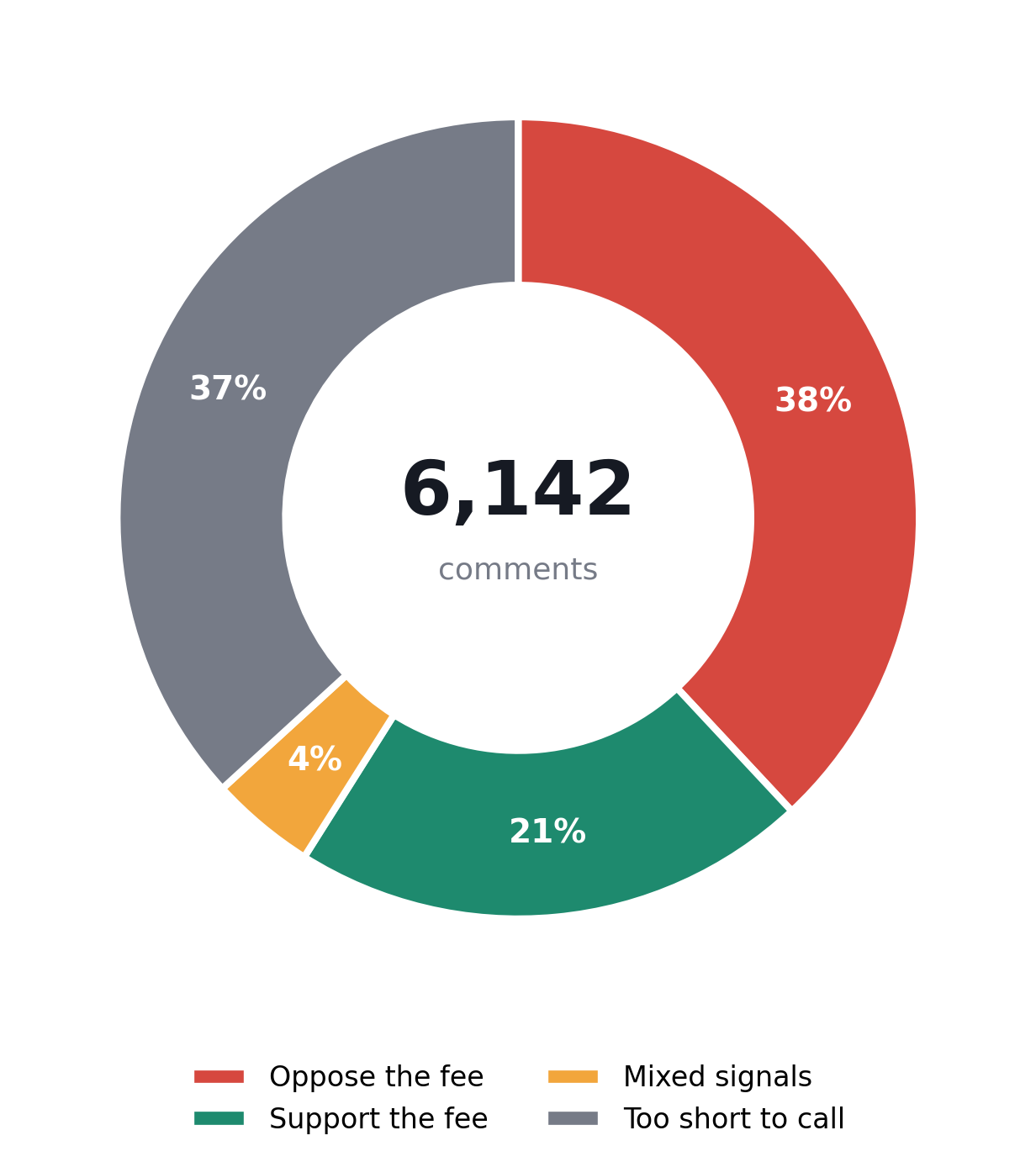
We read every comment and sorted them by tone: does it clearly support the fee, clearly oppose it, do both, or is it too short to tell? This isn’t a scientific poll – it’s a careful read of 6,000+ real comments, one at a time.

What you’re looking at: the whole donut is all 6,142 comments. 38% (red) clearly oppose the fee. 21% (green) clearly support it. The rest are too short or mixed to score – things like “In favor” or a bare link to a file.
Why it matters: among people who took a clear side, opposition beats support by roughly 2 to 1. That’s the headline – but it hides something more interesting, which is what happened hour by hour. Keep reading.
Source: DHS Docket USCIS-2026-0298 · Analysis: Asia91 (keyword-based, not a scientific survey)
Day one leaned one way. Every day after flipped.
On the very first day this went live, comments leaned in favor of the fee. Starting the next morning, that reversed hard – and stayed reversed.

What you’re looking at: each bar is one day. The green part is the share who supported the fee that day, red is the share who opposed it. On Aug 25, green (support) was 71% of the bar. One day later, red (oppose) had taken over and never gave it back.
Why it matters: this looks like two different online communities racing to find the comment page. Whoever wanted the fee found it first – within hours. Then a much bigger, slower-moving group of H-1B holders, international students, and tech employers arrived and dominated every day after.
Source: DHS Docket USCIS-2026-0298 · Analysis: Asia91
Two sides, arguing about completely different things
Forget “for” and “against” for a second. What are people actually typing about? We searched every comment for specific topics and counted how often each one came up.

What you’re looking at: each bar is one topic, and the number is what share of all 6,142 comments mention it. A comment can mention more than one topic, so these don’t add up to 100%.
Why it matters: “Wages / American workers” and “Innovation / competitiveness” are almost tied at the top – meaning both sides feel equally strongly, they’re just arguing about different things entirely.
Source: DHS Docket USCIS-2026-0298 · Analysis: Asia91
The case against the fee
International students who took out loans years before this fee existed. Small businesses that can’t afford a six-figure hire the way Google can. A legal claim that a court already struck down a similar $100,000 charge as an illegal tax.
The case for the fee
IT staffing firms accused of using the visa as cheap labor. Concern about American tech wages being undercut. A repeated (if fuzzy) claim that most H-1B workers come from one country.
7 things people actually said in the comments
Beyond “for it” or “against it,” the comments contain some genuinely surprising, specific arguments. Here’s the full range – with the numbers to back it up.
Accusations of caste-based hiring
264 comments raise some kind of bias or discrimination issue. Within that group, 22 comments go further than a general complaint – they specifically allege that Indian hiring managers, once promoted into a position to hire, favor candidates from their own caste or community. That’s a much sharper, more specific claim than plain “the system is unfair” venting, and it’s not just one person: several different comments make a similar claim independently.

What you’re looking at: out of all 6,142 comments, how many used each specific word or accusation.
Source: DHS Docket USCIS-2026-0298 · Analysis: Asia91

What you’re looking at: this time the percentages are out of the 264 comments that raised any bias claim, not out of all 6,142 – that’s the fair comparison. Casteism is 8.3% of that smaller group; plain nepotism is a much bigger 30.3%; general “discrimination” is the largest slice at 56.8%.
Why it matters: casteism is real and specific, but it’s the fourth-largest slice of a fairly small pie – context worth having before running a headline with just the number 22.
Source: DHS Docket USCIS-2026-0298 · Analysis: Asia91
A small number of comments in this file went further than argument – they named specific private individuals and linked to their personal LinkedIn profiles as supposed “evidence.” We’re not repeating those names or links. That a federal comment box got used this way is itself worth knowing, which is why we’re mentioning it – but the specific targets don’t belong in any published piece.
A full breakdown of this finding – including the counter-argument for why these claims shouldn’t be taken at face value – runs in its own piece: “Is There a Caste Problem in Tech Hiring?”
Actual lawyers showed up – with citations
553 comments – nearly one in ten – cite a specific U.S. immigration law by name, arguing the government doesn’t even have the legal authority to charge this fee. Others cite the exact court case that already struck down a similar charge. This isn’t public opinion, it’s a parallel legal argument, filed one comment at a time.

What you’re looking at: how many comments name each specific law or legal precedent.
Why it matters: if this rule ever gets challenged in court, the arguments are already sitting right here, in public.
Source: DHS Docket USCIS-2026-0298 · Analysis: Asia91

What you’re looking at: of the 696 comments that cite any legal argument, what share cites each one. INA §286(m) – the core question of whether DHS even has the authority to charge this fee – dominates at 79.5%.
Source: DHS Docket USCIS-2026-0298 · Analysis: Asia91
This isn’t just a tech story
625 comments mention STEM fields directly – but 82 specifically raise healthcare, including rural hospitals that rely on H-1B doctors. If this fee goes through, some small hospitals could quietly lose their only specialist. That’s a very different story than “tech worker visa fight.”

What you’re looking at: how many comments mention each group or specific visa-cap number.
Why it matters: the popular image is “tech workers vs. American coders.” The comments say it’s bigger than that – hospitals, universities, and research labs are all in the mix.
Source: DHS Docket USCIS-2026-0298 · Analysis: Asia91

What you’re looking at: of the 1,385 comments naming a sector or specific cap number, what share goes to each. STEM dominates at 45.1%, but healthcare still gets a real 5.9% – not nothing, for a “tech visa” fight.
Source: DHS Docket USCIS-2026-0298 · Analysis: Asia91
“AI is already doing the job – why do we need the visa?”
A genuinely unexpected argument: 74 comments frame this as AI-versus-everyone, not immigrant-versus-citizen. Some say AI is already doing the technical work H-1B visas were meant for. Others say the opposite: losing global talent now is exactly how the U.S. falls behind China in the AI race – a country named in 165 separate comments.
15 people were too scared to give their name
A small but real detail: 15 comments mention fear of getting in trouble with an employer just for commenting. This is supposed to be a safe, official way to speak up – and some people clearly didn’t feel safe doing it under their own name.
410 people brought up Canada, unprompted
Nobody asked about Canada. 410 comments mentioned it anyway – almost always as “the job just moves there instead.” Add in 165 mentions of China and 54 direct references to “brain drain,” and there’s a real argument here: pricing out global talent doesn’t send the job to Ohio. It sends it to Toronto or Shenzhen.
The companies that got named – for very different reasons
Microsoft, Google, and Amazon get named most – usually in arguments about AI and competitiveness. Cognizant, Infosys, and TCS – the outsourcing firms – get named specifically as the “problem,” almost never in a flattering way.

What you’re looking at: how many comments mention each company. Red bars are outsourcing firms named as part of the “problem.” Green bars are big tech, mostly named around AI and competitiveness.
Why it matters: this could be its own article – a scorecard of who got dragged and why.
Source: DHS Docket USCIS-2026-0298 · Analysis: Asia91

What you’re looking at: of the 147 comments that name a company at all, what share goes to each one. Microsoft alone accounts for over a third.
Source: DHS Docket USCIS-2026-0298 · Analysis: Asia91
Someone submitted the AI prompt instead of the answer
At least five different people submitted the exact same text into the official record. It wasn’t a form letter. It was a raw ChatGPT-style instruction – brackets and all.
Nobody filled in the bracket. Nobody ran the prompt. Someone shared an AI template in a group chat or on Reddit, and at least five people copy-pasted the raw instructions straight into the official government record – the same permanent file as the legal briefs above. Funny, and also a real look at what “organized advocacy” looks like in 2026.
Form letters, from both sides
About 2% of all comments are near-identical to at least one other comment – meaning organized templates were circulating, not just individual people typing in the moment.

What you’re looking at: each bar is one specific piece of text that showed up more than once, and how many times it was copy-pasted.
Why it matters: some of these are clearly advocacy-group talking points dressed up as personal stories. The line between “one person’s real opinion” and “coordinated campaign” is blurrier than it looks.
Source: DHS Docket USCIS-2026-0298 · Analysis: Asia91
From “Based.” to legal essays
The shortest comment is four characters. The longest hits the platform’s character limit. Both are in the same file.

What you’re looking at: comments grouped by length, from a single word (amber) to multi-thousand-character essays (red). The typical comment lands around 700 characters – roughly the length of this paragraph.
Why it matters: 801 comments run past 3,000 characters – long enough to cite specific laws and court cases. At the other end, people just typed “Based.” and moved on. Same file, wildly different effort levels.
Source: DHS Docket USCIS-2026-0298 · Analysis: Asia91
225 people think $103,265 isn’t high enough
Among people who support the fee, plenty didn’t just want the government to keep the number – they wanted it higher. Some by a little. Some by a lot.

What you’re looking at: each bar is a fee amount someone proposed instead of $103,265, and how many comments proposed it.
Why it matters: seven separate people want the fee to be ten million dollars. That’s not really a policy position – it’s a way of saying “just end the program” without literally saying it.
Source: DHS Docket USCIS-2026-0298 · Analysis: Asia91

What you’re looking at: of the 195 comments that proposed some number higher than $103,265, what share picked each tier. Most people who want it higher land in the “$200K or more” range – the $10 million asks are a small, loud minority within that group.
Source: DHS Docket USCIS-2026-0298 · Analysis: Asia91
A government comment page is still the internet
Most of this file is a genuine, real debate – real financial stakes, real frustration, both sides. But a small slice of the anti-immigrant comments cross from disagreeing with a policy into openly hostile language toward Indian applicants specifically, not just criticism of the visa program. It’s a small share of the total – well under 1% used explicit slurs – but it’s sitting in the same permanent government record as everything above. We’re not repeating that language here; the pattern is the point, not the words themselves.
This is still open for comment
The public has until September 25, 2026 to weigh in – so everything above is a snapshot, not the final tally. Comment volume usually spikes again in the last 48 hours of any window like this, and given how fast this one started, the ending could be bigger than the beginning.
By law, the government has to review and respond to the substance of what people said before finalizing anything. Whatever number it lands on, it will have to answer to a record that includes rural hospitals, laid-off engineers, immigration lawyers, a leaked AI prompt, and seven people who think the fee should be ten million dollars.
This is still open for comment.
We’re tracking every new submission until the window closes September 25. Get the update on the Asia91 app before anyone else does.
Desi Community News – Desi Events – Desi News