 Skip to content
A Gen Z girl stands at her bathroom sink, splashing water on her face.
She looks up at the camera, mock horror in her eyes: “Oh my god. I just used water that was supposed to go to AI. Jeff Bezos is going to be so mad at me.”
The reel got millions of views. So did a hundred versions of it — people apologizing to their showers, their swimming pools, their water bottles.
Here’s the twist: the Bezos quote everyone was mocking — that water should be prioritized for AI over human needs — was never real. Fact-checkers traced it to a satire post after his appearance at VivaTech in Paris. He never said it.


But notice what happened. Millions of people saw a billionaire supposedly telling them to drink less water so machines could think more — and believed it instantly. No hesitation. No fact-check needed.
That instant believability is the real story.
Because while the quote was fake, the anxiety behind it is very real. AI data centers do drink billions of gallons of water. They do consume electricity on the scale of entire cities. And communities across America are genuinely asking whether their resources now come second to server farms.
So let’s talk about what’s actually happening — because the truth is stranger than the meme.
“A facility that uses a city’s worth of electricity and millions of gallons of water might employ thirty to a hundred people. That’s it. No jobs boom. No middle-class revival. Just a handful of high-skill technicians and security guards.”
“Water and power constraints — not chip shortages — are now the primary bottlenecks for expansion.”
“Data centers are becoming an important issue in local, state, and potentially federal elections because it is an important subject for voters.”
Have you ever imagined that every time you ask an AI chatbot a question, generate an image, or use a smart assistant, somewhere a building the size of several football fields springs into action?
Imagine a modern-day gold mine.
Except instead of miners digging for precious metal, thousands of processors are digging through data. Instead of pickaxes, there are GPUs. Instead of dynamite, there is electricity.
And instead of gold, the commodity is intelligence itself.
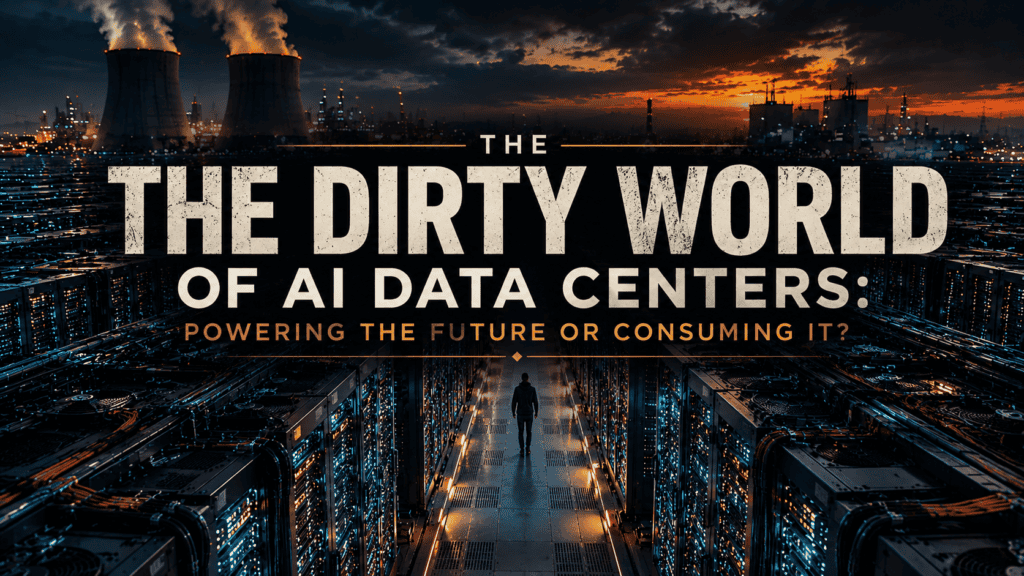
Hidden behind the excitement of artificial intelligence is a rapidly expanding network of AI data centers — vast industrial facilities quietly reshaping economies, politics, energy systems, and even local elections.
While AI is often discussed as software, its real foundation is brutally physical: land, power, water, and money.
And the scale is staggering. The International Energy Agency’s satellite tracking shows that “AI factories” — cutting-edge data centers built specifically for AI — have more than tripled in capacity in just 18 months. Electricity consumption by AI-focused data centers surged 50% in 2025 alone.
The question is no longer whether AI will transform society.
The question is: who will bear the cost of building the infrastructure that makes it possible?
What Exactly Are AI Data Centers?
At their simplest, data centers are buildings filled with servers that store, process, and transmit information.
AI data centers are a different breed altogether.
Unlike traditional facilities that handle websites, emails, and cloud storage, AI data centers are designed to train and operate large artificial intelligence models. They contain thousands of specialized chips working simultaneously, processing oceans of information around the clock.
Here’s one number that captures the leap:
A conventional server rack consumes 5 to 15 kilowatts of electricity. A modern AI rack? 30 to over 100 kilowatts.
That’s not an upgrade. That’s a different species — up to twenty times hungrier, rack for rack.
The result is a new class of infrastructure that demands:
- Massive electricity supplies — often with dedicated substations
- Advanced cooling systems — increasingly liquid-cooled, chip by chip
- High-speed fiber networks
- Large land parcels — hundreds of acres at a time
These facilities have become the factories of the AI age.
America’s New Gold Rush
If the nineteenth century was defined by railroads and the twentieth century by oil, the twenty-first may be defined by compute power.
Technology giants — Microsoft, Google, Amazon, and Meta — have collectively committed hundreds of billions of dollars toward AI infrastructure, with combined annual capital spending now rivaling the GDP of mid-sized nations.
The United States government and many state governments see these projects as strategic assets.
Why?
Because AI leadership increasingly depends on compute capacity. The US already accounts for roughly 45% of global data center electricity consumption — the largest market on Earth. Countries that control advanced AI infrastructure gain advantages in:
- Economic competitiveness
- Military applications
- Scientific research
- Cybersecurity
- Technological innovation
To win these projects, states across America are rolling out the red carpet:
- Property tax exemptions
- Sales tax incentives
- Fast-track approvals
- Infrastructure support packages
- Favorable zoning policies
The result? What many analysts call a new real estate rush.
Large tracts of land with access to power and fiber are suddenly worth multiples of what they fetched a few years ago. Rural counties that once competed for factories now compete for AI campuses.
But beneath the promises of investment and innovation lies a more complicated story.
What Lies Beneath the AI Boom?
Supporters portray data centers as engines of economic development.
Critics see something very different.
Across Virginia, Texas, Georgia, Michigan, Arizona and beyond, residents are increasingly organizing against proposed projects. And Virginia shows why the stakes feel so personal: data centers already consume an estimated 26% of the state’s electricity — more than one in every four kilowatt-hours.
The concerns are not ideological. They are practical:
- Rising electricity demand — and rising residential bills
- Pressure on local water supplies
- Industrial noise, humming 24/7
- Land consumption
- Limited long-term employment
- Increased strain on infrastructure
The community argument is simple: the benefits flow to large technology companies and investors. The costs stay local.
This is why data centers have begun appearing in election campaigns and local political debates — and why the coalitions opposing them look so unusual.
Environmental activists, farmers, suburban homeowners, and fiscal conservatives are finding themselves on the same side, for different reasons.
Some oppose the environmental footprint. Some oppose public subsidies. Some simply ask: does a facility employing a small workforce justify hundreds of millions in tax incentives?
For many Americans, AI is no longer an abstract technology debate.
It’s a line item on the utility bill. A water table. A changed skyline.
The Hidden Costs of the AI Race
The AI revolution is often told as a story of algorithms.
Increasingly, it is a story of resources.
⚡ Electricity
Perhaps the greatest challenge facing AI expansion is power.
A single large AI campus can consume hundreds of megawatts — comparable to a small city.
Zoom out and the numbers get dizzying. The IEA projects global data center electricity consumption will roughly double from about 485 TWh in 2025 to 950 TWh by 2030 — nearly 3% of all electricity on the planet. In the US, data centers consumed about 4.4% of national electricity in 2023; federal researchers project that share could hit as much as 12% by 2028.
One January 2026 industry forecast put it vividly: US data center demand is set to jump from 80 to 150 gigawatts between 2025 and 2028 — like adding an entire Spain to the grid in three years.
Utilities now face an impossible-sounding question: How do you power AI growth while pursuing clean energy goals?
The answer remains uncertain — and the scramble is real.
Some companies are betting on nuclear: hyperscalers locked up over 10 gigawatts of new or restarting nuclear capacity in just 18 months, and the pipeline of small modular reactor agreements nearly doubled to 45 GW by early 2026.
Others are building natural gas generation. Renewables continue to grow — but the sheer scale of demand has sparked concerns that fossil fuel dependence could persist far longer than climate plans assumed.
💧 Water
Cooling advanced AI systems requires serious resources.
In many regions, data centers depend on water-intensive cooling. US data centers drew an estimated 17 billion gallons of water directly in 2023 — with over 200 billion more consumed indirectly through the power plants feeding them.
In drought-prone areas like Arizona, that math has become a flashpoint between communities and developers. Newer liquid-cooling technology can cut direct water use dramatically — but it doesn’t touch the electricity, which remains the dominant cost.
🏗️ Land and Infrastructure
Data centers occupy enormous footprints.
Unlike manufacturing plants or corporate headquarters, they may generate relatively few permanent jobs after construction ends — often just that thirty-to-a-hundred headcount.
This raises hard questions about land-use priorities and what a community actually gets for what it gives up.
🔒 Privacy and Centralization
Beyond environmental concerns, some critics worry about concentration of power.
The same infrastructure that enables AI innovation can also support increasingly sophisticated data collection, analytics, and digital services.
Whether these developments ultimately enhance convenience, efficiency, and security — or create new concerns about surveillance and control — remains an ongoing public debate.
Why Indian-Americans and Investors Are Paying Attention
The AI infrastructure boom is deeply connected to the Indian and Indian-American technology ecosystem.
Indian-origin executives lead major technology firms across cloud computing, semiconductors, and AI development. Indian-American engineers, researchers, and entrepreneurs are designing the software and hardware these facilities run on.
At the same time, infrastructure funds, pension funds, and institutional investors increasingly view data centers as premium long-term assets.
Investors describe them as the “digital equivalent of toll roads” — critical infrastructure that businesses depend on regardless of economic cycles.
India itself is pursuing the same path.
The country’s AI ambitions, exploding digital economy, and expanding cloud market are driving heavy investment in domestic data center capacity.
Yet India faces the very questions confronting America:
- Can electricity generation keep pace?
- How will water resources be managed?
- Where should large facilities be located?
- Who benefits most from the economic gains?
The Real Battle May Not Be AI — It May Be Energy
For years, the AI conversation was about software breakthroughs.
Today, a different reality is emerging.
The limiting factor may not be algorithms. It may be energy.
Industry analysts increasingly agree: the binding constraint on AI is no longer silicon. It’s sites, grid interconnections, power procurement, and politics.
The countries that can build reliable generation, modern transmission, and resilient infrastructure may hold the decisive advantage in the AI era.
In this sense, the race for artificial intelligence increasingly resembles earlier struggles over oil, railways, and industrial capacity.
Compute is becoming a strategic resource.
And every AI query ultimately traces back to a power plant somewhere.
The Questions We Haven’t Answered Yet
A century ago, people looked at smokestacks and saw progress.
Only later did they begin asking what was entering the air.
Today, many look at artificial intelligence and see limitless possibility.
But behind every AI response stands a warehouse of servers, a flow of electricity, a source of water, and a chain of political and economic decisions.
Are AI data centers the power stations of a new digital civilization?
Or are they the first signs of a resource-intensive future whose costs are still hidden from view?
When the AI age is finally written into history books, will these facilities be remembered as the foundations of unprecedented innovation — or as monuments to a technological race that consumed more than it created?
The machines are learning.
The data centers are growing.
The power meters are spinning.
The rest of the story is still being written.
Key figures sourced from the International Energy Agency, Lawrence Berkeley National Laboratory, and industry research published through mid-2026.

Gold Medalist from IIMC, Shreya Pathak covers stories that matter most to the Indian and South Asian community in America. From breaking news and policy developments to diaspora life and culture, she brings credibility, clarity, and a passion for impactful journalism.