 Skip to content
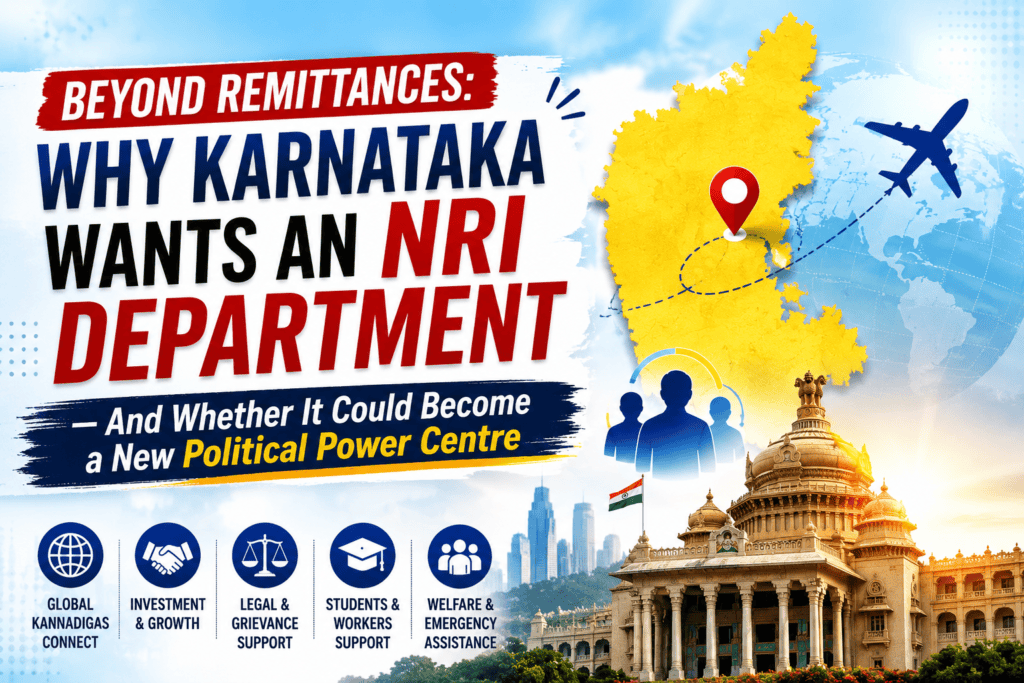
The Karnataka government’s proposal to create a dedicated mechanism for Non-Resident Indians (NRIs) has sparked a wider debate about how Indian states engage with their overseas communities.
In recent weeks, overseas Kannadigas organisations have intensified their demand for a dedicated institution to handle the concerns of the state’s global diaspora. A delegation led by entrepreneur and philanthropist Dr. Ronald Colaco met Karnataka leaders and called for a separate ministry, secretariat and directorate to address issues ranging from welfare and legal assistance to investment facilitation and student support.
The discussion gained momentum after Karnataka Deputy Chief Minister D. K. Shivakumar announced plans to establish a dedicated NRI-focused government department aimed at strengthening engagement with overseas Kannadigas and attracting investment into the state. However, subsequent reports indicate that the government is still evaluating the proposal and examining whether a new department would overlap with existing agencies involved in investment promotion and administration. As a result, it remains unclear whether the final structure will be a full-fledged ministry, a department, a secretariat or another institutional arrangement.
The debate reflects a broader trend across India: states increasingly see their overseas populations not merely as emigrants sending remittances home, but as investors, skilled professionals, entrepreneurs and influential global networks.


What Karnataka Is Proposing
According to government announcements and diaspora representatives, the proposed NRI mechanism would focus on:
- Grievance redressal for overseas Kannadigas.
- Assistance in legal and property-related matters.
- Support for overseas students and workers.
- Emergency coordination during crises abroad.
- Investment facilitation through a single-window system.
- Stronger links between the state government and the global Kannadigas community.
Supporters argue that Karnataka, despite having one of India’s largest overseas professional communities, lacks a dedicated institutional framework comparable to those operating in several other states.
At the same time, the proposal appears to be evolving. While diaspora groups have demanded a separate ministry, government discussions have increasingly focused on the practical structure and whether existing departments can already perform some of these functions.
Other States Have Already Built Similar Institutions
Karnataka would not be the first state to create a dedicated diaspora-focused institution.
Kerala: India’s Most Developed NRI Model
The benchmark remains Kerala’s Non-Resident Keralites Affairs Department (NORKA), established in 1996 as the first state-level NRI department in India.
Over the years, NORKA has developed into a comprehensive system that includes:
- Grievance redressal services.
- Welfare programmes.
- Insurance schemes.
- Overseas recruitment support.
- Assistance during emergencies.
- Rehabilitation and entrepreneurship support for returning migrants.
- Dedicated coordination with Indian missions and central government agencies.
- Kerala has continued expanding these efforts. In recent years, it launched additional welfare and insurance initiatives for expatriate Malayalis and strengthened support systems for overseas workers and returnees.
Because of its institutional depth and longevity, NORKA is often cited as the model that other states seek to emulate.
Punjab: Focus on Legal and Property Issues
Punjab maintains a dedicated Department of NRI Affairs along with a State Commission for NRIs.
The department has historically concentrated on:
- Property disputes involving overseas Punjabis.
- Legal assistance.
- Complaint redressal.
- Coordination with police and district administrations.
Punjab’s model emerged largely because of the large Punjabi diaspora in countries such as Canada, the United Kingdom, the United States and Australia.
Rajasthan: The Newest Entrant
Rajasthan recently established the Department of Domestic and Overseas Rajasthani Affairs (DORA).
The department focuses on:
- Engagement with overseas Rajasthanis.
- Investment promotion.
- Diaspora outreach.
- Grievance handling.
Because the initiative is relatively new, it is still too early to assess its long-term effectiveness.
Other States
Several other states have diaspora-focused bodies, though not always full ministries or departments.
These include:
- Gujarat’s Non-Resident Gujarati initiatives.
- Andhra Pradesh’s overseas Telugu engagement programmes.
- Telangana’s NRI cell and migrant welfare efforts.
- Tamil Nadu’s Overseas Tamils Welfare mechanisms.
- Uttar Pradesh’s Pravasi engagement programmes.
The structures differ significantly, but the common goal is to maintain stronger links with overseas communities.
Why Governments Want Dedicated NRI Institutions
Supporters of dedicated NRI departments argue that they serve practical administrative needs rather than purely political objectives.
Millions of Indians live and work abroad. Many encounter challenges involving:
- Labour disputes.
- Immigration issues.
- Property conflicts.
- Documentation problems.
- Fraud and recruitment scams.
- Emergency evacuations.
- Repatriation after deaths or crises.
Because responsibility for these issues is often spread across multiple agencies, a dedicated department can act as a single point of contact.
Investment and Economic Benefits
States also view their diasporas as valuable economic partners.
NRIs frequently invest in:
- Real estate.
- Healthcare.
- Education.
- Startups.
- Infrastructure projects.
A specialised institution can reduce bureaucratic hurdles and provide a single-window mechanism for investors.
For Karnataka in particular, this argument carries weight because many overseas Kannadigas work in technology, engineering, medicine and business sectors that align closely with the state’s economic priorities.
Emergency Response
Events such as the COVID-19 pandemic, conflicts in West Asia and sudden labour crises have demonstrated the importance of organised communication channels between governments and overseas citizens.
Departments like NORKA have often played an important role during such emergencies by coordinating with Indian embassies and helping affected expatriates.
The Limits of State-Level NRI Departments
Despite their benefits, such institutions face significant limitations.
Foreign affairs remain the exclusive responsibility of the Union government.
State governments cannot:
- Issue visas.
- Conduct diplomacy.
- Negotiate with foreign governments.
- Directly intervene in immigration policies.
As a result, state NRI departments largely function as coordination and facilitation bodies.
Another challenge is administrative overlap. Many of the functions proposed for NRI departments are already handled by investment agencies, labour departments, revenue authorities, police departments or the Ministry of External Affairs.
This concern appears to be one reason Karnataka is reviewing its proposal before making a final decision.
Are NRIs Becoming a Political Constituency?
The Karnataka debate also raises a broader political question.
Traditionally, NRIs were viewed primarily through the lens of remittances and economic contributions. Today, they are increasingly recognised as influential global communities with financial resources, professional networks and significant social influence.
Although most overseas Indians cannot easily participate in elections without travelling to India, diaspora groups often influence public opinion through:
- Community organisations.
- Social media networks.
- Business associations.
- Philanthropic initiatives.
- Political advocacy campaigns.
This has led some critics to question whether governments are creating NRI institutions primarily for welfare purposes or partly to cultivate influential support networks abroad.
Critics argue that if such departments are not carefully structured, they could evolve into:
- Patronage networks.
- Donation channels.
- Elite lobbying platforms.
- Preferential access systems for wealthy expatriates.
Supporters counter that these concerns should not overshadow the genuine administrative needs of millions of overseas Indians. They argue that transparency, independent oversight and clear accountability mechanisms can prevent misuse.
What Has the Central Government Done for NRIs?
The Union government has significantly expanded diaspora engagement over the past few years.
Key initiatives include:
- Expansion of digital consular services.
- Continued reforms under the e-Migrate system to protect overseas workers.
- Pravasi Bharatiya Divas outreach programmes.
- Increased focus on Overseas Citizen of India (OCI) services.
- Measures to simplify investment and financial transactions for NRIs and OCIs.
- Consular assistance and evacuation support during international crises.
The central government’s approach has generally focused on economic engagement, worker protection, cultural ties and strategic outreach rather than creating a separate political constituency.
A Test Case for the Future
Karnataka’s proposal comes at a time when states are increasingly competing for global capital, skilled professionals and diaspora engagement.
Whether the state eventually creates a ministry, department, secretariat or another institutional mechanism, the debate highlights a larger transformation in Indian governance.
Overseas Indians are no longer seen solely as remittance senders. They are increasingly viewed as investors, innovators, knowledge partners and global ambassadors for their home states.
The success of any future Karnataka NRI institution will ultimately depend on whether it delivers practical benefits—faster grievance redressal, better investment facilitation and stronger welfare support—or whether it becomes another layer of bureaucracy.
The larger question remains unresolved: are Indian states building these institutions because NRIs genuinely need them, or because overseas communities are becoming an increasingly valuable source of influence, funding and political capital?

Gold Medalist from IIMC, Shreya Pathak covers stories that matter most to the Indian and South Asian community in America. From breaking news and policy developments to diaspora life and culture, she brings credibility, clarity, and a passion for impactful journalism.